
17 Bedroom Wallpaper Accent Wall Ideas That Turn the Bed Into a Focal Point (2026)
By Haseeb
The right bedroom wallpaper accent wall ideas do something paint alone can’t: they give the bed a backdrop with pattern, texture, and personality. One wallpapered wall behind the headboard turns the most-used piece of furniture in the room into a deliberate focal point — and because it’s just one wall, you can go bolder than you’d ever dare in a whole room.
These 17 ideas cover every bedroom situation: behind-the-bed classics, moody dark patterns, murals, ceilings, panel-molding pairings, small-bedroom tricks, and renter-friendly removable options — all bedroom-specific, with real price ranges.

Key Takeaways
- Wallpaper the wall behind the headboard — it’s the natural focal point, visible from the doorway, and one wall keeps bold patterns affordable.
- Match pattern scale to room size: large-scale prints suit spacious bedrooms; small rooms need delicate, light patterns.
- One wall costs $80–$300 in materials (2–4 rolls), making accent walls the cheapest dramatic bedroom change.
- Peel-and-stick ($40–$120 per wall) gives renters and commitment-phobes the same impact with zero damage.
- Pair wallpaper with panel molding for a high-end framed look that costs $50–$100 in trim.
- Don’t forget the ceiling — wallpapering the “fifth wall” above the bed is 2026’s boldest bedroom move.
- Coordinate, don’t match: pull one color from the wallpaper for bedding and repeat it twice in the room.
- Order samples first ($3–$8 each) and live with them for a few days — wallpaper looks different at night.
How to Choose a Bedroom Wallpaper Accent Wall That Actually Works
Choosing a bedroom wallpaper accent wall comes down to four decisions, and the wall itself is the first. The wall behind the headboard is the natural focal point: it is visible from the doorway, it frames the bed, and because it is just one wall, you can go bolder than you would ever dare in a whole room. In a bedroom without a clear headboard wall, choose the wall you face when entering, and avoid the window wall, where light washes out the pattern for most of the day. Second, match the pattern scale to the room: large-scale prints suit spacious bedrooms, while small rooms need delicate, light patterns so the wall adds personality without closing the space in. Third, set the budget before you fall in love with a paper. One wall typically costs $80 to $300 in materials for 2 to 4 rolls, peel-and-stick typically runs $40 to $120 per wall, and pairing wallpaper with panel molding for a high-end framed look typically costs $50 to $100 in trim. Murals and premium papers like grasscloth or hand-printed designs run higher, typically $150 to $400 for the wall. Fourth, plan the rest of the room around the paper instead of matching it: pull one color from the wallpaper for the bedding and repeat it twice in the room, coordinate, do not match. Before you order, sample first: samples typically cost $3 to $8 each, and live with your samples for a few days, because wallpaper looks different at night. Renters and commitment-phobes get the same impact from peel-and-stick, which is repositionable, washable, and removes cleanly, and bedrooms are ideal for it, since there is no steam or cooking grease to weaken the adhesive. A bedroom accent wall takes 2 to 3 hours for a first-timer, and buying 10 percent extra covers pattern matching. And if you want the boldest move in the room, do not forget the ceiling: wallpapering the fifth wall above the bed is 2026’s boldest bedroom move.
Frequently Asked Questions About Bedroom Wallpaper Accent Walls
Can I wallpaper the ceiling in a bedroom?
Yes, wallpapering the fifth wall above the bed is 2026’s boldest bedroom move. It works best with a pattern that reads well from below, and the same sample-first rule applies: live with your sample for a few days before committing.
What if my bedroom is dark?
Choose a lighter pattern so the wall adds personality without closing the space in, and consider metallic accents, which catch evening light and add glamour after dark. Avoid the window wall, where light washes out the pattern for most of the day.
Should my wallpaper match my bedding?
Coordinate, do not match. Pull one color from the wallpaper for the bedding and repeat it twice in the room. Matching everything to the paper makes the room feel flat; one repeated color ties it together.
What is the cheapest way to get the wallpaper accent wall look?
Peel-and-stick typically runs $40 to $120 per wall, and pairing wallpaper with panel molding for a framed look typically costs $50 to $100 in trim. Both give the high-end look without the cost of premium papers, which typically run $150 to $400 for the wall.
If the spare room needs the same treatment, guest bedroom ideas show how to make it feel like a boutique hotel. Pair the paper with bedroom curtain ideas so the window dressing echoes the wall. Renters can keep it damage-free, as removable wallpaper ideas for renters use the same peel-and-stick approach. The same pattern play works in a wet room too, and bathroom wallpaper ideas explain which papers survive steam. And for the smallest room in the house, nursery accent wall ideas bring the same focal-point trick to a cot wall.
The Ideas
1. Bold Botanical Behind the Headboard
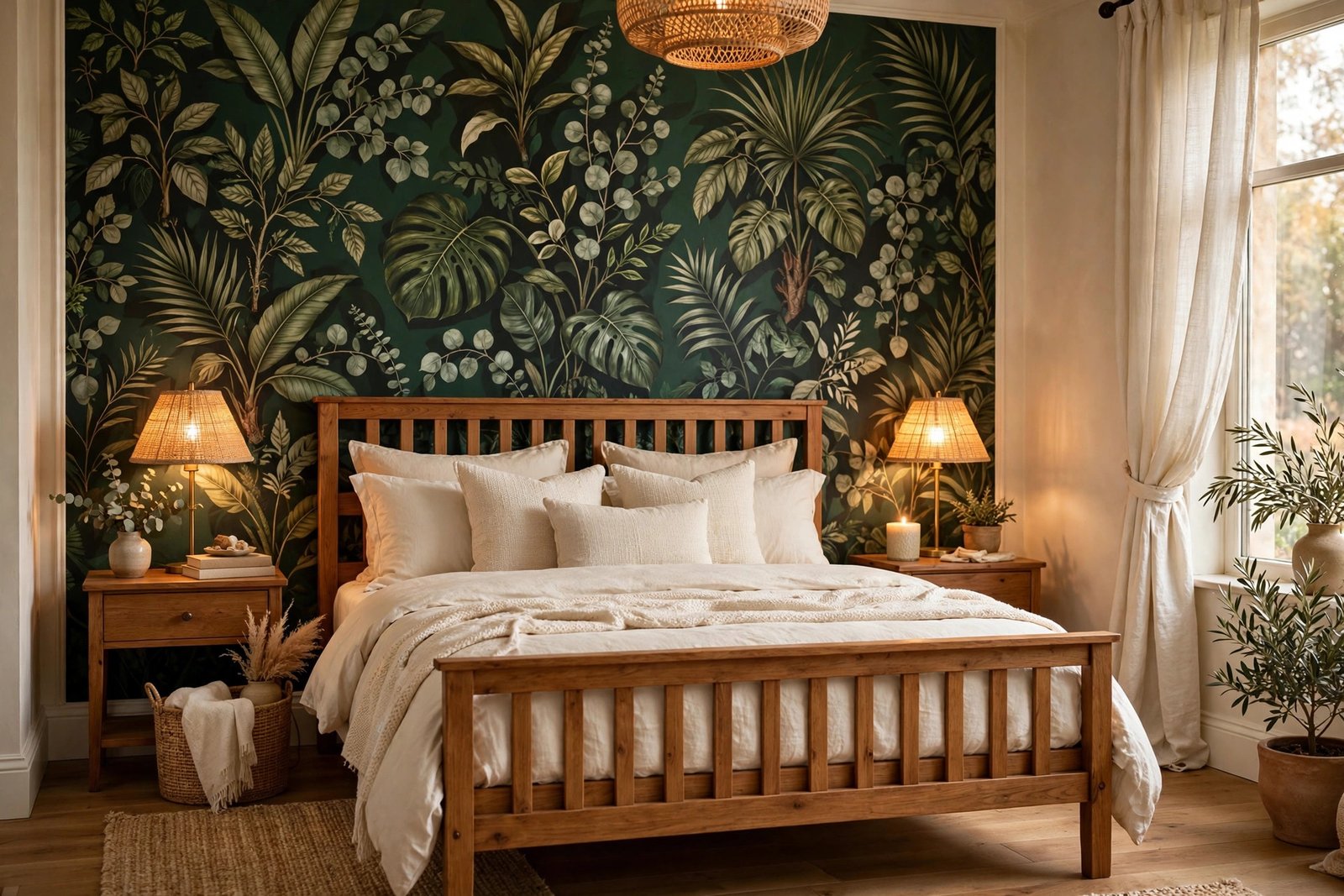
The classic bedroom wallpaper accent wall: a large-scale botanical print behind the bed. Oversized leaves and branches in greens, creams, or muted jewel tones create a headboard-like backdrop even with a simple bed frame. This is the highest-impact, lowest-risk wallpaper move — botanicals read as timeless rather than trendy, and they pair with almost any bedding. Budget $100–$250 for 2–3 rolls of a quality botanical. Tip: hang the paper first, then position the bed — centering the bed on the pattern’s focal motif (the biggest bloom, the tallest branch) makes the whole wall feel designed.
2. Moody Dark Floral for Drama
Deep emerald, charcoal, or navy florals turn a bedroom into a cocoon — perfect if you want the room to feel intimate rather than airy. Dark wallpaper behind the bed absorbs light and makes brass sconces, cream linen, and warm wood glow by contrast. This look needs good lighting to avoid feeling like a cave: two bedside lamps or wall sconces minimum. A dark floral wall costs the same as any wallpaper ($100–$280) but delivers twice the drama. Who should skip it: north-facing bedrooms with one small window — without enough natural light, dark walls can feel heavy by day.

3. Mural: A Landscape Behind the Bed
A full-wall mural — misty mountains, a forest scene, rolling hills in sage and cream — turns the bedroom wall into art. Murals come as pre-sized panels ($150–$400 for a queen-wall width) and install like wallpaper, but the continuous scene has no repeat pattern to match, which actually makes hanging easier. Choose soft, low-contrast landscapes for sleep spaces; high-contrast scenes energize instead of calm. This is the statement choice — guests will ask about it — so pick a scene you’d happily wake up to for years. I’ve found that nature murals age better than abstract ones; trees don’t date.

4. Textured Grasscloth for Quiet Luxury
If pattern feels like too much, grasscloth gives you texture instead — woven fibers in natural tones that catch light and add warmth without a single printed motif. It’s the quiet-luxury choice: the wall looks expensive up close and calm from across the room. Natural grasscloth runs $120–$300 per wall and needs careful installation (the seams show if misaligned), so budget for a pro unless you’re experienced. Keep bedding simple — cream linen, one textured throw — and let the wall be the texture star. Note: grasscloth and cats are mortal enemies; choose a faux-grasscloth vinyl if you share the bed with claws.

5. Panel Molding + Wallpaper: The Framed Look
Here’s the combination that looks like a designer did it: install simple panel molding rectangles on the accent wall ($50–$100 in trim and paint), then wallpaper inside the panels. The molding frames the pattern like art, adds architectural interest to flat drywall, and elevates even budget wallpaper. This works with any pattern — chinoiserie, toile, subtle damask — because the frames give it structure. Paint the molding the same white as the trim for a classic look, or match it to the wallpaper’s background color for a seamless effect. It’s a weekend project with a custom-millwork payoff.

6. Vertical Stripes to Lift a Low Ceiling
Vertical stripes in warm beige and cream visually stretch the wall, making 8-foot ceilings feel taller — the oldest wallpaper trick in the book, and it still works. Keep the stripes tone-on-tone (two close neutrals) for a calm bedroom; high-contrast stripes energize, which is wrong for sleep. Wide stripes (4–6 inches) feel modern, narrow pinstripes feel traditional. This is one of the most forgiving patterns to hang because stripes are easy to align. Cost: $80–$200 for the wall. Pair with a low-profile bed frame to maximize the height illusion.

7. Chinoiserie for Timeless Elegance
Chinoiserie — delicate branches, birds, and blossoms on a soft ground — is the pattern that never leaves the design magazines. In a bedroom, it reads as romantic and serene, especially in muted colorways (sage on cream, gray on ivory). It’s traditionally a formal pattern, so balance it with relaxed bedding — washed linen, not crisp hotel cotton — to keep the room from feeling like a museum. Chinoiserie runs $120–$350 per wall; the hand-painted look costs more than printed versions. One wall is plenty — this pattern at full-room scale overwhelms.
8. Wallpaper the Ceiling: The Fifth Wall
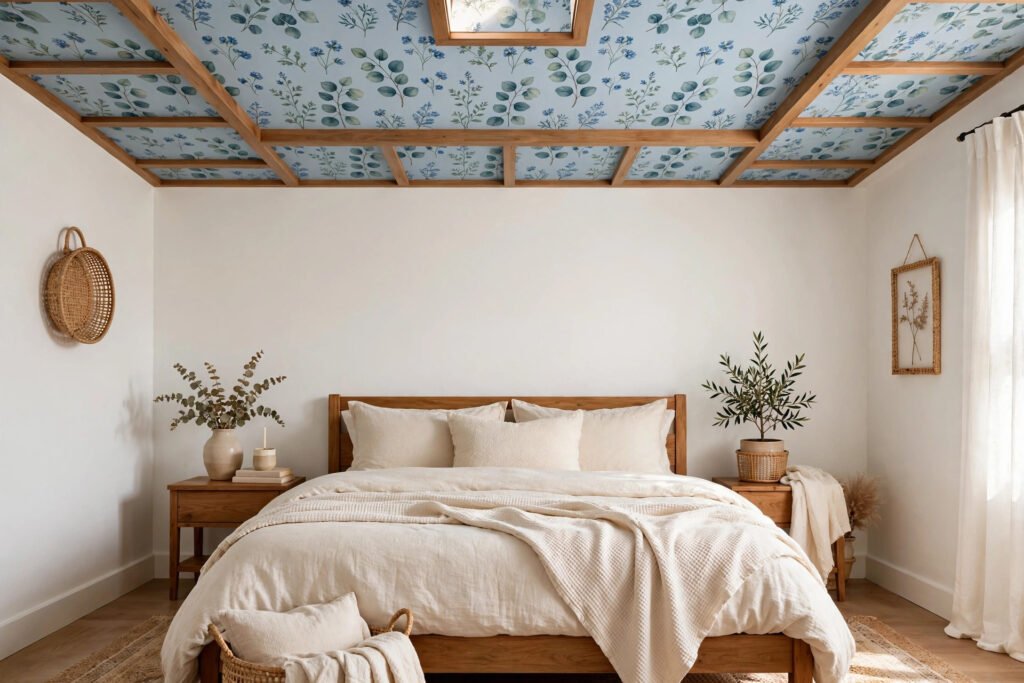
The boldest bedroom wallpaper move of 2026: paper the ceiling above the bed. You see it every morning and every night — it’s the wall you actually look at most. A soft botanical, subtle stripe, or pale mural on the ceiling feels like sleeping under a canopy. It works best with simple white walls so the ceiling is the undisputed star. Installation is harder overhead (hire help, $200–$400 installed), but the impact is unmatched — no other single change transforms a bedroom this completely. Keep the pattern light in color; dark ceilings can feel oppressive when you’re lying directly beneath them.
9. Half-Wall Wallpaper Below a Chair Rail
Can’t commit to a full wall? Paper only the lower half. Install a chair rail ($30–$60 in trim), wallpaper below it in a rich pattern — terracotta, deep botanical, textured weave — and paint above in warm white. The half-and-half treatment adds pattern without overwhelming, and the chair rail gives the room architectural detail it probably lacked. This is ideal for bedrooms where a full patterned wall feels like too much but flat paint feels like too little. It also uses half the wallpaper, so premium papers become affordable: that $200 roll you loved now covers the project.

10. Metallic Accents for Evening Glam
Wallpaper with metallic ink — gold lines on navy, champagne on charcoal, copper on cream — comes alive in lamplight. By day it’s subtle; by evening, the metallic threads catch every light source and the wall shimmers. This is the glam bedroom choice, and it pairs beautifully with velvet headboards, crystal lamps, and mirrored nightstands. Metallic wallpapers run $130–$300 per wall. One caution: metallics show every installation flaw, so this is a hire-a-pro pattern, not a first-DIY one. Keep the rest of the room’s metallics in the same family (all gold or all silver) for cohesion.

11. Small Bedroom: Light Pattern, Big Personality
Small bedrooms need wallpaper discipline: light backgrounds, small-to-medium patterns, and plenty of breathing room in the design. A delicate floral or fine botanical in blush and cream makes a tiny bedroom feel charming rather than cramped — the pattern gives the eye somewhere to go, which paradoxically makes the room feel larger than a flat wall. Avoid dark grounds and large-scale prints; they close in small spaces. Extend the wallpaper onto just the headboard wall and keep the other walls a matching warm white pulled from the paper. Total cost for a small wall: $60–$150.

12. Wrap Two Walls Around the Corner
Instead of one flat accent wall, wrap the wallpaper around the corner onto the adjacent wall — behind the bed and along one side. This envelops the sleeping area and makes the bed zone feel like a distinct room-within-a-room, which is especially effective in studio apartments and open-plan bedrooms. Use the same paper on both walls for a seamless wrap; the corner becomes a design feature rather than an interruption. You’ll need 3–5 rolls ($120–$300), and pattern matching at the corner takes patience — start the second wall’s first strip at the corner and work outward.
13. Behind a Floating Headboard Shelf
No headboard? A floating shelf mounted at headboard height, styled with art and small objects, creates a headboard zone — and wallpaper behind it makes the zone unmistakable. The shelf ($30–$70) gives you display space for the items that would sit on a headboard ledge, while the wallpaper provides the visual weight a missing headboard leaves behind. This combination is perfect for renters: the shelf needs only two small holes (or heavy-duty adhesive), and peel-and-stick wallpaper leaves no trace. Style the shelf sparsely — three items max — so it reads as intentional, not as storage.
14. Peel-and-Stick for the Commitment-Phobes
Modern peel-and-stick wallpaper has closed the quality gap — textured, washable, and genuinely repositionable options now cover a bedroom wall for $40–$120. It’s the right choice if you rent, if you change your mind seasonally, or if you’ve never hung wallpaper and fear the paste. The bedroom is actually the ideal peel-and-stick room: one accent wall is a manageable first project (2–3 hours), and there’s no steam or grease to test the adhesive. Buy 10% extra for pattern matching, and smooth with a plastic smoother, not your hands — fingerprints stretch the vinyl.
15. Geometric in Muted Tones
If florals aren’t your language, geometric patterns in muted tones — soft arches, tone-on-tone hexagons, faded terrazzo — give a bedroom structure without softness. Muted geometrics read as modern and calm, especially in warm neutrals and dusty blues. They’re also the most forgiving patterns for DIY hanging: geometric repeats are easier to match than organic florals. Keep the scale medium — tiny geometrics buzz visually, oversized ones dominate. This is the pattern family I’d recommend to anyone wallpapering for the first time: easy to hang, hard to get wrong, and it photographs beautifully.
16. Coordinate Bedding to the Wallpaper
The wallpaper only looks designed if the bedding talks to it. Pull one color from the paper — the sage leaf, the terracotta bloom, the navy ground — and repeat it in the duvet, throw, or pillows. Two repetitions minimum: the eye needs to see the connection twice to register it. You don’t need a bedding set that matches the wallpaper’s era; modern washed linen in a pulled color looks better than fussy matchy-matchy prints. Budget $60–$120 for a duvet cover and two pillowcases in the right tone. This single step is what separates “wallpapered wall” from “designed bedroom.”
17. Sample Before You Commit
The least glamorous but most money-saving of these bedroom wallpaper accent wall ideas: order samples ($3–$8 each) of your top three choices and tape them to the wall for three full days. Look at them in morning light, afternoon light, and lamplight — wallpaper shifts dramatically, and the sample you loved at noon may look muddy at 9 p.m. Live with them behind the bed, where they’ll actually hang. This $15–$25 investment prevents the $200 mistake of hating a full wall. I’ve never regretted sampling; I’ve only regretted skipping it.
Frequently Asked Questions
How much does it cost to wallpaper one bedroom accent wall?
A single bedroom accent wall typically costs $80–$300 in materials: 2–4 rolls of wallpaper ($40–$120 total for peel-and-stick, $100–$280 for traditional), plus paste and tools ($15–$30) if needed. Professional installation adds $200–$400. Murals and premium papers (grasscloth, hand-printed) run higher at $150–$400 for the wall.
Which wall should be the wallpaper accent wall in a bedroom?
The wall behind the headboard — it’s the natural focal point, visible from the doorway, and framing the bed makes the whole room feel designed. In bedrooms without a clear headboard wall, choose the wall you face when entering. Avoid wallpapering the window wall, where light washes out the pattern for most of the day.
Is peel-and-stick wallpaper good for bedrooms?
Yes — bedrooms are ideal for peel-and-stick because there’s no steam or cooking grease to weaken the adhesive. Modern peel-and-stick is repositionable, washable, and removes cleanly, making it perfect for renters. A bedroom accent wall takes 2–3 hours for a first-timer. Buy 10% extra for pattern matching.
What wallpaper pattern is best for a small bedroom?
Light backgrounds with small-to-medium scale patterns — delicate florals, fine botanicals, or subtle geometrics in pale tones. Light patterns make small bedrooms feel charming rather than cramped. Avoid dark grounds and oversized prints, which close in tight spaces. Keep the other walls a warm white pulled from the wallpaper.
Wake Up to a Wall You Love
One wallpapered wall is the highest-impact change you can make in a bedroom — more transformative than new bedding, cheaper than new furniture, and completely personal. Pick the pattern that makes you happy at 7 a.m., sample it for three days, and hang it behind the bed. For the rest of the bedroom, our Nancy Meyers-inspired bedroom ideas layer beautifully over any of these walls, and the master bedroom makeover guide covers the full-room refresh.



4 Comments