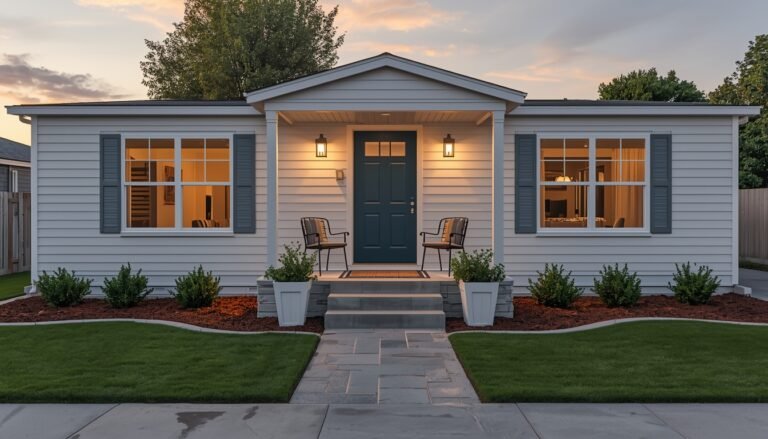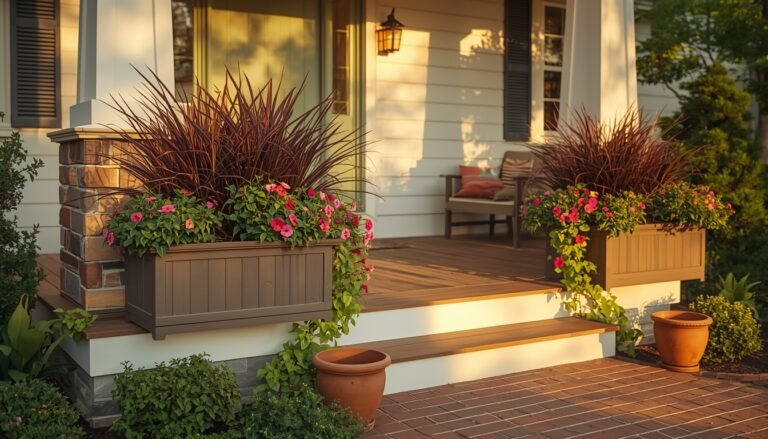
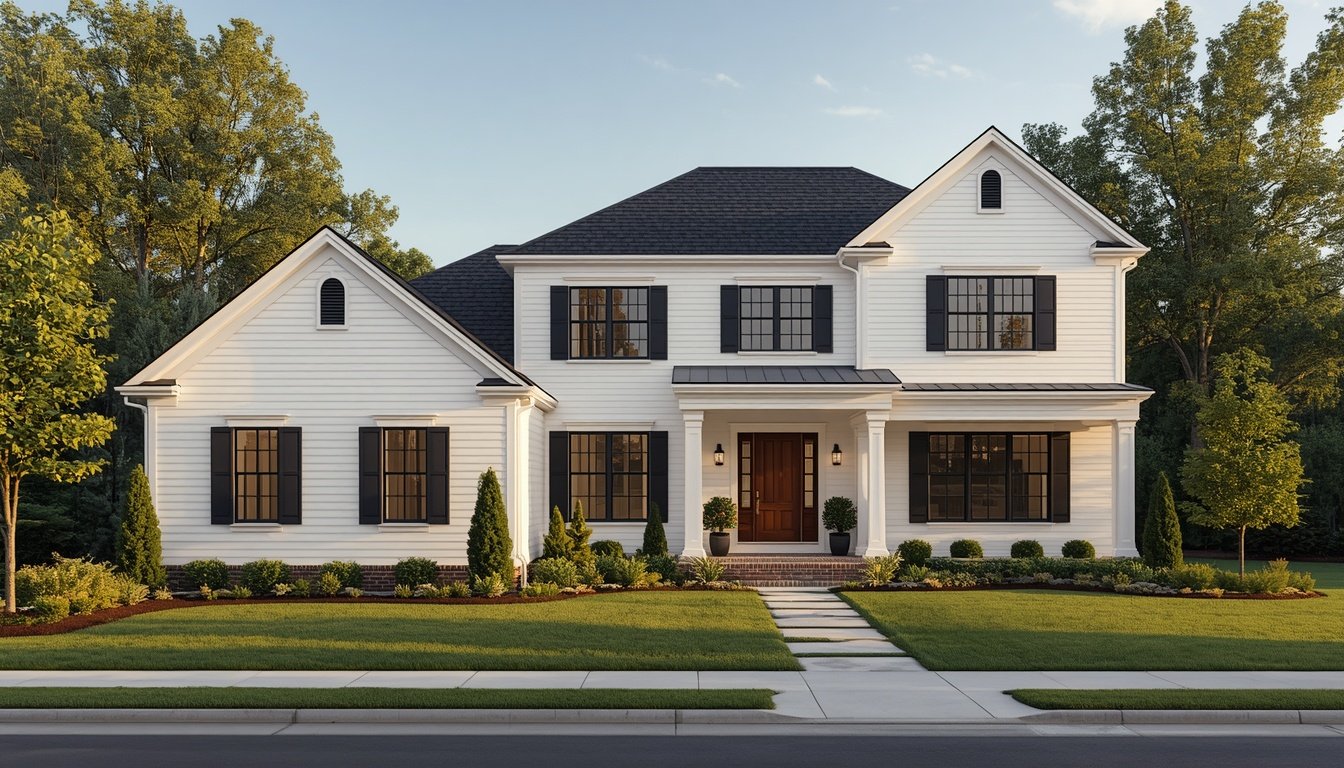
White Exterior House Colors: 20 Best White Paint Colors for Your Home
Choosing the right white exterior house colors can completely change your home’s curb appeal. But not every white looks the same outdoors. Some feel crisp and modern while others bring warmth and softness.
From warm white exterior paint colors to clean cool whites and timeless off-white exterior colors, this guide covers 20 of the best options for every home style. You’ll also learn how lighting, undertones, LRV, trim, roofing, and exterior materials affe
ct the final look so you can choose a white exterior paint color with confidence.
Are White Exterior House Colors Still Popular in 2026?
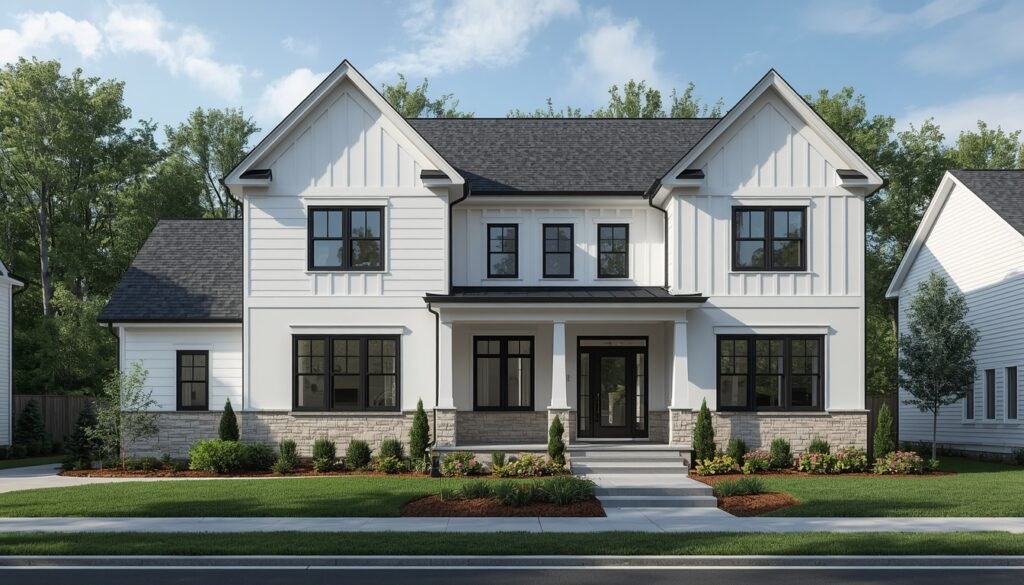
Yes. White exterior house colors remain a dependable choice in 2026 because they work across a surprisingly wide range of architectural styles. White can make a small home feel brighter, give a new build a clean appearance, or highlight the craftsmanship of an older house without competing with its details.
The look has also evolved. Today’s white houses aren’t limited to bright, almost-blue whites with matching trim. Warm whites, creamy whites, soft off-whites, and white-gray hybrids have become especially useful because they create depth without abandoning the light exterior people love. A warm white paired with natural wood can feel relaxed and modern. A cleaner white with black windows can create a sharper contemporary look.
White also gives you room to experiment with accents. A white exterior can support a black roof, charcoal shutters, a navy front door, deep green accents, natural cedar, or warm bronze hardware. That flexibility makes it easier to refresh the home’s personality later without repainting the entire exterior.
However, a white exterior can look too stark when the surrounding materials are equally bright and there is little visual contrast. It can also appear washed out when the paint has an extremely high LRV and the house receives strong direct sunlight. The goal isn’t simply to find the whitest paint. The goal is to find a white with the right amount of warmth, depth, and contrast for your property.
For more inspiration on how exterior palettes are changing, see this guide to exterior house color trends.
How to Choose the Best White Exterior Paint Color
Start With the Undertone
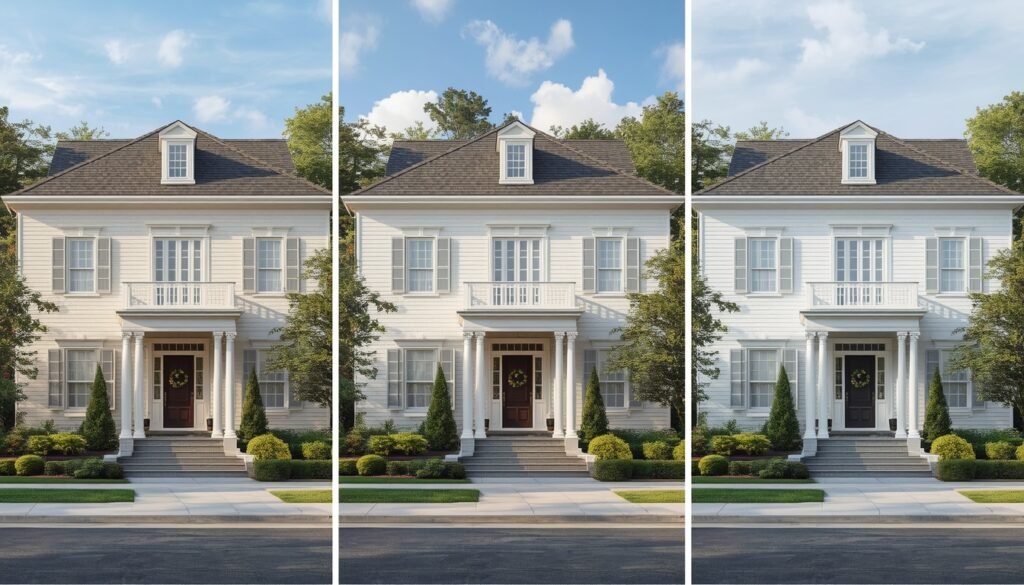
Undertones are the quiet personality hiding underneath a paint color. A white may look neutral on a tiny card, yet reveal yellow, beige, gray, blue, or even green influences once it covers an entire exterior. Warm whites generally contain hints of yellow, beige, cream, or red. Cool whites lean toward gray or blue. Neutral whites sit closer to the middle and tend to change less dramatically between different surroundings.
Outdoors, those undertones matter even more because you aren’t looking at the paint in isolation. A warm brick wall can make a neutral white look warmer. Blue-gray stone can pull the same white in a cooler direction. Green landscaping can make some whites appear slightly creamier. Your roof can do the same thing.
When choosing between two similar exterior white paint colors, don’t ask only which one looks whiter. Ask which one works with everything that will remain on the house after painting.
Understand LRV (Light Reflectance Value)
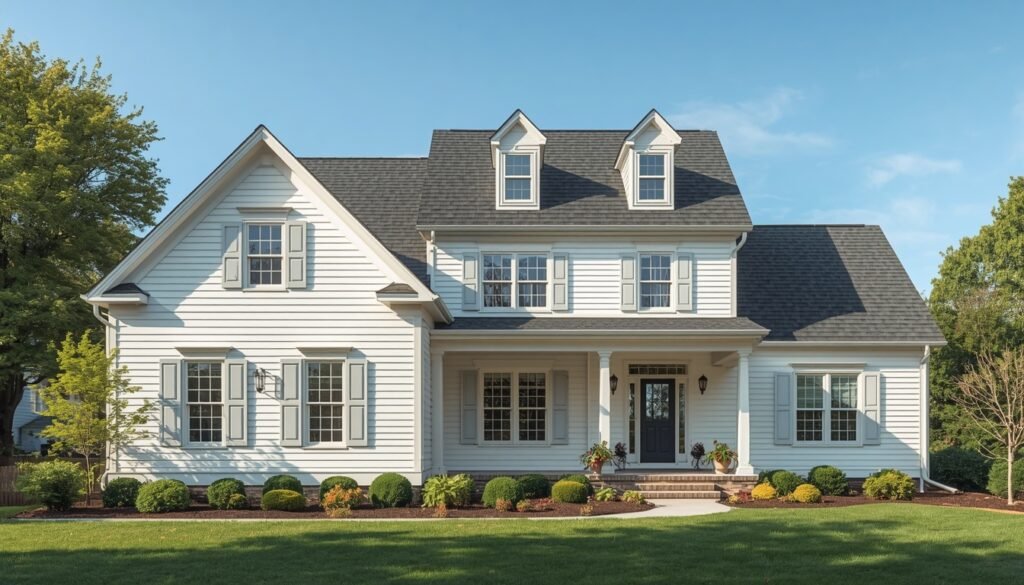
LRV stands for Light Reflectance Value. It describes how much visible light a color reflects on a scale from 0 to 100. Benjamin Moore explains that 100 represents pure white while 0 represents absolute black. A higher LRV generally means the color reflects more light and appears lighter.
This matters with exterior whites because direct sunlight can make high-LRV colors look extremely bright. A white that seems soft on a sample board can look much crisper when the afternoon sun hits a large wall. Conversely, a lower-LRV off-white can provide enough depth to prevent a large exterior from looking flat.
There isn’t one magic LRV for every house. As a practical starting point, many popular exterior whites fall somewhere from the low 70s into the upper 80s. The best range depends on exposure, surrounding materials, and how much contrast you want.
Consider Your Home’s Natural Light and Exposure
The direction your house faces changes the light that reaches the paint. That means the same white can look different on the front, side, and rear elevations. Benjamin Moore specifically notes that whites can take on different tonalities from morning through evening and recommends living with samples under changing light before buying paint.
North-Facing Homes
North-facing elevations often receive cooler, softer light. That can make cool whites appear colder and gray whites look more pronounced. A warm or balanced white usually works better when you want the exterior to maintain a welcoming appearance rather than looking icy.
South-Facing Homes
South-facing elevations generally receive stronger natural light for more of the day. Warm whites can become noticeably creamier in this setting. If you want a clean appearance, a balanced neutral white may be easier to control than an aggressively warm shade.
East-Facing Homes
East-facing homes receive stronger morning light. A white can look brighter and warmer early in the day before becoming more subdued later. If your home’s most important curb-facing elevation points east, inspect samples during the morning before making a final decision.
West-Facing Homes
West-facing elevations can change dramatically during the afternoon. Warm late-day sunlight can intensify creamy undertones and make some whites appear richer. A color that looks perfectly neutral at noon may feel much warmer near sunset.
The safest approach is simple: test the same paint on several sides of the house. A single front-wall sample cannot tell you how the color will behave everywhere.
Consider Your Home’s Architecture
Architecture should guide the white rather than the other way around. Modern homes often benefit from clean whites that emphasize simple lines, large windows, and dark frames. Farmhouses can handle warmer whites because they pair naturally with wood, black accents, and softer landscaping. Colonial and traditional houses often look beautiful with classic whites that highlight shutters, columns, and trim.
Craftsman homes need a little more caution because the exterior often contains several materials. A white that works beautifully on smooth siding may look too stark against stone or stained wood. Coastal homes can accommodate crisp whites particularly well, while Mediterranean and stucco houses often benefit from warmer whites that sit comfortably beside terracotta, stone, and earthy roof materials.
Look at the Existing Exterior Materials
Your siding isn’t the only color you’re choosing. Brick, stone, roofing, windows, gutters, garage doors, decks, and landscaping all become part of the final palette. A white with a faint gray undertone may complement blue-gray stone beautifully. A creamy white may sit more naturally beside warm red brick.
Wood also deserves attention. Natural cedar, walnut-toned doors, stained decks, and timber accents can make a cool white feel surprisingly sharp. Warm whites usually create a more connected transition between painted siding and natural wood.
The 20 Best White Exterior Paint Colors
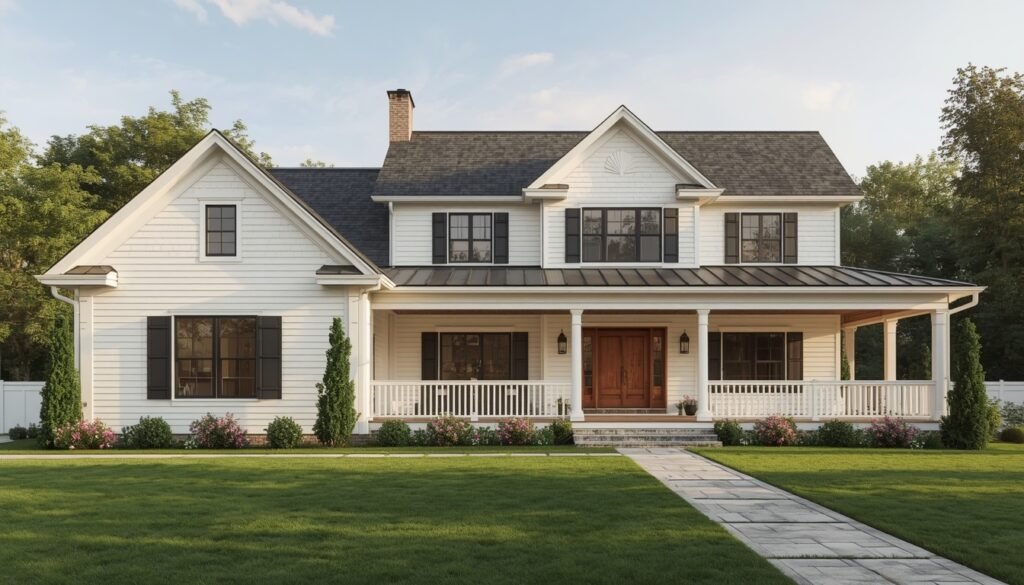
The 20 shades below cover a wide spectrum, from clean bright whites to softer off-whites and light greige options. Their listed LRVs come from current manufacturer information where available. Remember that an LRV is a useful reference rather than a promise of exactly how the paint will look on your house.
1. Sherwin-Williams Alabaster (SW 7008)
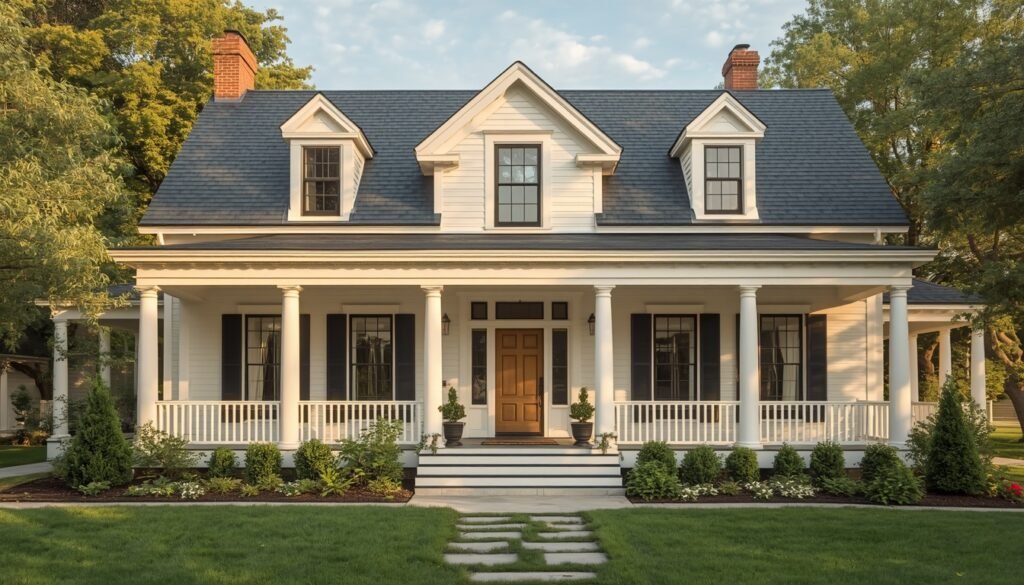
Alabaster SW 7008 is one of the easiest whites to consider when you want a soft exterior without going heavily creamy. Sherwin-Williams currently lists its LRV at 82.215 and identifies it for interior and exterior use.
Its warmth helps it feel comfortable on traditional homes, modern farmhouses, and exteriors with natural wood. It can also soften a black-and-white palette so the house doesn’t feel overly stark. For trim, a cleaner white such as Pure White can create subtle definition, while dark bronze, black, or natural wood accents provide stronger contrast.
Alabaster is especially useful when you want a white that feels relaxed in bright sunlight. It isn’t the right answer for every exterior, but it is an excellent starting point when pure white feels too severe.
2. Benjamin Moore White Dove (OC-17)
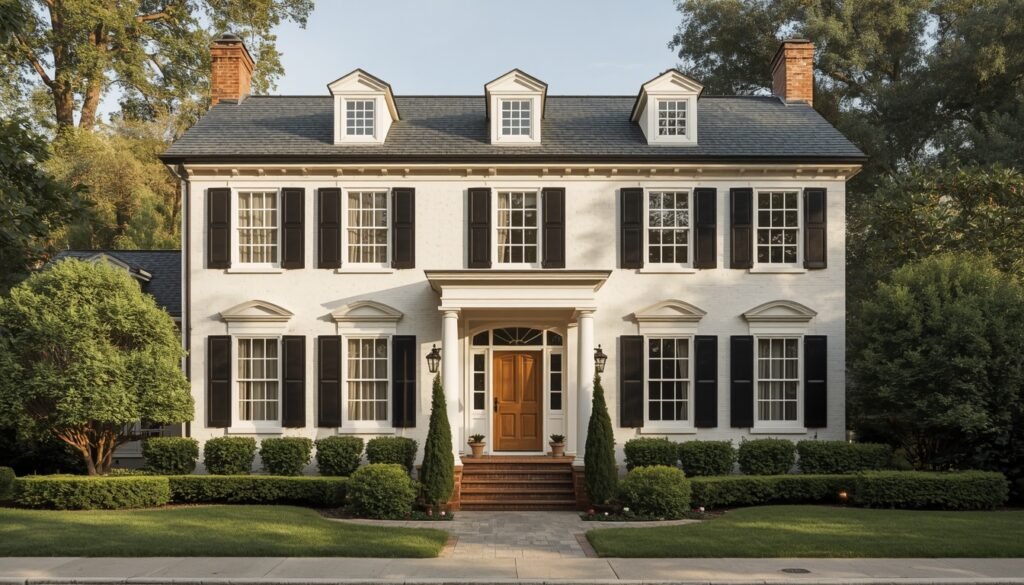
White Dove OC-17 is a classic choice for homeowners who want a soft, timeless white. Benjamin Moore currently lists an LRV of 83.16 for OC-17 and describes it as a clean, classic white.
It works particularly well with traditional architecture, painted brick, shutters, natural stone, and warm wood. White Dove can also create a sophisticated white-on-white exterior when the trim has enough difference in sheen or depth to create separation.
For a front door, black, dark green, navy, and natural wood can all create attractive contrast. If the home already has warm materials, White Dove is often easier to coordinate than a very blue or icy white.
3. Sherwin-Williams Pure White (SW 7005)
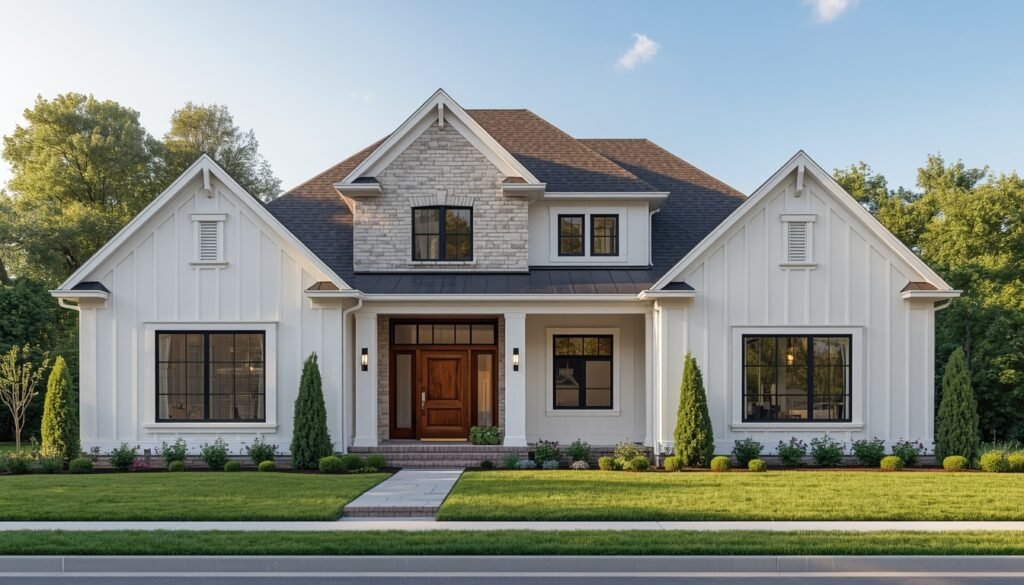
Pure White SW 7005 offers a brighter, cleaner appearance while retaining a subtle warmth. Sherwin-Williams currently lists an LRV of 83.957 and notes that its slight yellow undertone helps prevent it from appearing overly stark.
It is particularly useful for modern homes, trim, garage doors, siding, and exteriors where you want a fresh white without moving into a strongly cool palette. Pair it with black windows for a crisp modern look or natural wood for a softer Scandinavian-inspired exterior.
Because it sits near the bright end of the exterior-white spectrum, test it carefully on large surfaces before choosing it for a fully exposed south- or west-facing elevation.
4. Benjamin Moore Simply White (OC-117)
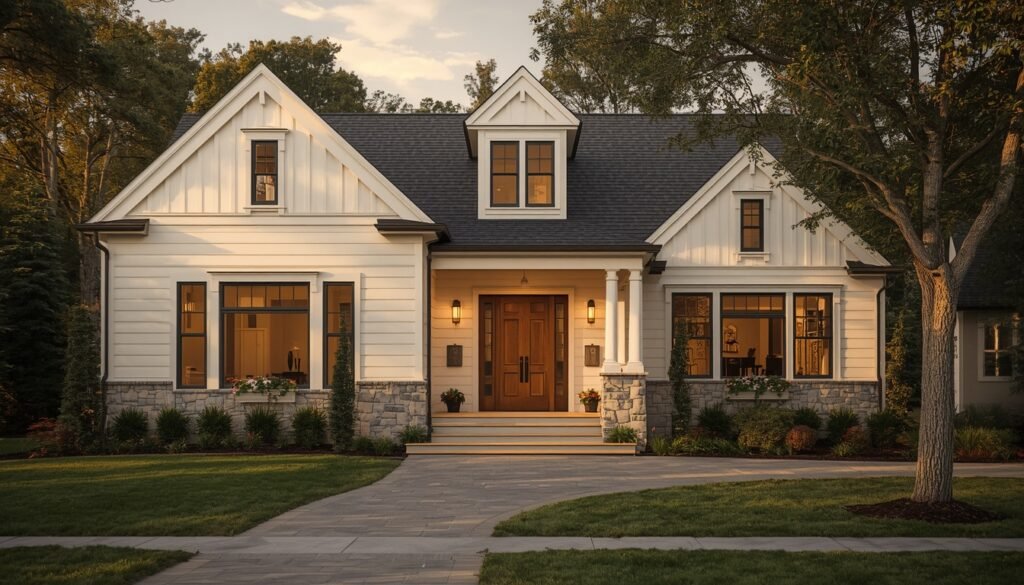
Simply White OC-117 has a very high LRV of 89.52 according to Benjamin Moore. The brand describes it as a clean, crisp white with a slight hint of warmth.
That high reflectance makes it a strong choice when you want an airy, bright exterior. It can look especially effective on modern siding, coastal houses, and homes with dark windows or charcoal roofing.
The trade-off is that strong sunlight can make it appear extremely bright. If your house receives intense afternoon sun, compare it with a slightly deeper white before committing to the entire exterior.
5. Sherwin-Williams Greek Villa (SW 7551)
Greek Villa SW 7551 has an LRV of 84.223 and sits in the warm-white family.
Its warmth makes it particularly appealing for farmhouse exteriors, traditional homes, and houses with natural wood. It can also work beautifully with warm stone because the paint doesn’t fight the earthy undertones already present around the house.
Greek Villa is a good option when you want the exterior to feel light without looking clinical. Black lighting, bronze hardware, and natural timber can make the combination feel polished without becoming overly formal.
6. Benjamin Moore Chantilly Lace (OC-65)
Chantilly Lace OC-65 is one of the brightest whites in this group. Benjamin Moore lists its LRV at 90.04 and describes it as a classic go-to white.
That brightness makes it compelling for contemporary homes, coastal exteriors, and houses where you want a crisp white envelope around dark windows. It can also make architectural details feel exceptionally clean.
However, Chantilly Lace deserves careful sampling outdoors. A very high-LRV white can look dramatically brighter on a large sunlit wall than it does on a small interior sample. If you want a softer look, compare it with White Dove, Alabaster, or Oyster White.
7. Sherwin-Williams Oyster White (SW 7637)
Oyster White SW 7637 is a softer option with an LRV of 72.491. Sherwin-Williams lists it for both interior and exterior use.
Because it has more visual depth than the brightest whites, Oyster White can be excellent on large homes where an ultra-bright exterior might feel overwhelming. It works naturally with stone, brick, warm roofs, and earthy landscaping.
This is also one of the better choices when you want an exterior that reads white from the street but doesn’t have that freshly bleached appearance.
8. Sherwin-Williams White Duck (SW 7010)
White Duck SW 7010 has an LRV of 74.005.
It belongs in the soft, warm-off-white category and works beautifully when a house needs more depth than a bright white provides. White Duck is particularly attractive on modern farmhouse exteriors, wood siding, and homes surrounded by mature greenery.
It pairs naturally with black, dark bronze, warm gray, and wood accents. If you are trying to avoid an overly stark exterior, White Duck deserves a spot on the sample board.
9. Benjamin Moore China White (OC-141)
China White OC-141 offers a cooler interpretation of white. Benjamin Moore currently lists an LRV of 76.43 and identifies cool gray undertones.
That makes it useful when you want a refined exterior that isn’t aggressively bright. It can work well with gray roofs, cool stone, dark windows, and restrained landscaping.
China White can also help a traditional home feel updated without pushing it into a stark modern palette. The key is making sure the existing exterior materials don’t have strong yellow or orange undertones that could make the contrast feel awkward.
10. Benjamin Moore Swiss Coffee (OC-45)
Swiss Coffee OC-45 is a warm white with an LRV of 81.91. Benjamin Moore describes it as an essential white with the right amount of warmth.
It works especially well when the home contains warm wood, beige stone, brown roofing, or natural landscaping. The warmth gives the exterior a welcoming quality while keeping the overall appearance light.
If your goal is a cozy white house rather than a crisp contemporary white house, Swiss Coffee is worth testing alongside Alabaster and White Dove.
11. Sherwin-Williams Snowbound (SW 7004)
Snowbound SW 7004 has an LRV of 82.771.
It is a versatile white that can bridge the gap between warm and cool exterior palettes. That makes it useful when a house has mixed materials or when you’re trying to coordinate siding with both gray and warmer accents.
Snowbound can look particularly polished with charcoal roofing, black windows, gray stone, and muted landscaping. It also gives traditional architecture a cleaner appearance without making every surface look stark.
12. Benjamin Moore Oxford White (CC-30)
Oxford White CC-30 has an LRV of 86.69. Benjamin Moore describes it as a classic bright white with the slightest cool cast.
That slight coolness makes it a strong candidate for modern homes and exteriors with gray or blue-gray materials. It can also provide a crisp backdrop for deep green doors, black hardware, and dark roofing.
If you already have warm brick or creamy stone, sample Oxford White carefully. Its cooler character may create more contrast than you expect.
13. Benjamin Moore Simply White / Alternative Neutral White
Simply White has already appeared as one of the strongest bright-white choices in this guide, but it also illustrates an important point about neutral white exterior paint. Not every homeowner needs a completely different paint color. Sometimes the better decision is choosing one white for the siding and another closely related white for trim or architectural details.
For example, a bright white siding color can be paired with a slightly softer trim white to create depth without introducing a completely new color family. The goal is tonal layering rather than collecting several unrelated whites around the house.
14. Sherwin-Williams Shoji White (SW 7042)
Shoji White SW 7042 has an LRV of 74.345 and is listed by Sherwin-Williams for interior and exterior use.
This is one of the better options for homeowners who like white but want more softness. Shoji White can read as a sophisticated off-white rather than a bright, reflective white. It is particularly attractive with natural wood, black accents, stone, and warm landscaping.
Its depth also helps large exterior walls feel less visually harsh. It is a strong choice for modern farmhouse, transitional, and organic-modern homes.
15. Benjamin Moore Pale Oak (OC-20)
Pale Oak OC-20 sits closer to the off-white and light greige family than a traditional bright white. Benjamin Moore lists an LRV of 68.64 and describes its undertones as warm gray.
That lower LRV gives it more presence than the brighter whites in this guide. On the right house, Pale Oak can look like a very soft white from a distance while providing enough depth to keep the exterior from feeling washed out.
It works particularly well with natural stone, warm gray roofs, wood accents, and traditional or transitional architecture. If bright white keeps looking too intense, this is the kind of shade worth considering.
16. Benjamin Moore Seapearl (OC-19)
Seapearl OC-19 has an LRV of 76.43. Benjamin Moore identifies cool gray undertones that freshen the shade.
Seapearl is useful when you want an off-white with a polished, slightly cooler character. It can complement gray stone, charcoal roofs, black accents, and modern traditional architecture.
Because its undertones are more noticeable than those of a simple warm white, compare it directly with China White and White Dove before choosing. Small differences can become surprisingly visible across an entire elevation.
17. Sherwin-Williams Egret White (SW 7570)
Egret White SW 7570 has an LRV of 69.642, giving it considerably more depth than the brightest whites.
It works well when you want an exterior that feels soft and sophisticated rather than brilliant. Its deeper value can be especially helpful on large homes, where an extremely high-LRV white might look flat or glaring in direct sunlight.
Pair it with dark bronze, charcoal, black, or natural wood accents. It can also transition nicely between white siding and stone foundations.
18. Sherwin-Williams Aesthetic White (SW 7035)
Aesthetic White SW 7035 has an LRV of 73.097.
This is another soft white that sits comfortably between a traditional white and a light neutral. It can be useful for homes with beige stone, warm roofing, stained wood, or mixed exterior materials.
Aesthetic White is particularly helpful when the goal is understated elegance. Instead of shouting “white house,” it creates a quieter backdrop that lets architecture, landscaping, and materials do more of the visual work.
19. Benjamin Moore Ballet White (OC-9)
Ballet White OC-9 has an LRV of 71.97. Benjamin Moore describes it as an off-white with just the right amount of color.
This makes it a strong option when traditional white feels too bright but beige feels too heavy. Ballet White can create a warm, refined exterior that works beautifully with stone, dark shutters, natural wood, and traditional architecture.
Its lower LRV means it will show more depth than Chantilly Lace or Simply White. That difference can be valuable on a large facade where you want the paint to feel substantial.
20. Sherwin-Williams Pearly White (SW 7009)
Pearly White SW 7009 has an LRV of 77.327.
It offers a soft, warm-leaning white appearance without moving as deep as some of the more obvious off-whites. Pearly White can work well on traditional homes, farmhouse exteriors, and houses that combine painted siding with warm stone or wood.
Its moderate LRV also gives you more flexibility when the exterior receives strong sunlight. Pair it with dark bronze or black accents for contrast or natural wood for a softer, more organic palette.
Best White Exterior Paint Colors by Style
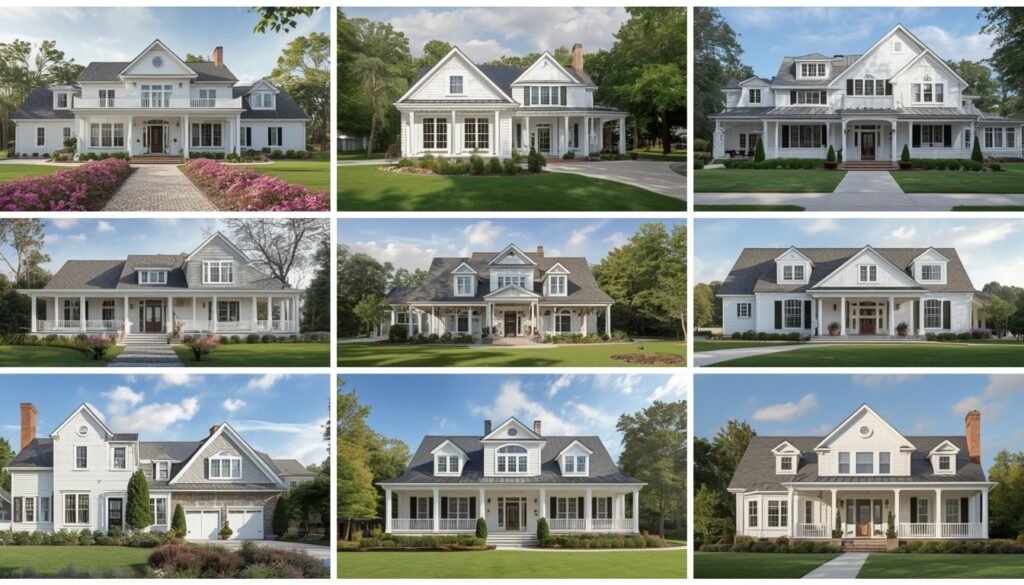
Best White Paint Colors for Modern Homes
Modern homes usually benefit from whites that feel clean rather than creamy. Chantilly Lace, Simply White, Pure White, Oxford White, and Snowbound can all create a crisp backdrop for black windows, simple landscaping, concrete, and metal accents. If the home has a lot of warm wood, however, a softer white such as Alabaster or Shoji White can create a more balanced composition.
Best White Paint Colors for Farmhouse Exteriors
Farmhouse architecture tends to look better with whites that have some warmth and softness. Alabaster, White Dove, Greek Villa, White Duck, Shoji White, and Swiss Coffee are especially useful starting points. They work naturally with black windows, natural wood, galvanized details, stone, and simple landscaping.
Best White Paint Colors for Traditional Homes
Traditional homes often benefit from classic whites that highlight columns, shutters, cornices, and other architectural details. White Dove, Alabaster, Snowbound, Oyster White, and Ballet White can all create a timeless exterior. The more ornate the architecture, the more useful a slightly softened white can become because it allows the details to remain visible.
Best White Paint Colors for Craftsman Homes
Craftsman houses often combine siding, stone, wood, and substantial trim. A soft white such as White Duck, Alabaster, Oyster White, or Aesthetic White can connect those materials without creating harsh transitions. Natural wood and dark bronze accents can then provide the contrast the architecture needs.
Best White Paint Colors for Coastal Homes
Coastal homes can handle brighter whites particularly well. Chantilly Lace, Simply White, Pure White, and Oxford White can create a fresh exterior when paired with navy, black, soft gray, or natural wood. If you want the house to feel less stark, White Dove or Snowbound can soften the palette.
Best White Paint Colors for Brick Homes
Brick requires more attention than plain siding because the masonry already contains a complicated mix of colors. White Dove, Alabaster, Oyster White, Swiss Coffee, and White Duck can complement warm brick without making it look disconnected. For more ideas on coordinating exterior colors with masonry, explore these exterior color schemes for red brick homes.
Best White Paint Colors for Stucco Homes
Stucco usually looks most natural with whites that have enough warmth to connect with tile, stone, wood, and landscaping. Alabaster, Greek Villa, Swiss Coffee, White Dove, and Ballet White are useful starting points. Very cool whites can sometimes feel detached from earthy stucco surroundings.
Warm White vs. Cool White vs. True White
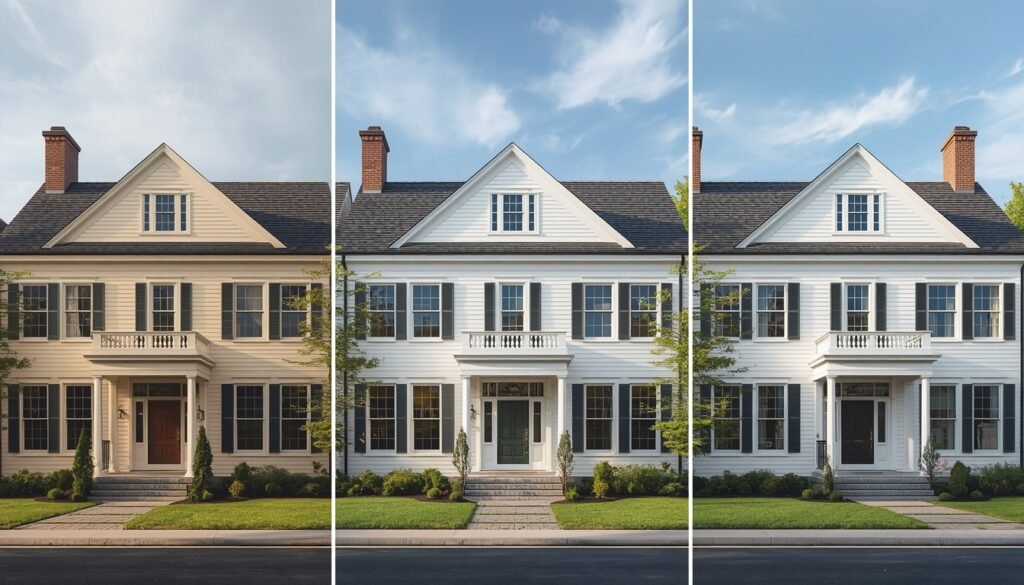
Best Warm White Exterior Paint Colors
Warm whites are ideal when you want the house to feel welcoming rather than clinical. Alabaster, White Dove, Greek Villa, Swiss Coffee, White Duck, Shoji White, Ballet White, and Pearly White all belong on the warm or warm-leaning side of this discussion.
Best Cool White Exterior Paint Colors
Cool whites can make a house feel crisp and contemporary. China White and Seapearl offer softer cool character while Oxford White provides a brighter option. These colors tend to work best when the home already contains gray, blue-gray, black, or cool stone elements.
Best Neutral White Exterior Paint Colors
Neutral whites are useful when your exterior contains several competing materials. Pure White, Snowbound, White Dove, and some of the softer whites in the list can act as a bridge between warm and cool elements. This is particularly valuable on homes with mixed siding, stone, brick, and metal.
Best True White Exterior Paint Colors
True or near-true whites create the cleanest appearance. Chantilly Lace, Simply White, Pure White, and Oxford White are useful candidates when you want maximum brightness. They look especially sharp with dark windows and restrained accent colors.
| White Type | Visual Effect | Best Lighting | Best Styles | Pairs Well With |
|---|---|---|---|---|
| Warm White | Soft and welcoming | North and mixed light | Farmhouse, traditional | Wood, brick, warm stone |
| Cool White | Crisp and refined | Warm sunlight | Modern, transitional | Gray stone, black, blue |
| Neutral White | Balanced and adaptable | Mixed exposure | Most styles | Mixed materials |
| True Bright White | Fresh and high-contrast | Moderate to bright light | Modern, coastal | Black, navy, charcoal |
Best White Exterior Colors That Don’t Look Yellow
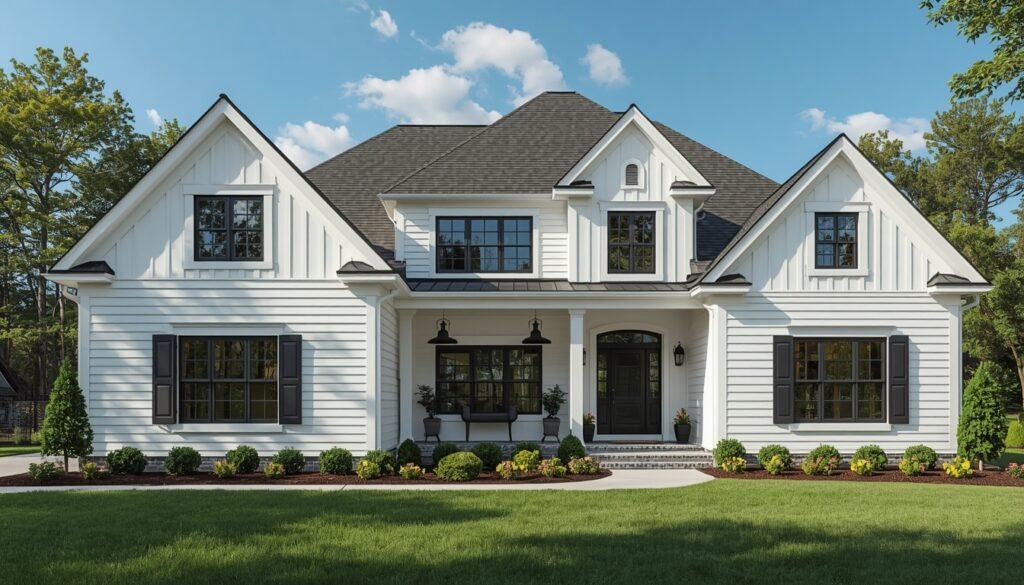
When homeowners say they want a white that doesn’t look yellow, they usually aren’t asking for a cold blue-white. They want a clean white without an obvious creamy cast. The trick is separating a gentle warm undertone from a strong yellow undertone.
Pure White, Chantilly Lace, Oxford White, Snowbound, China White, and Seapearl can be useful starting points depending on the surrounding materials. However, even a relatively neutral white can look warmer beside a cool gray roof or cooler beside warm brick.
Sunlight can also exaggerate warmth. A creamy white may look balanced under overcast skies but noticeably warmer in strong afternoon sun. That’s why the safest approach is to test the actual paint outdoors rather than judging it from a screen.
Choosing the Right White Trim Color
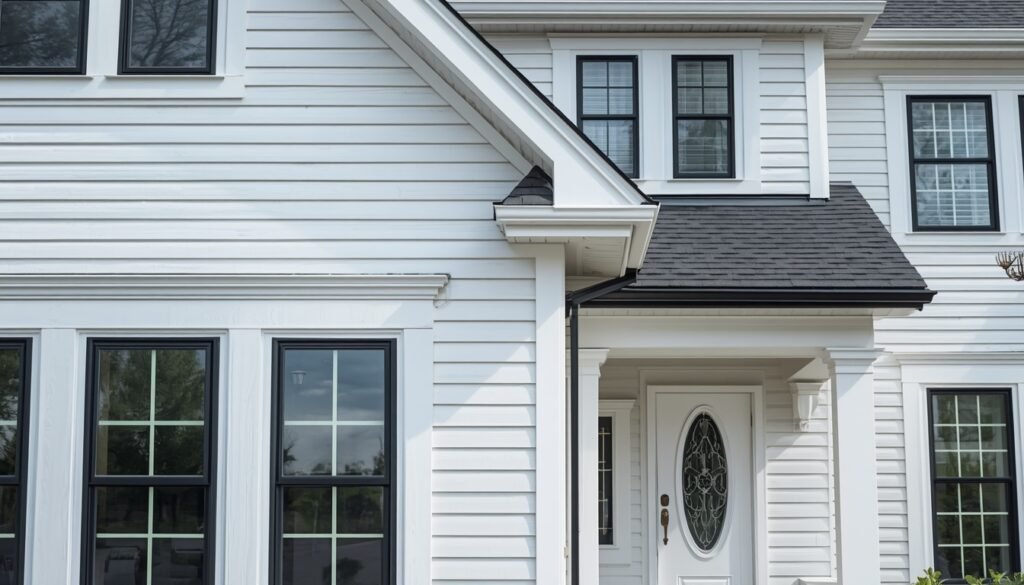
Should Exterior Trim Be the Same White as the Siding?
It can be. Using one white across siding and trim creates a streamlined exterior and works especially well on modern houses. However, the difference can become almost invisible when the same color and sheen cover every surface. If you want architectural details to stand out, a subtle change in value or finish can help.
Bright White Trim With an Off-White Exterior
Bright white trim can sharpen a softer exterior. For example, a deeper off-white siding color can look crisp when paired with Pure White trim. This approach works particularly well around windows, doors, columns, and porch details.
Off-White Trim With a White Exterior
Soft trim creates a gentler, more layered look. It works beautifully on traditional houses and exteriors with natural stone or wood. The contrast is quieter, but the result can feel more expensive because the palette relies on subtle tonal differences rather than obvious color changes.
Using a Darker Trim Color
Darker trim can completely change the character of a white house. Charcoal, deep bronze, black, and dark green can emphasize windows and architectural lines. On modern homes, dark trim creates a graphic effect. On traditional homes, it can make shutters and doors feel more substantial.
How Much Contrast Should You Have Between Siding and Trim?
There is no universal percentage of contrast that works for every house. A small difference can highlight architectural details without dominating them. Strong contrast works better when the home has simple shapes, bold windows, or a contemporary design.
Best White Trim Colors for White Houses
Pure White is a useful trim option when the siding is softer. Chantilly Lace can create an even brighter edge, while White Dove can soften the transition around traditional architecture. The important part is comparing the two whites side by side rather than assuming two colors with “white” in their names will coordinate.
Best Accent Colors for a White House Exterior
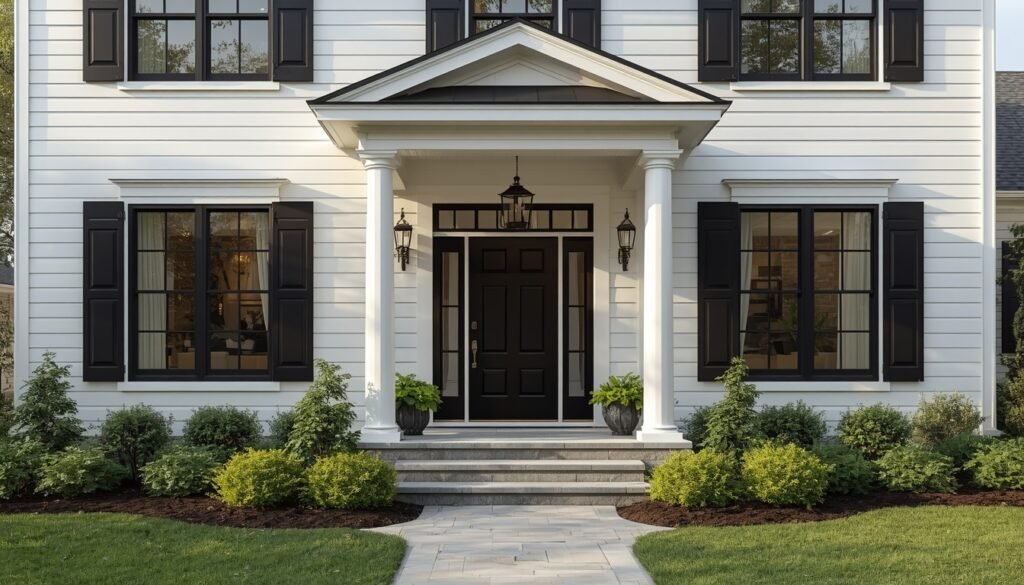
Best Front Door Colors for a White House
A white house gives the front door enormous freedom. Black creates classic contrast. Charcoal feels slightly softer. Navy introduces depth without becoming too dramatic. Deep green connects the architecture with landscaping, while natural wood brings warmth and texture.
If the exterior already has strong brick or stone, the door doesn’t need to compete. A restrained accent often looks better than adding another loud color to an already detailed facade.
Best Shutter Colors for a White House
Black, charcoal, deep navy, forest green, and dark bronze all work naturally with white siding. Traditional homes often look best when shutters echo the front door or roof rather than introducing a completely unrelated color.
Best Garage Door Colors for a White House
A garage door can either disappear into the exterior or become an intentional feature. Matching the siding keeps the facade calm. A darker gray, black, or natural wood-look finish creates a stronger architectural anchor.
Best Gutter and Downspout Colors
White gutters disappear more easily against white siding. Dark gutters can frame the roofline and windows but should usually relate to another dark element on the house. Matching gutters to the roof, window frames, or trim can keep the exterior visually organized.
Best Metal Finishes for a White Exterior
Black hardware feels crisp and modern. Bronze adds warmth. Brass introduces a more traditional decorative note. Silver or galvanized finishes work particularly well with coastal, industrial, and farmhouse-inspired exteriors.
Best Roof Colors for a White House
White House With a Black Roof
A black roof creates one of the strongest white-house combinations. It works especially well with modern farmhouse, contemporary, and transitional architecture. The key is repeating the dark color elsewhere through windows, lighting, hardware, or the front door.
White House With a Gray Roof
Gray roofing creates a softer transition. It works especially well with neutral and cool whites such as Snowbound, China White, Seapearl, and Oxford White. A warm white can still work if the gray roof contains warmer undertones.
White House With a Brown Roof
Brown roofs usually call for warmer whites. Alabaster, White Dove, Swiss Coffee, Greek Villa, and White Duck can create a more connected palette. A bright blue-white beside a warm brown roof may feel visually disconnected.
White House With a Metal Roof
Metal roofing can move in several directions. Black and dark bronze work naturally with bright whites. Galvanized or silver metal can complement cooler whites. A warm bronze metal roof often looks better beside a warm off-white.
Best White Exterior Colors for Different Exterior Materials
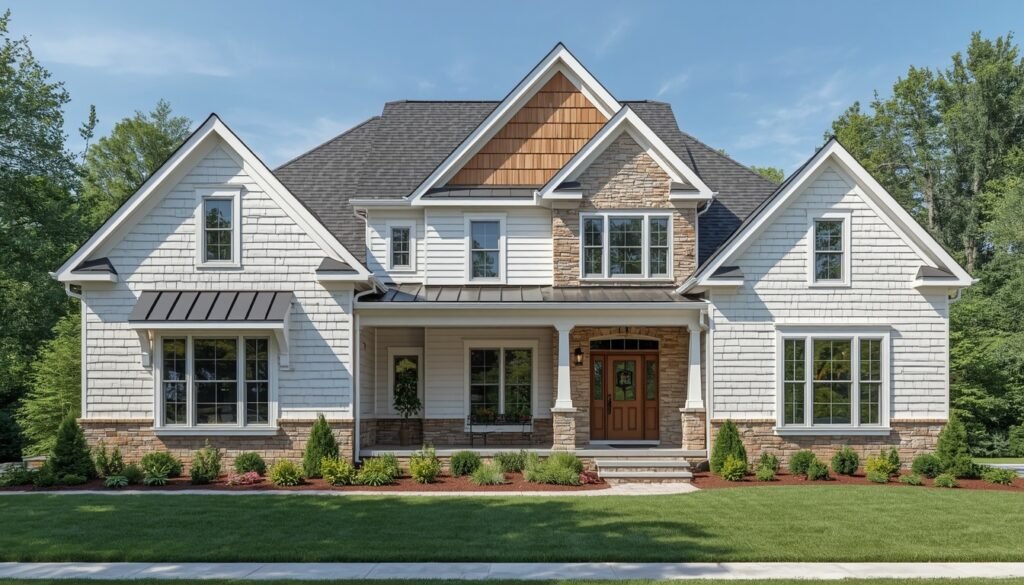
White Paint Colors for Brick Houses
Brick contains more visual information than plain siding, so softer whites often perform well. White Dove, Alabaster, Oyster White, Swiss Coffee, and White Duck can help the masonry feel integrated rather than visually separated.
White Paint Colors for Wood Siding
Wood siding can handle both warm and cool whites. The best choice depends on the stain and wood species around the house. Warm whites connect naturally with cedar and oak, while crisp whites can create a stronger modern contrast.
White Paint Colors for Vinyl Siding
Vinyl siding often benefits from whites that aren’t excessively bright because the large, uniform surfaces can reflect substantial light. Alabaster, White Dove, Snowbound, White Duck, and Oyster White are useful shades to test.
White Paint Colors for Fiber Cement Siding
Fiber cement can support nearly any white palette. Its clean surface works particularly well with modern whites such as Pure White, Chantilly Lace, and Oxford White. Softer colors such as Alabaster or Shoji White create a more relaxed farmhouse appearance.
White Paint Colors for Stucco
Stucco tends to look most natural with whites that relate to the landscape. Warm whites and soft off-whites often pair well with stone, tile, wood, and desert-inspired landscaping. For a broader curb-appeal strategy, landscaping can make as much difference as the paint itself.
White Paint Colors for Stone + White Siding Combinations
When stone and white siding share the same facade, compare the white directly against the stone. Cool gray stone may favor Seapearl or China White. Warm limestone may favor White Dove, Alabaster, or Swiss Coffee. The stone should help determine the white rather than being treated as an afterthought.
How to Test White Exterior Paint Colors Before Painting
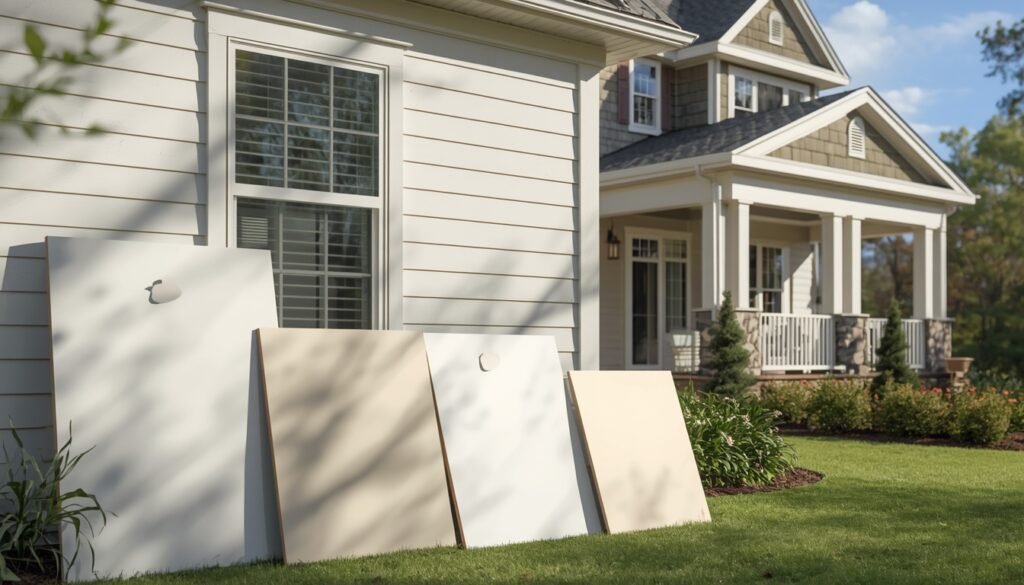
Never Choose an Exterior White From a Small Color Chip Alone
A tiny paint chip cannot reproduce the scale, texture, sunlight, shadow, and surrounding colors of an entire house. Benjamin Moore specifically recommends testing whites with samples and observing them over changing lighting conditions.
Test Large Samples on Multiple Sides of the House
Paint large sample areas or large movable boards and place them against different elevations. A front-facing wall may receive completely different light than the side of the house. Seeing the sample at scale reveals undertones that disappear on small chips.
Check the Color in Morning, Afternoon, and Evening Light
White is unusually sensitive to changing light. Morning light, midday sun, cloudy skies, and warm evening light can each produce a different impression. Don’t make the final decision after seeing the sample for five minutes.
Compare the Color Against Your Roof, Trim, and Existing Materials
Hold the sample beside the roof, brick, stone, windows, garage door, and permanent landscaping. A white that looks beautiful by itself may clash with one of those elements.
Use Peel-and-Stick Samples or Large Painted Boards
Large reusable samples make it easier to move the color around the exterior. They also allow you to compare several whites without covering the house in test patches.
Give the Sample Time to Dry Before Deciding
Wet paint doesn’t represent the final appearance. Let the sample dry fully and inspect it repeatedly under different conditions. If two whites still look nearly identical after several days, choose the one that coordinates better with your permanent materials.
Common Mistakes When Choosing White Exterior Paint
Choosing a White That Is Too Bright
The brightest white isn’t automatically the most attractive white. Extremely high-LRV colors can become intense in direct sun and may lose the softness you expected.
Ignoring Undertones
Two whites can have nearly identical brightness while feeling completely different because their undertones differ. Always compare whites in the actual environment where they’ll live.
Ignoring the Home’s Orientation
A color chosen from the front elevation may behave differently on a north-facing side wall. Exterior lighting should be part of the selection process from the beginning.
Choosing the Same White Without Considering Trim
One white across the entire exterior can look elegant, but it can also flatten architectural details. Decide early whether you want tonal contrast, color contrast, or a unified finish.
Matching the Paint to a Tiny Color Chip
A tiny sample doesn’t reveal how a white behaves across hundreds of square feet. Large-scale testing is far more reliable.
Forgetting About the Roof and Hardscape
The roof, driveway, walkway, retaining walls, and patio materials can strongly influence how your white exterior feels. These elements don’t change when the paint changes, so they should guide the choice.
Using Too Many Different Whites
Layering whites can create beautiful depth, but too many competing whites can make the exterior look accidental. Two or three closely coordinated values usually create more harmony than a collection of unrelated whites.
Not Testing the Color Outdoors
This is perhaps the easiest mistake to avoid. Exterior paint belongs outdoors, so make the final decision outdoors.
White Exterior House Color Combinations
White Siding + Black Trim
This combination creates strong architectural contrast and works particularly well on modern and farmhouse homes. Bright or neutral whites usually produce the cleanest effect.
White Siding + Natural Wood
Natural wood prevents a white exterior from feeling too sterile. Cedar, oak, walnut tones, and stained porch details can introduce warmth without adding another paint color.
White Siding + Gray Accents
Gray creates a quieter contrast than black. It works especially well when the roof, stone, or driveway already contains gray tones.
White Siding + Dark Green Door
Deep green connects beautifully with gardens, mature trees, and natural landscapes. It is an excellent alternative to black when you want the front entrance to feel softer.
White Siding + Navy Door
Navy creates classic contrast while keeping the exterior sophisticated. It works particularly well with coastal, traditional, and transitional architecture.
White Siding + Stone
Stone adds texture and visual weight to an otherwise light exterior. The white should echo the stone’s undertones rather than fight them.
White Siding + Black Roof
A black roof gives the white exterior a strong visual frame. Repeating black around the windows, lighting, or front door keeps the palette intentional.
White Exterior Paint Colors Compared
| Paint Color | Brand | Approx. LRV | Character | Best For |
|---|---|---|---|---|
| Alabaster SW 7008 | Sherwin-Williams | 82.2 | Soft warm white | Farmhouse and traditional homes |
| White Dove OC-17 | Benjamin Moore | 83.2 | Classic soft white | Traditional, brick, mixed materials |
| Pure White SW 7005 | Sherwin-Williams | 84.0 | Clean with slight warmth | Modern and transitional homes |
| Simply White OC-117 | Benjamin Moore | 89.5 | Bright warm white | Modern and coastal homes |
| Greek Villa SW 7551 | Sherwin-Williams | 84.2 | Warm and inviting | Farmhouse and wood accents |
| Chantilly Lace OC-65 | Benjamin Moore | 90.0 | Very bright white | Modern and coastal homes |
| Oyster White SW 7637 | Sherwin-Williams | 72.5 | Soft and muted | Large homes and stone |
| White Duck SW 7010 | Sherwin-Williams | 74.0 | Warm off-white | Farmhouse and natural materials |
| China White OC-141 | Benjamin Moore | 76.4 | Soft cool white | Cool stone and gray roofs |
| Swiss Coffee OC-45 | Benjamin Moore | 81.9 | Warm white | Wood, brick, traditional homes |
| Snowbound SW 7004 | Sherwin-Williams | 82.8 | Balanced soft white | Mixed materials |
| Oxford White CC-30 | Benjamin Moore | 86.7 | Bright with cool cast | Modern homes |
| Shoji White SW 7042 | Sherwin-Williams | 74.3 | Soft warm off-white | Organic modern and farmhouse |
| Pale Oak OC-20 | Benjamin Moore | 68.6 | Warm gray off-white | Stone and transitional homes |
| Seapearl OC-19 | Benjamin Moore | 76.4 | Cool gray white | Modern traditional homes |
| Egret White SW 7570 | Sherwin-Williams | 69.6 | Deep soft white | Large exteriors |
| Aesthetic White SW 7035 | Sherwin-Williams | 73.1 | Soft neutral | Mixed warm materials |
| Ballet White OC-9 | Benjamin Moore | 72.0 | Warm off-white | Traditional and stone homes |
| Pearly White SW 7009 | Sherwin-Williams | 77.3 | Soft warm white | Traditional and farmhouse homes |
Frequently Asked Questions About White Exterior House Colors
What is the most popular white exterior house color?
White Dove is one of the most recognized Benjamin Moore whites. Benjamin Moore currently identifies White Dove OC-17 as its most sampled white paint color, with Chantilly Lace and Swiss Coffee also among its popular whites.
What is the best white paint color for a house exterior?
There isn’t one universal winner. White Dove and Alabaster are strong all-around choices, while Pure White and Chantilly Lace suit homeowners who want a cleaner look. Oyster White, White Duck, and Shoji White work better when you want more softness and depth.
What is the best warm white for an exterior?
Alabaster, White Dove, Greek Villa, Swiss Coffee, and White Duck are excellent starting points. The final choice should depend on your roof, stone, brick, and sunlight.
What is the best cool white exterior paint color?
Seapearl, China White, and Oxford White are useful choices when you want a cooler exterior. They work particularly well with gray roofs, cool stone, black accents, and modern architecture.
What white exterior paint color does not look yellow?
Pure White, Chantilly Lace, Oxford White, Snowbound, Seapearl, and China White can be useful options when you want to limit a creamy appearance. However, surrounding colors and sunlight can still make any white appear warmer.
Should exterior trim be lighter or darker than the house?
Either can work. Lighter trim creates a subtle, layered look, while darker trim emphasizes architectural lines. For a classic white house, the amount of contrast should reflect the architecture rather than follow a fixed rule.
What is the best white for a modern house exterior?
Pure White, Chantilly Lace, Simply White, Oxford White, and Snowbound are strong candidates. If the modern house contains extensive natural wood, Alabaster or Shoji White may create a softer balance.
What is the best white for a farmhouse exterior?
Alabaster, White Dove, White Duck, Greek Villa, Shoji White, and Swiss Coffee are excellent places to start. They complement black windows, wood, stone, and simple landscaping.
What is the best white for a brick house?
White Dove, Alabaster, Oyster White, Swiss Coffee, and White Duck can work beautifully with brick. The brick’s undertone should guide the final selection.
Is bright white a good exterior house color?
Yes, particularly when the architecture is modern or coastal and the home has dark windows or trim. Very bright whites need careful testing because direct sunlight can make them look considerably more intense.
Does exterior paint look lighter or darker in sunlight?
Strong sunlight generally makes high-LRV colors appear brighter. The exact effect depends on the paint, surrounding materials, angle of light, shadows, and surface texture. This is why outdoor testing matters more than relying on an interior sample.
What LRV is best for exterior white paint?
There is no single ideal LRV. Many popular exterior whites sit roughly between the high 60s and around 90. A lower LRV can provide more depth, while a higher LRV produces a brighter appearance.
Can I use the same white for siding and trim?
Yes. Using one white can create a sophisticated monochromatic exterior. If you want more architectural definition, use a related white with a subtle value or sheen difference.
How many coats of exterior white paint should I use?
The number of coats depends on the existing surface, paint product, color change, coverage, substrate, and application method. Follow the paint manufacturer’s application instructions rather than assuming every exterior requires the same number of coats.
Final Thoughts: Finding the Right White for Your Home
The best white exterior house colors don’t succeed because they are simply white. They work because they respond to the entire house. Undertone, LRV, sunlight, architecture, roof color, brick, stone, wood, windows, and landscaping all influence the final result.
If you want a classic starting point, compare White Dove and Alabaster. If you prefer a cleaner contemporary look, test Pure White, Chantilly Lace, Simply White, and Oxford White. For a softer farmhouse or traditional exterior, look closely at White Duck, Shoji White, Oyster White, Swiss Coffee, and Ballet White. When you want more depth, Pale Oak, Egret White, Aesthetic White, and Seapearl deserve consideration.
Most importantly, don’t choose your exterior white from a tiny color chip or a digital image alone. Paint large samples, move them around the house, and watch them through morning, afternoon, cloudy, and evening light. Benjamin Moore similarly recommends living with white paint samples because whites can change noticeably as lighting conditions shift.
The right white should make your house look intentional, not merely painted white.
Once the main color feels right, build the rest of the exterior around it. Coordinate the trim, roof, front door, garage door, hardware, stone, wood, and landscaping so every element supports the same visual story. That is what turns a simple white exterior into a home with genuine curb appeal.
For additional exterior inspiration, explore these guides on mobile home curb appeal ideas, barndominium exterior design, and front-yard landscaping ideas. Together, the right paint color and thoughtful exterior details can make the entire property feel more cohesive.