15 TV Gallery Wall Ideas That Make Your TV Disappear (2026)
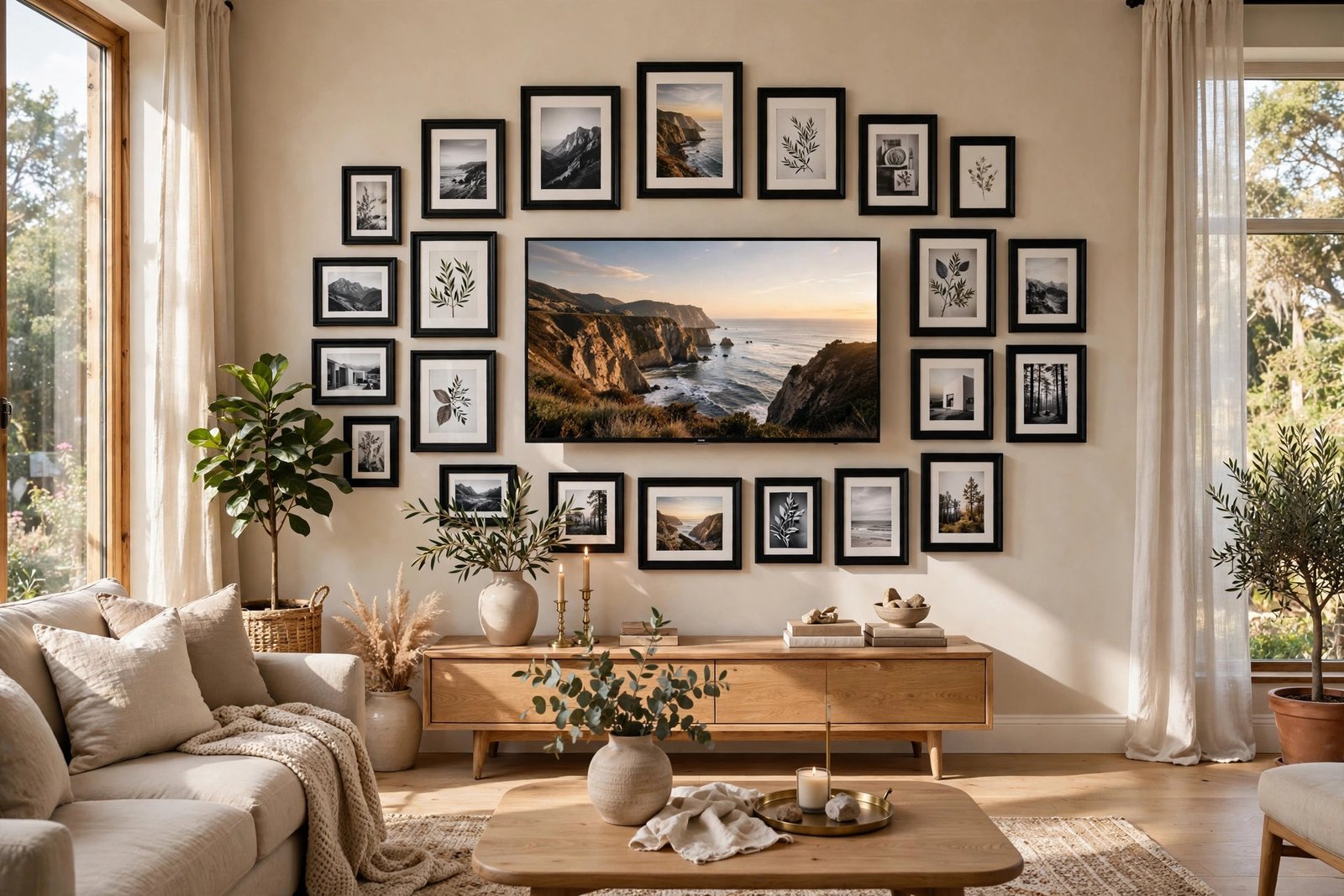
TV gallery wall ideas solve the ugliest problem in modern living rooms: the big black rectangle dominating your prettiest wall. Instead of fighting the screen, a gallery wall absorbs it — surrounding the TV with art, frames, and objects until it reads as just one more piece in a curated collection.
The trick isn’t owning great art. It’s placement math: the right spacing, the right sizes relative to your TV, and a layout that treats the screen as part of the composition instead of an obstacle. Below are 15 arrangements that work in any room, with the sizing rules and honest costs for each.
Key Takeaways
- Treat the TV as the anchor piece: build the gallery outward from the screen, not around it as an afterthought.
- The 2/3 rule: art beside the TV should span roughly two-thirds of the TV’s width for visual balance.
- Keep frame spacing tight — 2 to 3 inches between frames reads intentional; wider gaps read accidental.
- Center the whole arrangement at 57–58 inches (average eye level), TV included.
- Matte black frames on a dark wall make the screen nearly vanish; mixed finishes need one repeated element to stay cohesive.
- A Frame-style TV or a simple frame kit ($150–$250) turns the screen itself into rotating art.
1. The Centered TV + Symmetrical Frame Halo
Mount the TV dead center and ring it with matching frames in mirror-image pairs — same sizes left and right, top and bottom. Symmetry is the fastest way to make a TV look deliberate, and identical frames (think simple black or natural wood) keep the eye moving across the whole wall instead of snagging on the screen. Start with four frames, two per side, all the same size.
This layout flatters formal living rooms and anyone who likes order. Cost: $80–$250 for 4–8 matching frames plus hanging hardware.
2. Salon-Style: Build the Gallery Around the TV First
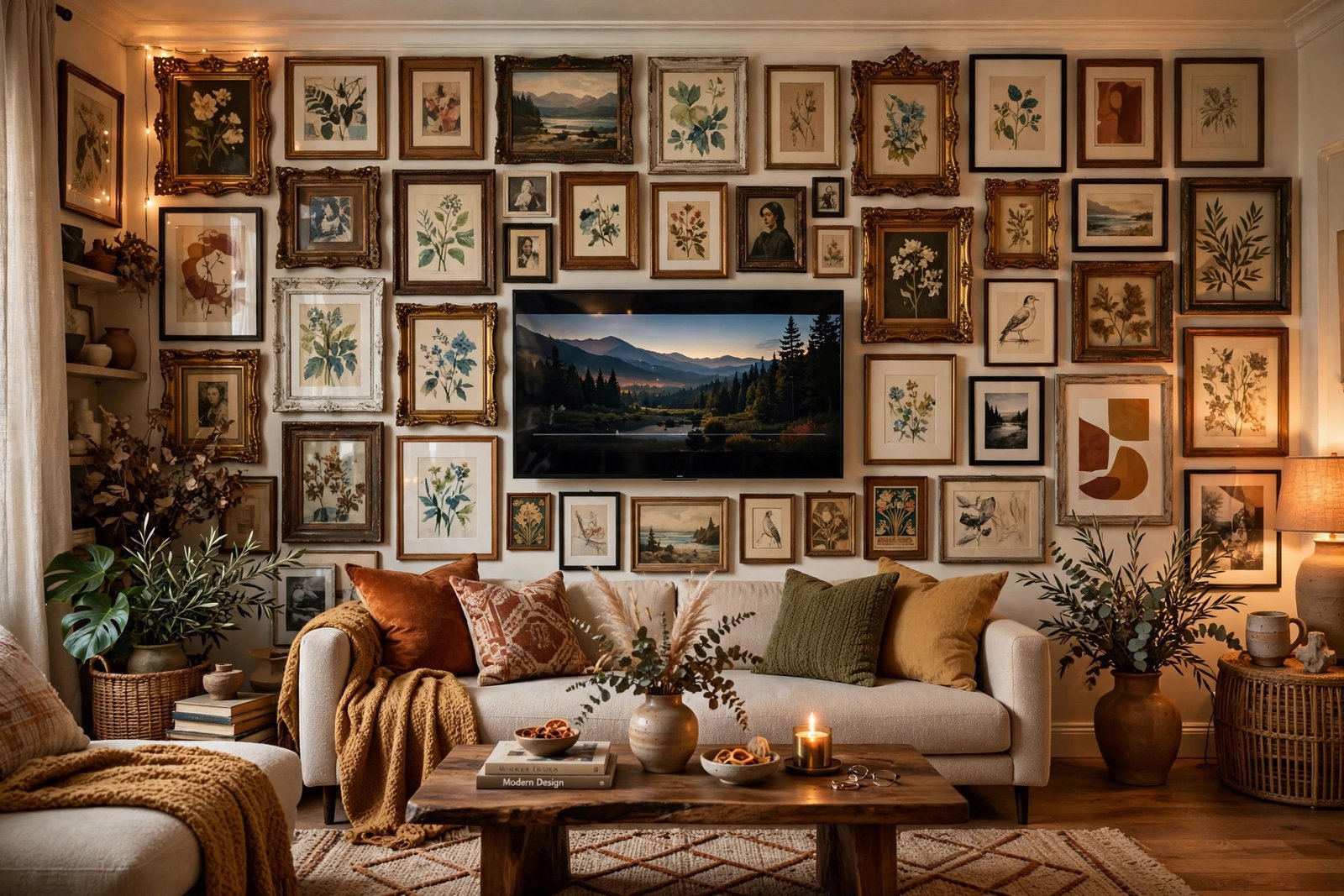
Salon style means an organic, floor-to-ceiling cluster — but with the TV as the anchor instead of the biggest painting. Lay the arrangement on the floor first with the TV (or a cardboard cutout its size) in the middle, then fill outward with varied frame sizes, keeping 2–3 inches between everything. The mix of sizes is what makes it feel collected rather than decorated.
Tip: photograph the floor layout before hanging — it’s your map, and it saves an hour of ladder time. Cost: $100–$300 for an eclectic mix of 8–12 frames.
3. The Oversized-Art Anchor Beside the TV
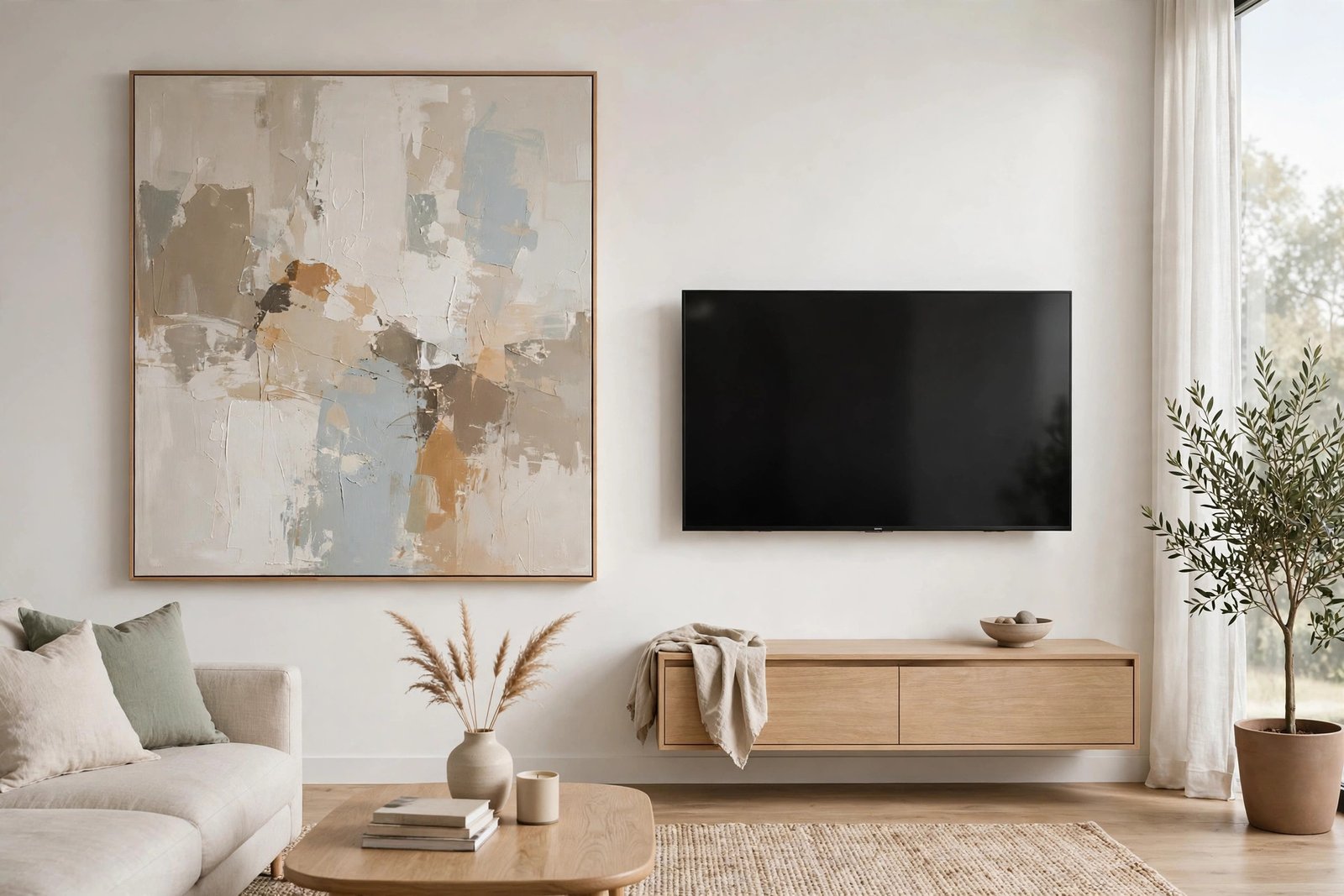
If a full cluster feels like too much, hang one oversized piece — 30×40 inches or larger — beside or above the TV and call it done. A single bold canvas or framed print carries the same visual weight as the screen, so the TV stops being the only thing you notice. Abstract or landscape art works best since it doesn’t compete with the screen for attention.
Keep the art’s longest side roughly two-thirds the TV’s width. Cost: $60–$200 for one large framed print or canvas.
4. Asymmetric Cluster for a Relaxed, Collected Feel
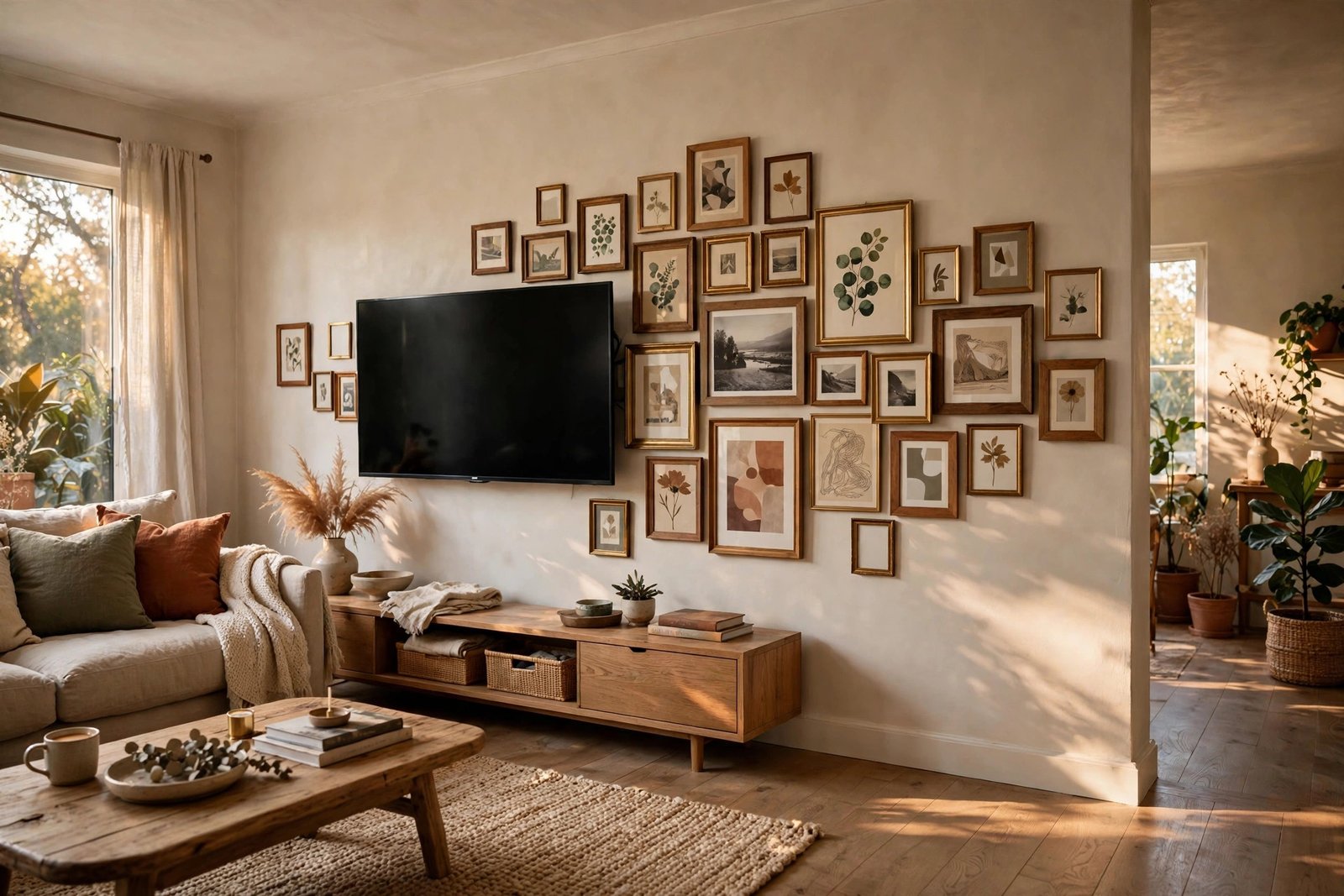
Asymmetry suits casual, lived-in rooms. Cluster frames in a loose cloud that extends further on one side of the TV — heavier (darker, larger) pieces low and left, lighter pieces high and right, which balances the composition the way photographers balance a frame. The TV sits slightly off-center in the whole arrangement, and the imperfection is the point.
In my experience, this is the most forgiving layout for beginners — nothing has to line up, so “mistakes” disappear. Cost: $80–$250 for 7–10 mixed frames.
5. Strict Grid for Modern Minimalists
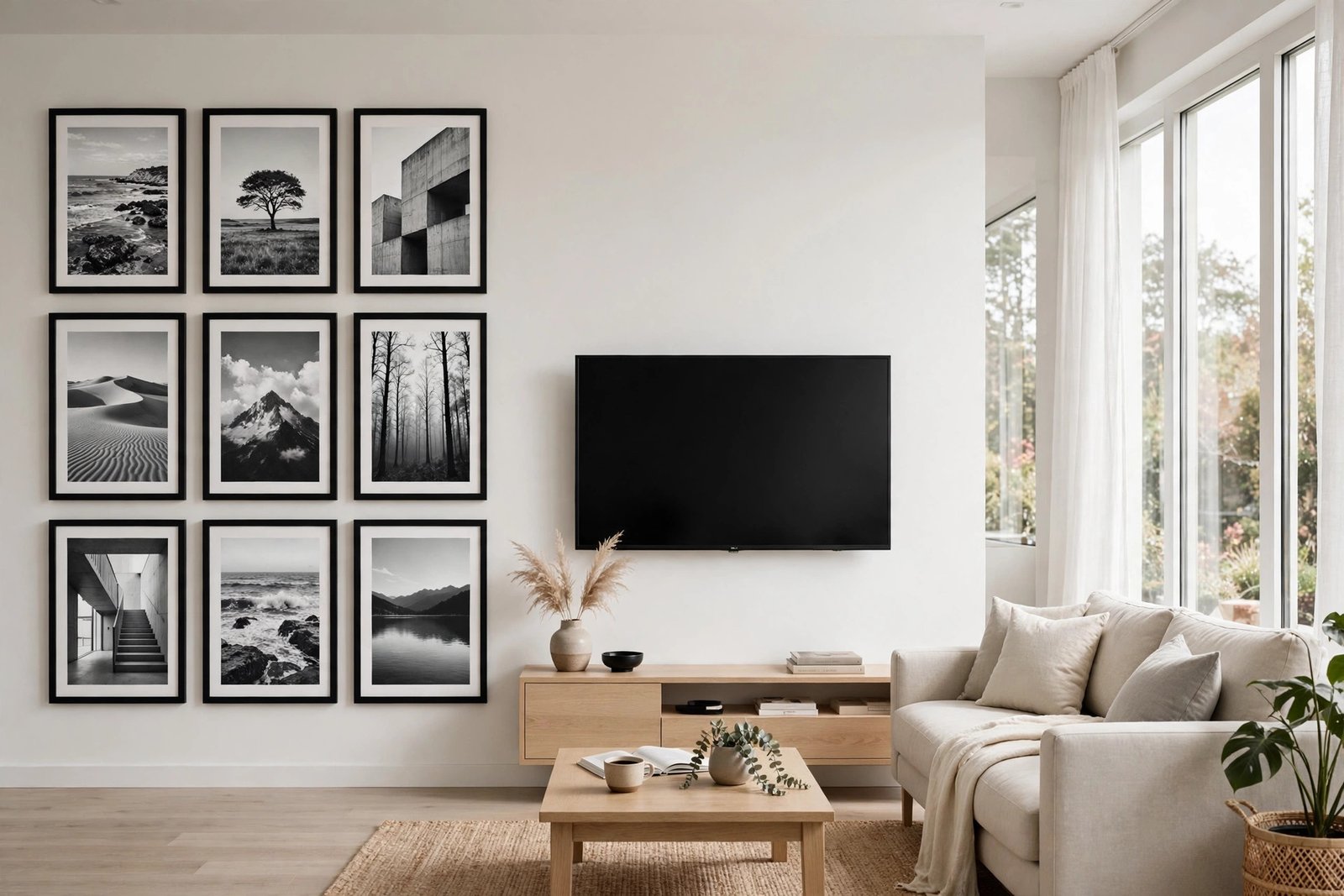
A precise grid of identical frames — say, nine 12×12 frames in three rows — brings gallery calm to a TV wall. The grid’s repetition is so visually strong that the TV becomes just another rectangle in the pattern. This works best with black-and-white photography or minimal line art, where the content doesn’t fight the structure.
Measure twice: grids punish sloppy spacing more than any other layout. Cost: $100–$280 for nine matching frames and prints.
6. Ledge Shelves: The No-Commitment Gallery
Two or three picture ledges flanking or spanning above the TV let you lean art instead of hanging it — rearrange in minutes, no new holes. Layer frames in front of each other at varying heights, mixing small prints with one medium anchor piece per shelf. The layered depth reads expensive and takes ten minutes to restyle for seasons.
This is also the easiest gallery to dust around a TV, since everything lifts off. Cost: $60–$150 for ledges and a starter set of leanable frames.

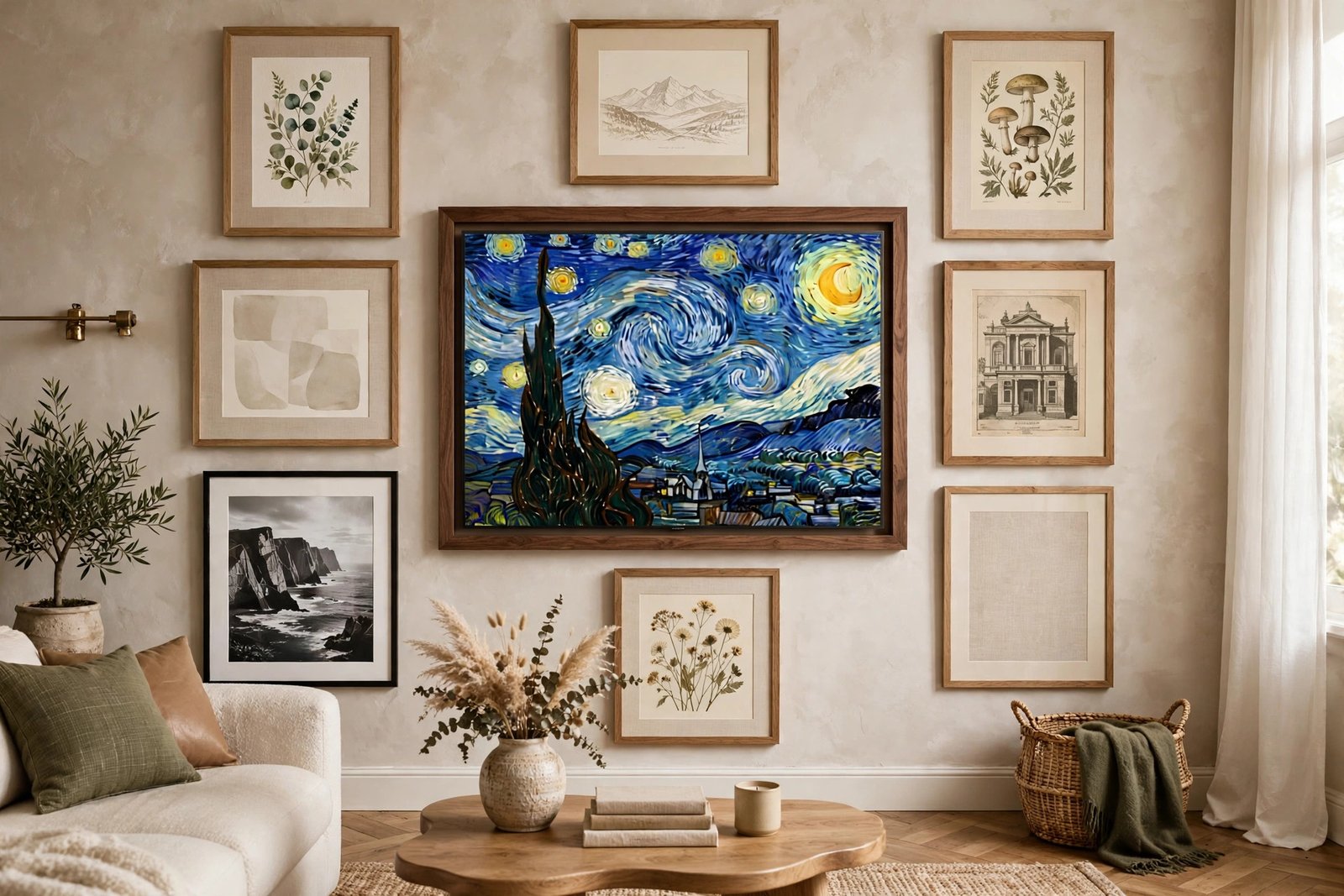
7. Frame-TV Mode: Make the Screen Part of the Gallery
A Samsung Frame TV (or any TV with art mode) surrounded by real frames is the ultimate camouflage — when idle, the screen displays art that matches your gallery’s palette. On a budget, a $150–$250 aftermarket frame kit adds a wood or metal border to a regular TV, and free art-mode apps cycle paintings on any smart TV. Match the on-screen art’s frame color to your real frames and guests won’t spot the TV.
It’s the priciest idea here, but nothing else hides a screen this completely. Cost: $150–$250 for a frame kit, or $1,000+ for a true Frame TV.
8. Black Frames on a Dark Wall (the Vanishing Act)
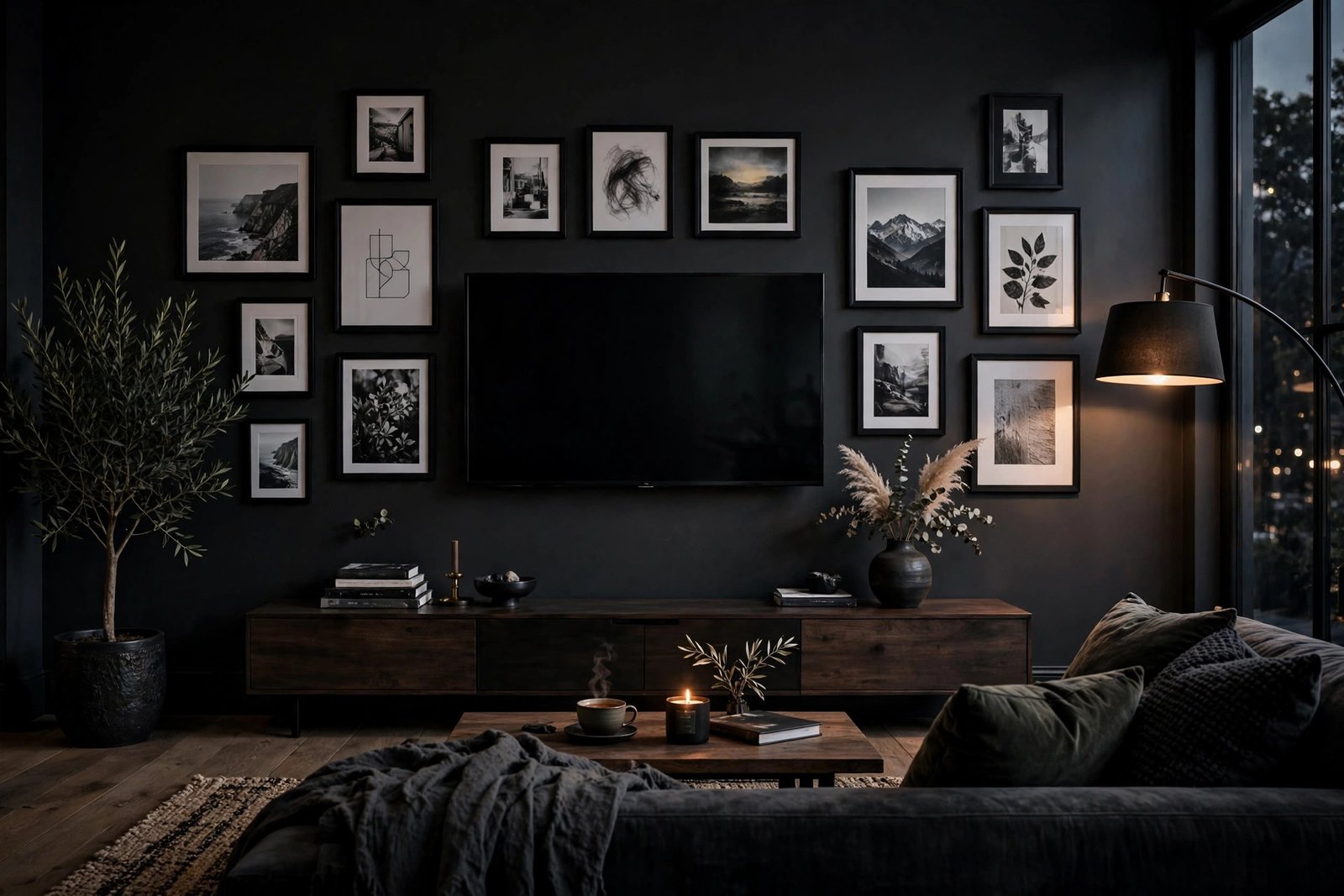
Paint the wall charcoal or deep green, hang black-framed art around the TV, and the screen dissolves into the composition — especially in the evening. The dark wall does half the work, so you need fewer pieces than on a white wall; five to seven frames is plenty. Add one brass or wood frame as an accent so the wall doesn’t feel like a void.
I’ve found this is the highest-impact trick for the money: a gallon of paint transforms the wall before you hang a single frame. Cost: $80–$220 for frames plus $30–$60 for dark paint.
9. Mix Frame Finishes Like a Pro
Mixed metals and woods look curated — if you repeat. The rule: three finishes maximum, and each one appears at least twice (two brass frames, two oak, the rest black, for example). Keep mat colors consistent — all white mats unify wildly different frames instantly. Without a repeat, mixed frames read as clutter; with one, they read as a collection built over time.
Start with what you own, then buy the repeats. Cost: $90–$260 to fill gaps with 5–8 new frames.
10. The 2/3 Rule: Art Width vs TV Width, Solved
Here is the sizing math that underpins every good TV gallery: the art grouping beside or above your TV should span roughly two-thirds of the TV’s width. A 55-inch TV (about 48 inches wide) pairs with a 30–34-inch-wide art arrangement. Hang the center of the grouping at 57–58 inches high — average eye level — and keep 2–3 inches between frames and 4–6 inches between the art and the TV’s edge.
Tape the outline on the wall first; it takes five minutes and prevents the too-small, too-high hanging that plagues TV walls. Cost: free — painter’s tape and a measuring tape.
11. Vertical Stacks for Narrow Walls Beside the TV
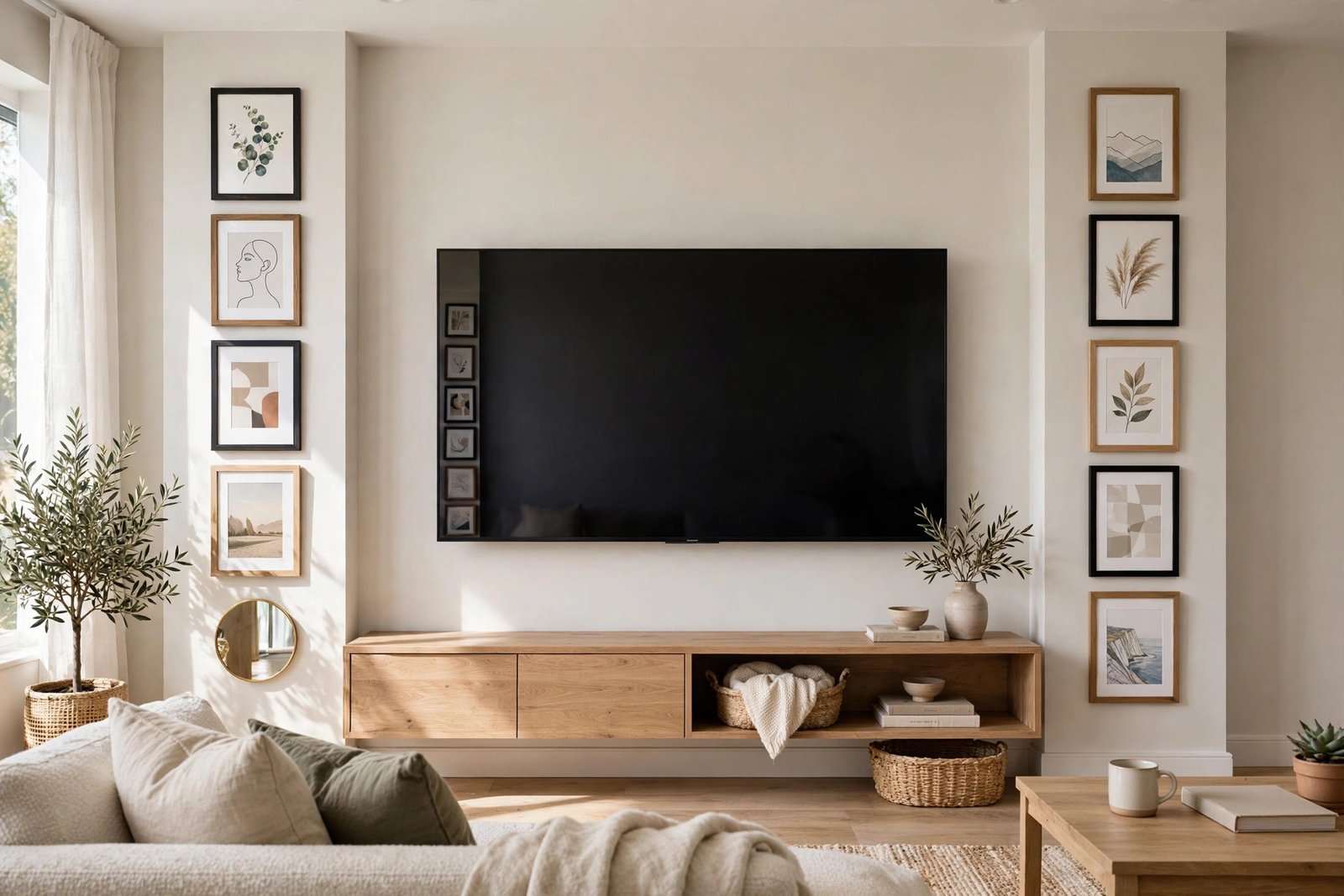
When the TV nearly fills the wall, go vertical: stack two or three frames in a column in the slim space on each side, or run one tall column on a single side for an asymmetric accent. Vertical stacks draw the eye up, making low ceilings feel taller, and they work in the 12–18 inches of wall that a wide TV leaves behind. Keep each column’s total height close to the TV’s height for balance.
Portrait-oriented prints and small mirrors alternate nicely in stacks. Cost: $70–$200 for 4–6 smaller frames.
12. Tuck Sculptural Objects Between the Frames
A gallery wall doesn’t have to be all frames. Weave in a small round mirror, a wall-mounted sconce, a woven basket, or a floating mini-shelf with a trailing plant between the art — the dimensional pieces break up the flatness and make the TV feel like part of a styled wall rather than a screen with pictures around it. One object per 4–5 frames is the right density.
Battery-operated sconces are the secret weapon here: light without wiring. Cost: $50–$180 for 2–3 objects or sconces.
13. Gallery Above the Console, TV Off to the Side
Not every TV has to be the centerpiece. In wide living rooms, mount the TV on one half of the wall and build a proper gallery — no TV involved — above the console on the other half. The gallery becomes the focal point, and the TV reads as secondary, which is exactly the hierarchy you want. This also solves the too-high TV problem, since the gallery fills the vertical space instead.
Balance the two halves by matching their visual weight: a dense gallery offsets a large screen. Cost: $90–$240 for the gallery-side frames.
14. Renter-Friendly TV Gallery: Strips, Ledges, and Leaning Frames
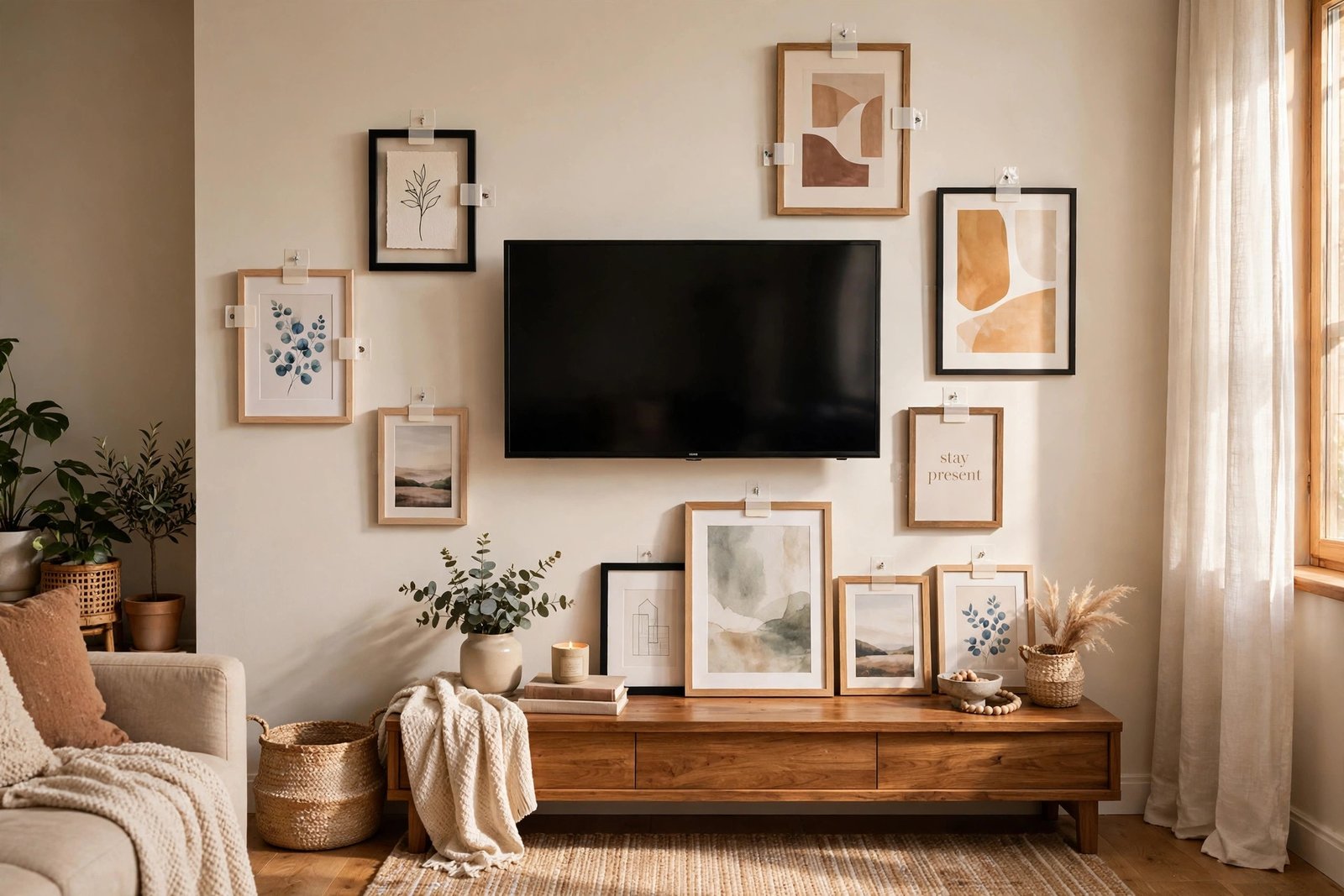
Renters can do nearly all of this with zero holes. Use adhesive picture-hanging strips rated for each frame’s weight (the large pairs hold up to 16 pounds), lean bigger pieces on the console against the wall, and use a picture ledge mounted with heavy-duty removable strips for the layered look. Photograph the bare wall on move-in day so you know exactly what “original condition” looked like.
Keep a small kit of spare strips — rearranging is half the fun, and resticking is free. Cost: $40–$120 for strips, ledges, and frames.
15. Light It: Picture Lights and Sconces That Elevate Everything
Gallery lighting is what separates styled from stunning. Battery-operated picture lights ($25–$45 each) mounted above key frames wash the art in warm light and make the whole wall glow after dark — which, conveniently, further diminishes the black screen. Two lights on the largest pieces is enough; lighting every frame looks like a museum gift shop.
Warm white (2700K) flatters both art and wood frames; cool white turns everything clinical. Cost: $60–$200 for 2–4 lights.
Gallery Mistakes That Keep the TV the Star
- Hanging art too high: the classic error — center the arrangement at 57–58 inches, not at the TV’s top edge.
- Frames too small: tiny frames beside a 65-inch TV look like postage stamps; respect the 2/3 width rule.
- Gaps too wide: more than 3 inches between frames breaks the cluster into random pictures.
- Ignoring the cords: a dangling cable ruins any gallery — route cords behind the TV with a $15–$25 cord cover before hanging.
- Matching everything: identical frames in identical sizes read as a hotel lobby; vary at least the sizes.
Frequently Asked Questions
How do you hang a gallery wall around a TV?
Start with the TV mounted at eye level (center of screen 42–48 inches from the floor when seated). Lay your frame arrangement on the floor around a cardboard TV cutout, photograph it, then transfer it to the wall working outward from the screen. Keep 2–3 inches between frames and 4–6 inches between art and the TV’s edge.
What size art works best next to a TV?
Follow the 2/3 rule: the art grouping beside your TV should span about two-thirds of the TV’s width — roughly 32 inches of art for a 55-inch TV. Individual pieces can be smaller within a cluster, but one anchor piece around that width keeps the composition balanced. Avoid anything under 8×10 inches directly beside a large screen.
Should gallery frames match the TV or contrast it?
Either works, but commit. Black frames on a dark wall make the TV vanish; mixed wood and brass frames make the TV one piece among many. What fails is one random frame style that matches nothing — pick a palette of up to three finishes and repeat each at least twice across the wall.
How do I hide TV cords in a gallery wall?
Route cables before hanging art. A paintable cord cover ($15–$25) running from the TV to the console disappears against the wall, or drill a cable pass-through behind the TV if you own the home. For gallery walls specifically, plan frame placement around the cord channel so no frame sits half-on, half-off the cover.
The Wall, Not the Screen, Gets the Attention
That’s the whole game: fifteen ways to make your TV one voice in a chorus instead of a solo act. Pick the layout that matches your room’s personality — symmetrical for calm, salon for collected, dark wall for drama — and hang with the sizing rules, not by guesswork. For the full room context, browse the living room and bedroom ideas archive, see how a TV shares a wall with a second focal point in the TV wall with fireplace ideas guide, and find more weekend projects in DIY and styling tips. For the bedroom specifically, see TV gallery wall ideas.