15 Coffee Bar Cabinet Ideas That Feel Built-In (2026)
If coffee bar cabinet ideas are filling your saved pins right now, you’re probably standing in your kitchen eyeing one specific cabinet and wondering whether your espresso machine fits inside it. It almost certainly does.
The cabinet-based coffee bar is the smartest version of the home coffee trend: everything lives behind closed doors, the counters stay clear, and when it’s done right, it looks like a custom built-in worth five figures. Below are 15 cabinet-only executions — from pocket doors to pull-out brewer shelves — each with real costs and the details that make it work.

Key Takeaways
- A single 24-inch (61 cm) cabinet holds a complete coffee setup — measure the brewer’s height with the lid open before you commit.
- Pocket doors and tambour doors beat regular hinged doors: they disappear instead of blocking the kitchen.
- Interior LED lighting ($15–$40) is the cheapest upgrade that makes a cabinet bar look expensive.
- Heat and steam are the enemy — always leave 2–3 inches of clearance and line cabinet interiors against moisture.
- In my experience, the pull-out shelf is the highest-impact retrofit: it turns any deep cabinet into an ergonomic station.
- Renters can do most of these reversibly — no drilling required for lighting, rails, or organizers.
1. The Coffee Bar Cabinet Tower: Floor-to-Ceiling Build
Convert a full-height appliance or pantry cabinet into a stacked coffee tower: brewer zone at counter height, bean and gear storage above, and pod or accessory drawers below. Removing one adjustable shelf usually creates the perfect brewer bay. This is the closest you get to a designer built-in without a contractor — the vertical mass reads as intentional architecture, not a converted cupboard. Add a small countertop-grade shelf for durability. Expect $120–$400 for shelf swaps, paint, and organizers if you DIY it.
2. Pocket Doors That Vanish Into the Cabinet
Standard cabinet doors swing open and block half your kitchen — pocket doors slide back into the cabinet walls instead. Conversion kits ($150–$450) replace the hinges with side tracks, so your coffee station opens like a hidden bar and closes like an ordinary cabinet. I’ve found this is the single upgrade that makes a cabinet bar feel like a $5,000 built-in. It needs about 1.5 inches of clearance on each side, so it suits deeper cabinets best. Measure twice; the tracks don’t forgive.
3. A Pull-Out Shelf That Brings the Brewer to You
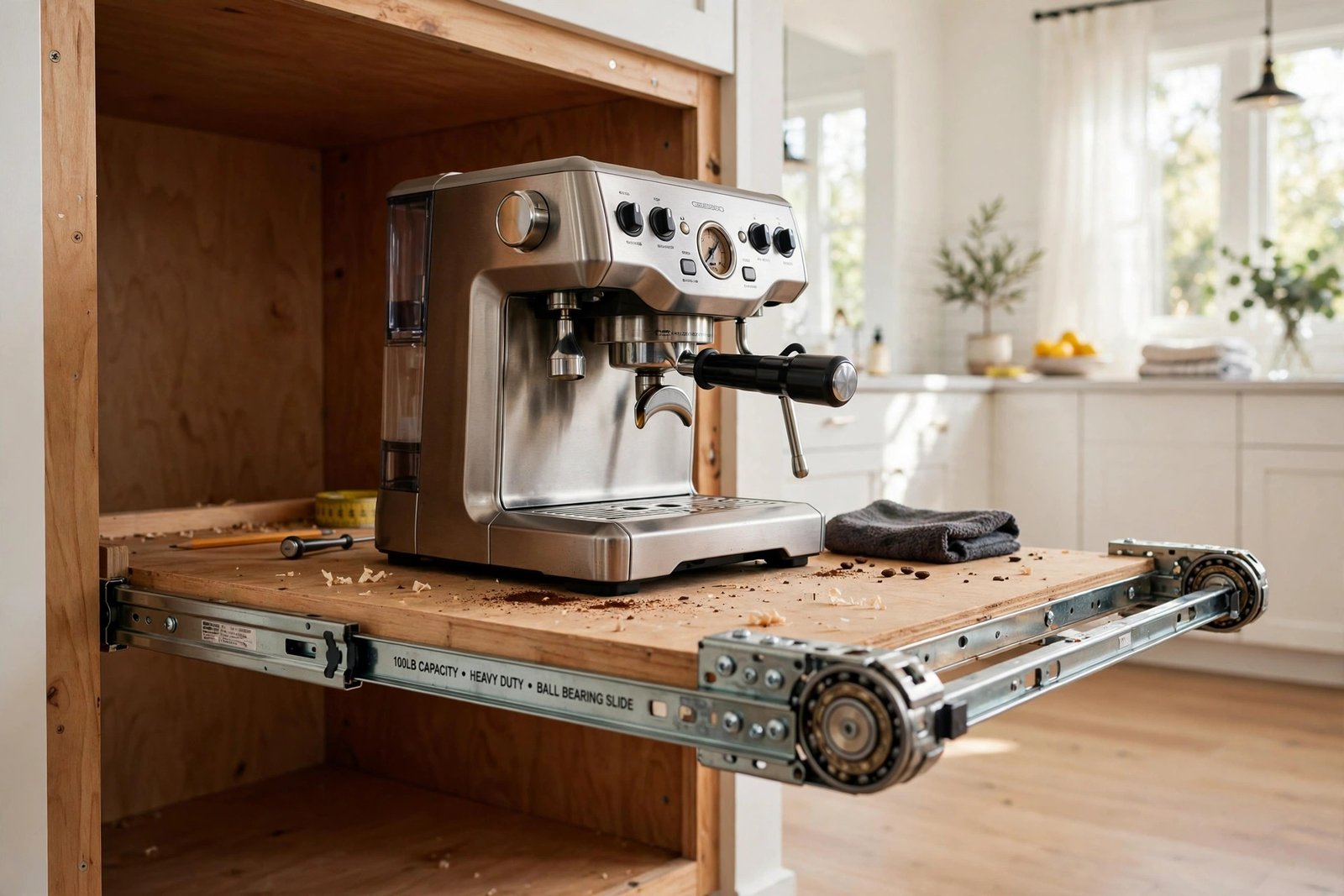
Deep cabinets are a pain — the brewer hides at the back and you spill water refilling the tank. A full-extension pull-out shelf retrofit ($25–$70 for heavy-duty slides) brings the whole machine out to you on a glide rated for 75+ pounds. Mount it at counter height, add a raised lip so the brewer can’t slide off, and suddenly a 22-inch-deep cabinet works better than open counter space. Tip: choose ball-bearing slides over friction ones — a brewer plus a full water tank is heavier than it feels.
4. Interior Lighting That Makes a Cabinet Bar Glow
Dark cabinet interiors make even nice gear look dingy. A warm LED strip along the top inside edge plus one motion-sensor puck ($15–$40 total) transforms the whole station — every morning it glows open like a jewelry box. Choose 2700–3000K for that cozy café warmth, and mount strips on the front underside of the shelf so light falls on the gear, not your eyes. Battery-powered options mean renters can do this with zero wiring. The closed door hides everything when guests arrive.

5. The Upper-and-Lower Cabinet Coffee Station
Split the station across a stacked pair: uppers hold mugs, beans, and pretty canisters at eye level while the base cabinet hides the brewer on a pull-out shelf. This works brilliantly when you have one available wall cabinet above an existing counter nook — the visual separation reads as “designed zone” rather than “stuff in a cupboard.” Cost stays low ($40–$150) since you’re mostly adding organizers and a shelf. Coordinate the hardware finishes between the two cabinets and the whole thing pulls together instantly.
6. Bifold Doors for a Hide-It-All Cabinet Bar
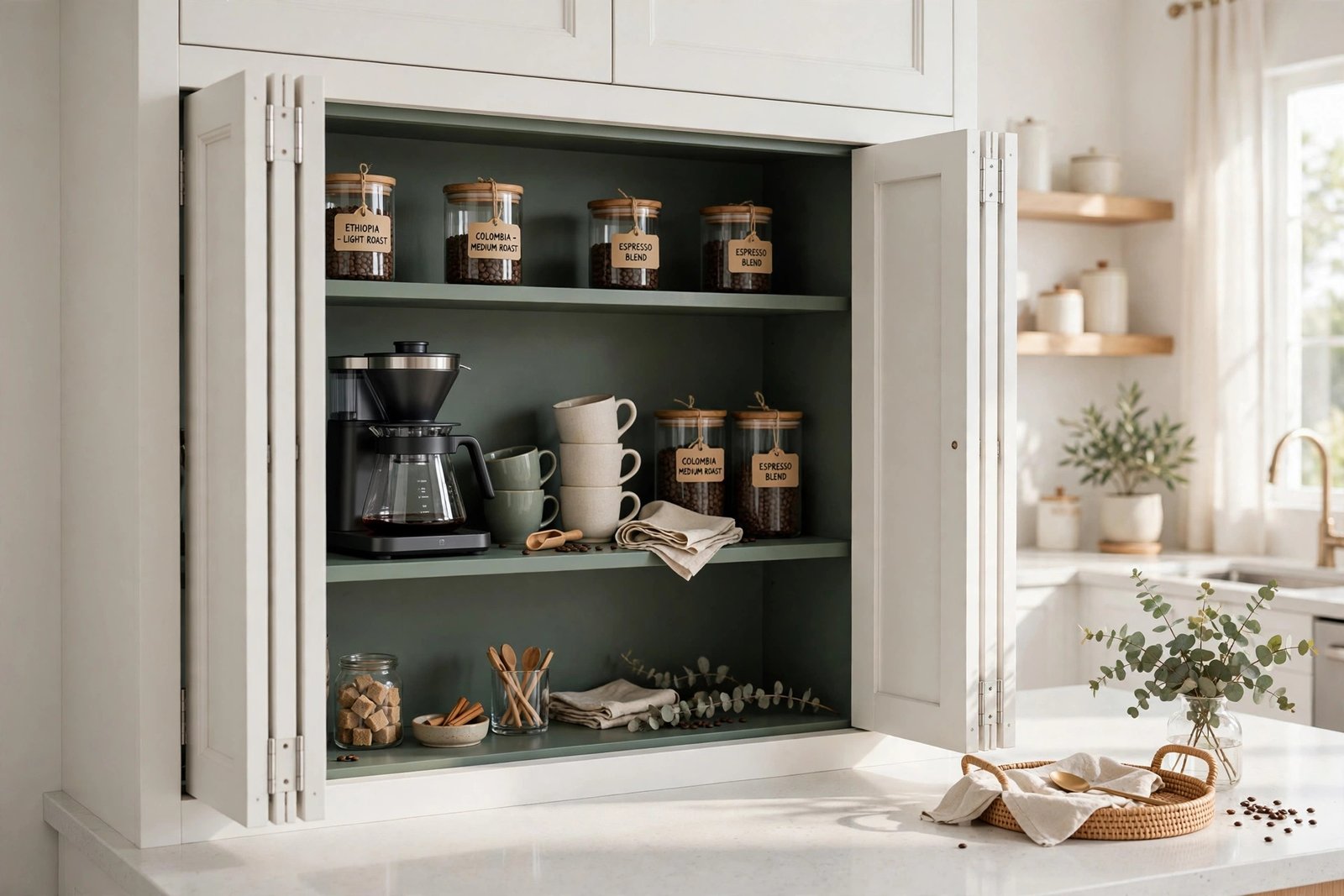
If pocket doors feel too ambitious, bifold cabinet doors are the friendly middle ground ($60–$180 for a retrofit pair). They fold flat against the cabinet sides, opening the full width of the bay so nothing feels cramped — perfect for wide two-door cabinets. I especially like these for espresso machines with tall milk pitchers, since the entire front is unobstructed. In my experience, painting the cabinet interior a shade darker than the exterior makes bifolds feel like a reveal moment rather than just open storage.
7. Coffee Pod Drawer Inserts for a Tidy Cabinet Bar
Pods, capsules, and filters turn into clutter fast — unless the base cabinet beneath your brewer holds a custom drawer insert. Tiered acrylic or bamboo inserts ($20–$55) organize 40+ pods in a single drawer while keeping them out of sight. Pair it with a small pull-out bin for used capsules and you’ve solved the two messiest parts of pod brewing. This is also the easiest idea on this list: it takes ten minutes and zero tools, which is why it’s the one I’d start with.

8. Glass-Front Uppers Styled as a Mug Display
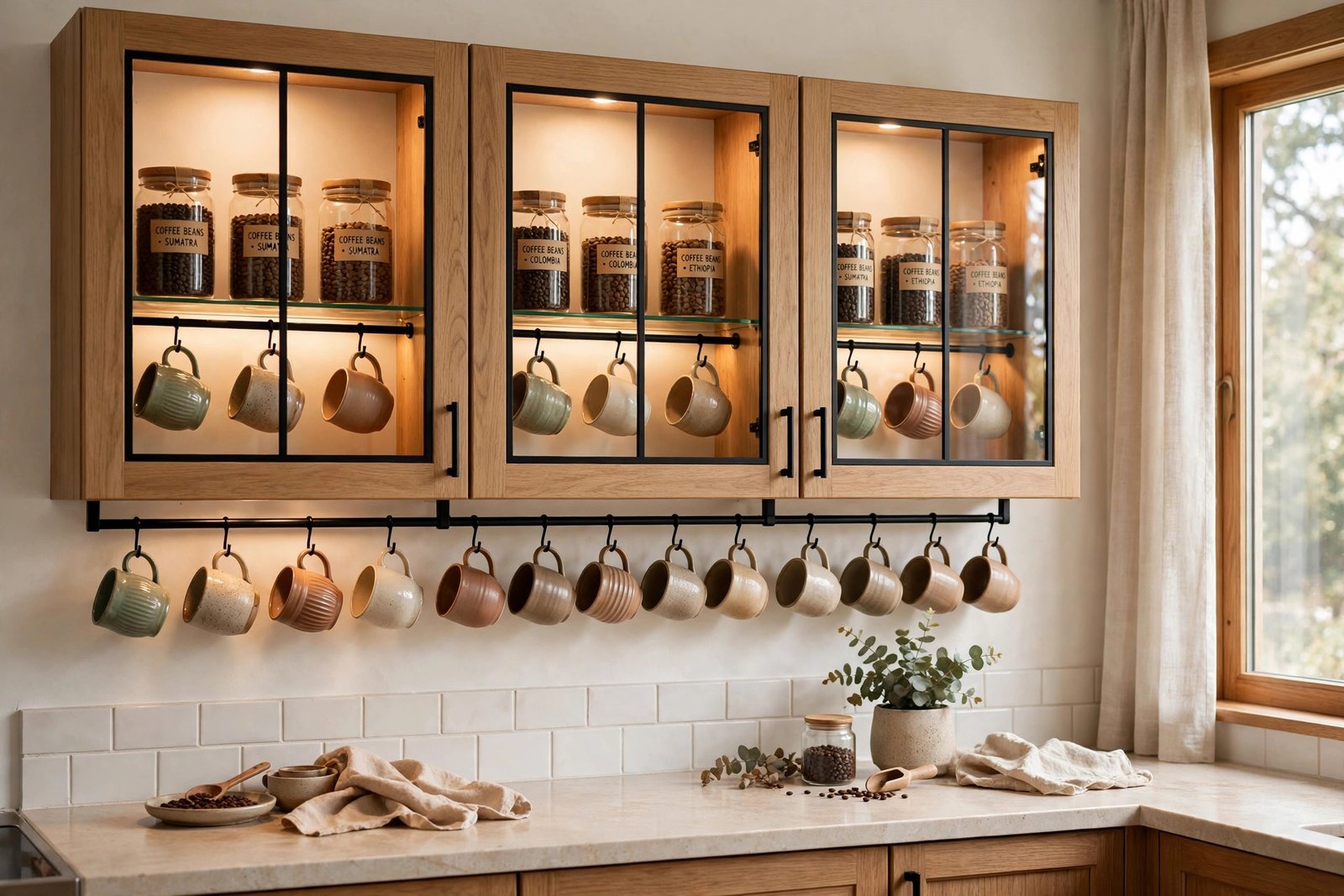
Swap the solid fronts on your coffee cabinet’s upper doors for glass ($80–$250 for retrofit panels or new doors) and suddenly your mug collection becomes the décor. Style it like a café shelf: mugs hung on under-shelf hooks, beans in matching glass jars, one trailing plant for life. This is the best option if you actually want the coffee bar seen — the glass turns storage into a feature wall. Who should skip it: anyone whose mug collection is chaotic — glass fronts demand a color-coordinated collection to look good.
9. The Pantry Cabinet Turned Coffee Station
Tall pantry cabinets are usually 24 inches deep — ideal for a coffee station with real counter-style working room. Dedicate the middle shelf to the brewer (add a heat-resistant mat), keep beans and filters above, and let the deep lower shelves hold bulk supplies. The cost ($100–$300) is mostly lighting, a liner, and maybe a shelf swap. The genius here is ergonomics: everything sits at the height you’d naturally reach, so the daily routine feels effortless instead of cramped.
10. A Corner Cabinet Carousel for Coffee Supplies
Corner cabinets are the Bermuda Triangle of kitchens — deep, dark, and unreachable. A two-tier lazy susan carousel retrofit ($30–$80) turns that dead corner into the coffee supply hub: syrups, filters, spare beans, and backup filters all spin to you. Pair it with the brewer in the adjacent straight cabinet and the whole corner becomes functional. This is the unglamorous workhorse of the list, but ask anyone who installed one — it gets more daily use than almost any other upgrade here.
11. Under-Cabinet Hooks and Rails Inside the Doors
The inside of cabinet doors is free real estate. A short stainless rail with S-hooks ($10–$25) mounted inside the door holds mugs, measuring spoons, or a small frothing pitcher right where you work. No drilling into the cabinet box itself, so this is fully renter-friendly (our renter friendly kitchen ideas guide covers more no-drill wins). Keep the weight light — door hinges aren’t rated for heavy loads, so mugs yes, full canisters no.

12. The False-Front Drawer Pull-Out Bar
That fake drawer front under the kitchen sink? It tilts out — and with a $35–$90 conversion kit it becomes a pull-out bar for coffee accessories. Mount a slim tray for stir sticks, sugar packets, and pods right where you’d otherwise waste the space. It won’t hold the brewer itself, but it puts every accessory within arm’s reach of the main station. This is the secret-weapon idea: guests never suspect it exists, and it costs less than a nice bag of beans.

13. A Hutch-Style Cabinet Coffee Bar Beside the Counter
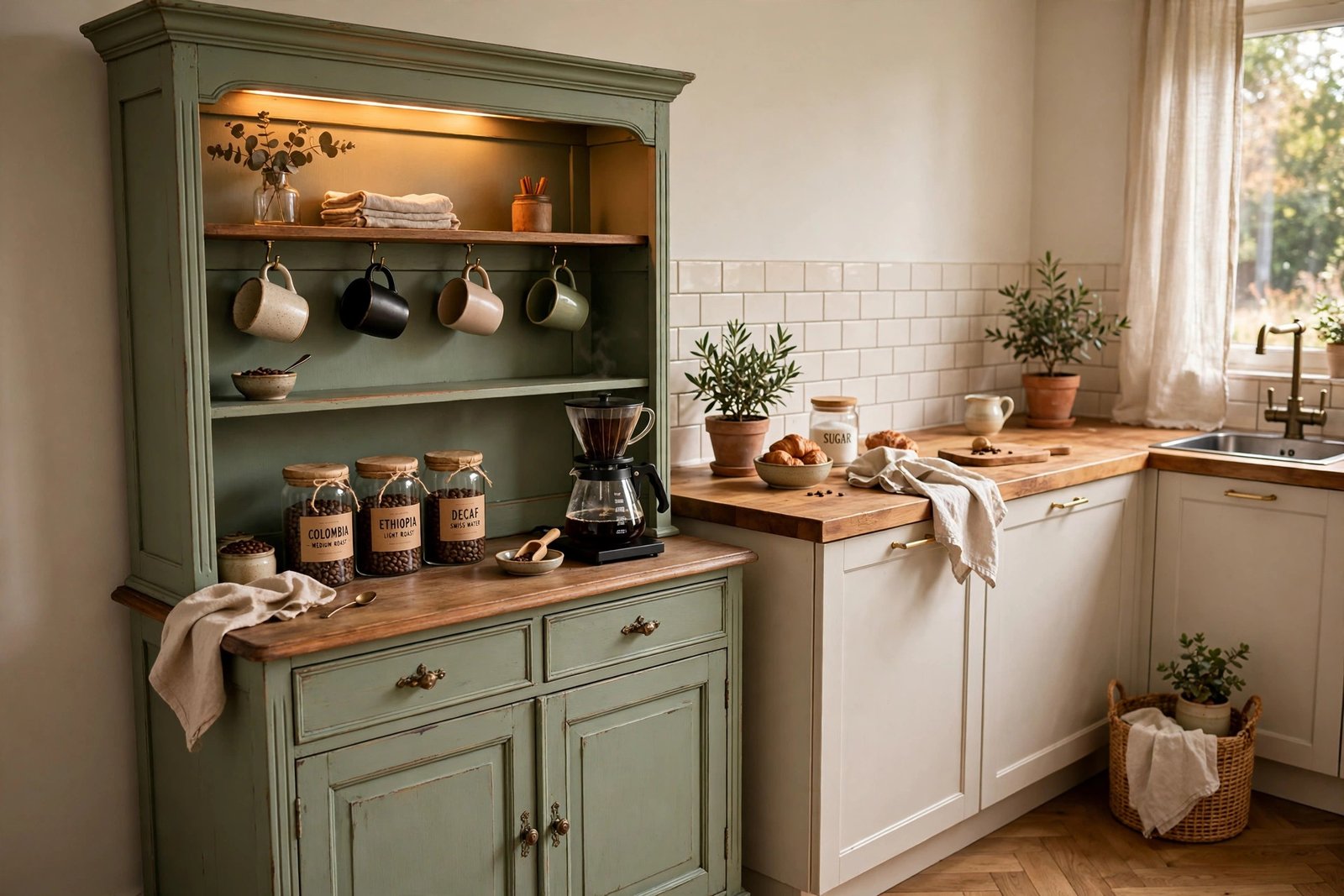
No spare kitchen cabinet? A thrifted hutch or china cabinet beside the counters becomes a freestanding coffee bar cabinet ($150–$600 depending on the find and paint). Remove the top-shelf glass doors for open mug display, wire battery LEDs under the crown, and you have a furniture-grade station with tons of storage. Thrifted hutches are ideal candidates for this — see our thrift store furniture makeover ideas for how to prep and paint one. The best part: it moves with you if you relocate.
14. Mini-Fridge Integration Inside a Base Cabinet
Cold brew fans and latte lovers, this one’s for you: a compact 1.7–3.2 cu ft mini fridge ($400–$900 including ventilation work) fits inside a 24-inch base cabinet, keeping milk and cold brew at arm’s length of the brewer. This needs planning — leave 2 inches of airflow clearance on all sides and never enclose the condenser coils in a sealed box. Done right, the coffee bar becomes fully self-contained: brew, chill, and serve from one cabinet bay. It’s the priciest idea here but the closest to a true appliance suite.
15. A Tambour Door Roll-Up Cabinet Bar
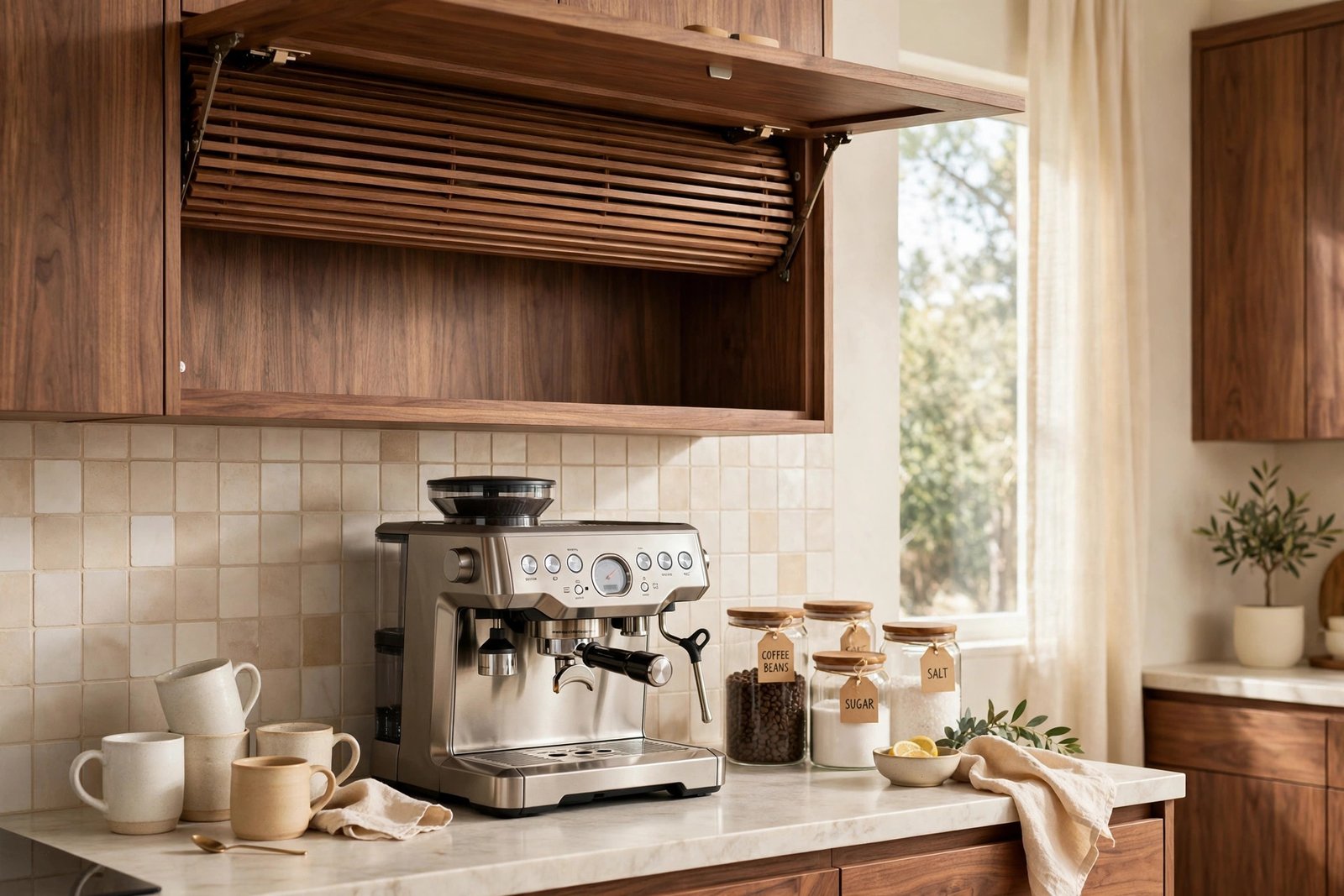
Tambour (roll-up) doors are the classic appliance-garage move for a reason: they disappear upward into the cabinet, take zero swing space, and look unmistakably custom. Retrofit tambour kits ($70–$200) fit standard 24-inch cabinets and install in an afternoon. Unlike pocket doors, there’s no side-clearance math — the door coils into the top of the cabinet. I love this for espresso machines because the wide, unobstructed opening means no more bumping the portafilter on a half-open door. Close it at night and the kitchen looks untouched.
4 Cabinet Coffee Bar Mistakes to Avoid
- Ignoring steam: espresso steam warps raw cabinet interiors. Line the brewer bay with a moisture-resistant liner or peel-and-stick wallpaper, and leave the doors open for 10 minutes after brewing.
- No outlet inside: running an extension cord through a cabinet door is a fire-adjacent habit. Have an electrician add an in-cabinet outlet, or place the cabinet within easy reach of one.
- Cheap slides under heavy brewers: a $12 friction slide will sag under a brewer with a full tank. Spend the extra $20 on ball-bearing, full-extension slides rated 75+ pounds.
- Measuring the brewer with the lid closed: water tanks fill from the top. Measure height with the lid fully open — this is the #1 reason cabinet conversions need redoing.
Budget Breakdown: What a Cabinet Coffee Bar Costs
| Approach | Budget | Effort | Best for |
|---|---|---|---|
| Organizer-only refresh (hooks, inserts, LEDs) | $40–$100 | 1 afternoon | Renters, quick wins |
| Pull-out shelf + lighting retrofit | $100–$200 | 1 weekend | Deep cabinets |
| Door conversion (bifold/tambour/pocket) | $150–$450 | 1–2 weekends | The built-in look |
| Full tower/pantry conversion | $250–$600 | 2–3 weekends | Dedicated coffee people |
| Fridge-integrated appliance suite | $400–$900 | Electrician + weekend | Cold-brew households |
Frequently Asked Questions
Can I put a coffee maker inside a closed kitchen cabinet?
Yes — with clearance and ventilation. Leave 2–3 inches around the brewer, brew with the doors open so heat and steam escape, and line the interior with a moisture-resistant liner. Give the cabinet 10 minutes of open-door airing after each espresso session to prevent warping.
How much does it cost to convert a cabinet into a coffee bar?
A basic conversion with organizers and battery LEDs costs $40–$100. Adding a pull-out brewer shelf plus a door conversion runs $150–$450. A full DIY tower with lighting and custom inserts typically lands between $250 and $600 — far below the $2,000+ a pro built-in costs.
Will coffee maker steam damage the inside of the cabinet?
It can over time if the interior is raw wood or MDF. The fix: a peel-and-stick moisture-resistant liner in the brewer bay, 2–3 inches of clearance, and brewing with doors open. Sealed or painted interiors handle steam far better than raw particleboard.
What is the best cabinet depth for a coffee bar?
Standard 24-inch-deep base cabinets are ideal — most brewers are 12–17 inches deep, leaving working room in front. Upper cabinets (12 inches deep) suit mug and bean storage but rarely fit a brewer. For shallow cabinets, pick a compact brewer under 12 inches deep.
The Built-In Look Is a Weekend Project
A cabinet coffee bar isn’t about having a bigger kitchen — it’s about making one cabinet work harder than the rest of them. Start with the cheapest wins (lighting, hooks, drawer inserts), then graduate to the pull-out shelf or door conversion that makes it feel custom. And if you’re still deciding on the style of your setup, our small coffee bar ideas guide covers carts, shelves, and corners beyond the cabinet world. For the full room, browse the Kitchen & Dining collection, and if you’re renting, start with our renter friendly kitchen ideas before you drill a single hole.


2 Comments