13 Thrifted Wall Art Ideas That Make Walls Look Collected (2026)
Thrifted wall art ideas are the fastest way I know to make blank walls look like they belong to someone interesting. A thrift store’s art aisle is chaos — $4 landscapes next to hotel prints next to genuinely good etchings — but with a plan for frames, mats, and layouts, that chaos turns into walls with real personality.
Here’s the thing most people get wrong: they shop for the art and ignore the frame, or they buy the frame and settle for sad art. The magic is in pairing them deliberately. These 13 ideas cover gallery walls, oversized pieces, mat upgrades, and the hanging rules that make it all look professional — walls only, no tabletop styling (that’s our thrifted home decor styling guide).
Key Takeaways
- Shop frames and art separately: great frames with replaceable prints are the best thrift deals.
- A $3 mat upgrade makes a $4 print look like a $60 custom-framed piece.
- The 58-inch rule: hang art so its center sits 58 inches from the floor (eye level).
- Above a sofa, art should span roughly two-thirds of the sofa’s width.
- Unified frame color (all black, all gold, all wood) makes mismatched thrifted art look cohesive.
- Leaning art on consoles and mantels is renter-friendly — zero holes required.
- Real price check: a full thrifted gallery wall costs $25–$60; the framed equivalent retail runs $300+.
The Ideas
1. The Eclectic Collector Gallery Wall
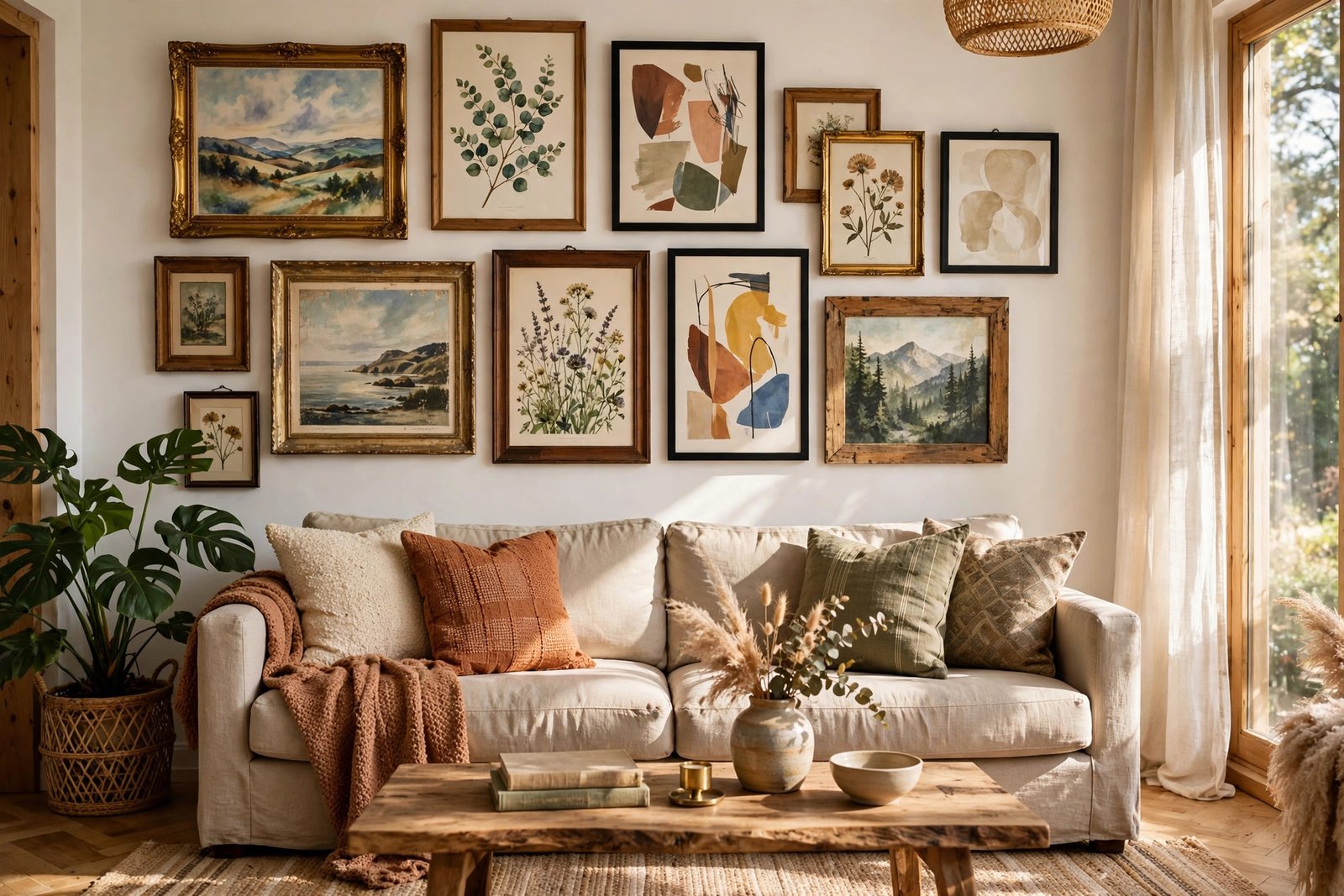
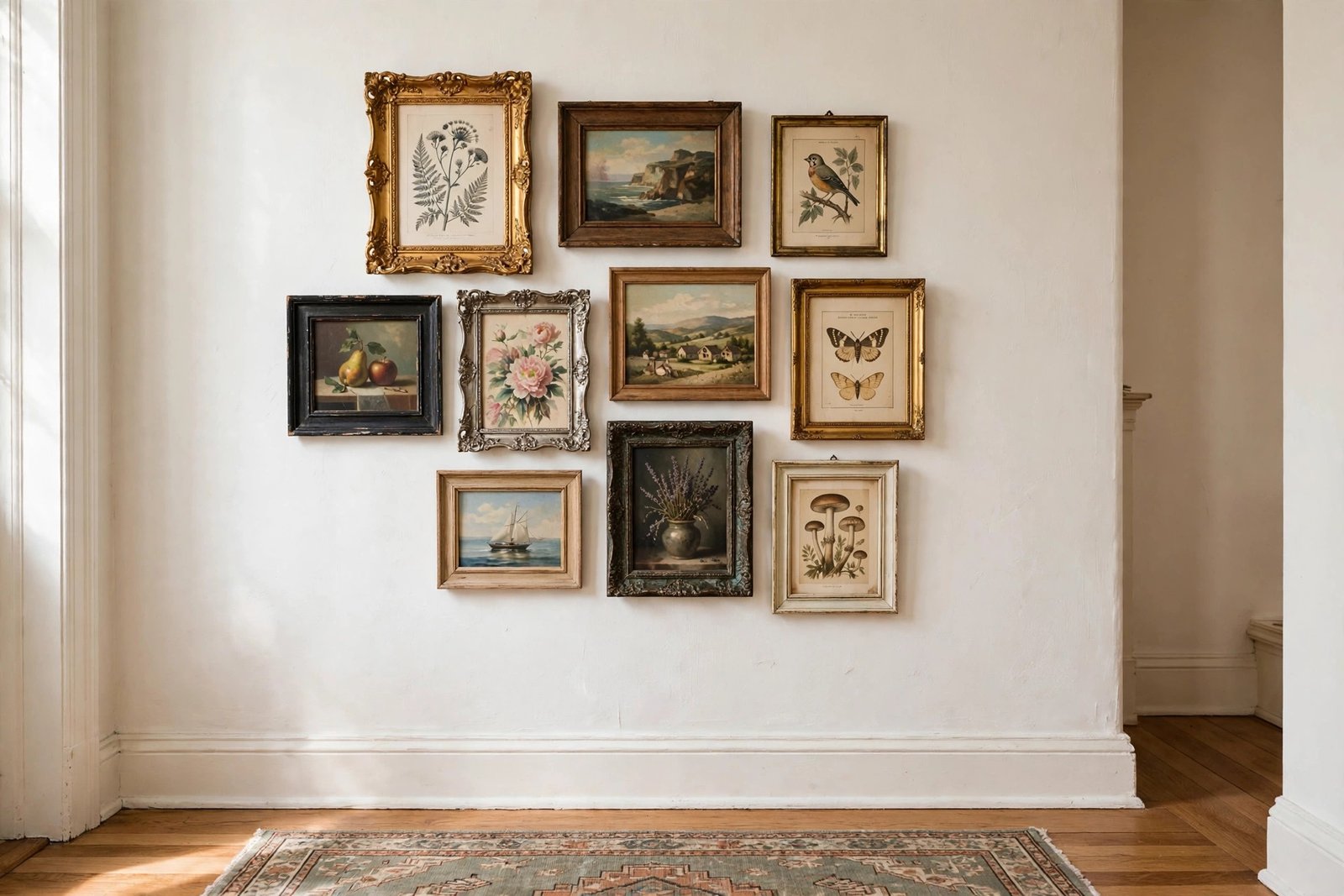
This is the signature thrifted-art move: 8–12 small pieces in mismatched frames, hung tight in a salon-style cluster. The secret is a through-line — all landscapes, all botanicals, or all black-and-white — so the variety of frames reads as charming, not random. Lay the arrangement on the floor first, photograph it, then transfer to the wall starting from the center piece outward. Tip: keep 2–3 inches between frames; tighter spacing reads as one installation, wider spacing reads as scattered.
2. Spray-Paint Mismatched Frames One Finish
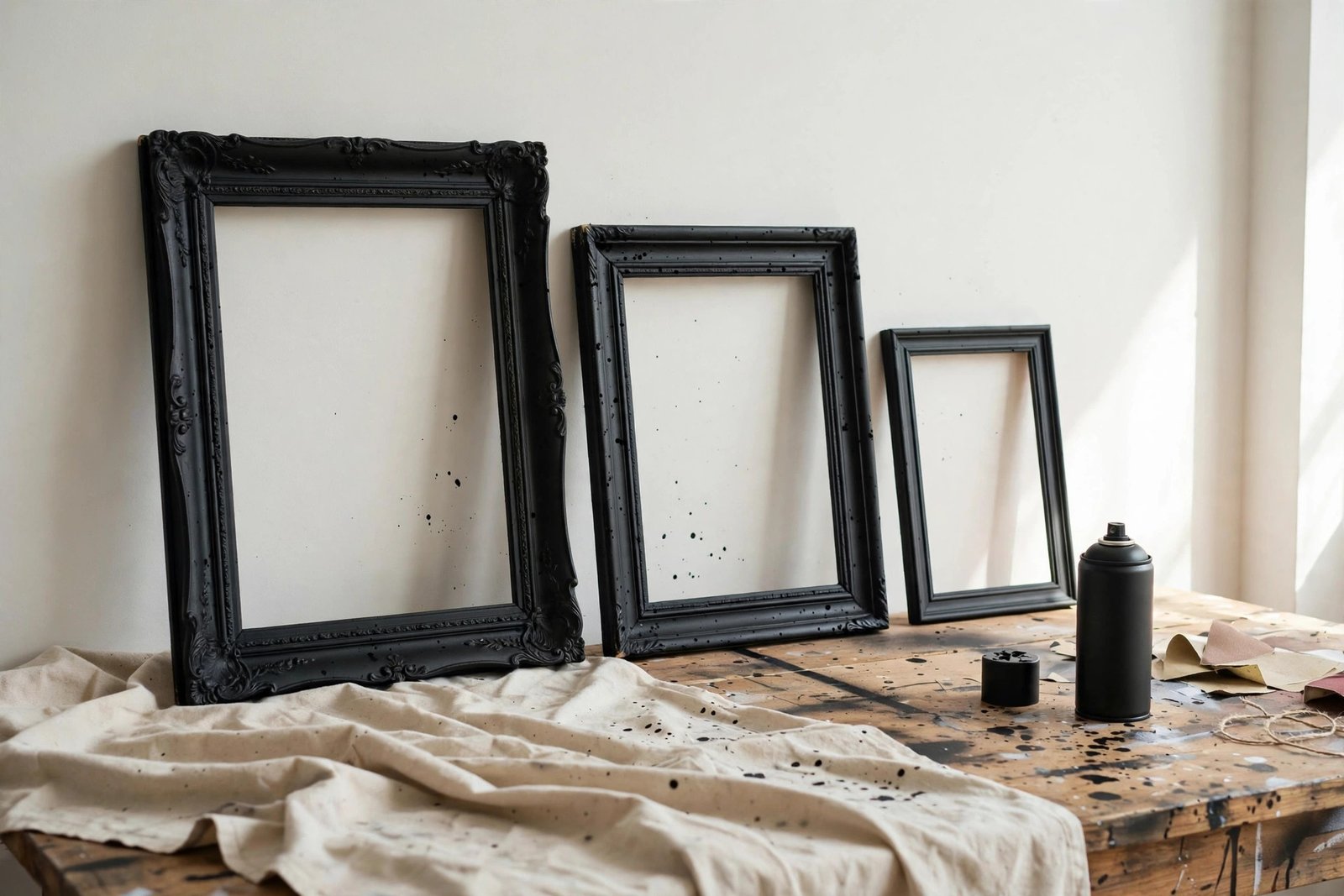
When the frames fight each other, unify them. A $6 can of spray paint (matte black, antique gold, or warm white) turns five clashing thrifted frames into a set in one afternoon. Remove the glass and art first, light coats, 10 minutes between them — two coats is plenty. Matte black is the safest choice: it makes every print inside look more expensive. In my experience, satin finishes hide frame flaws better than gloss, which shows every scratch the thrift store left behind.
3. Mat Upgrades: Cheap Print, Custom Look
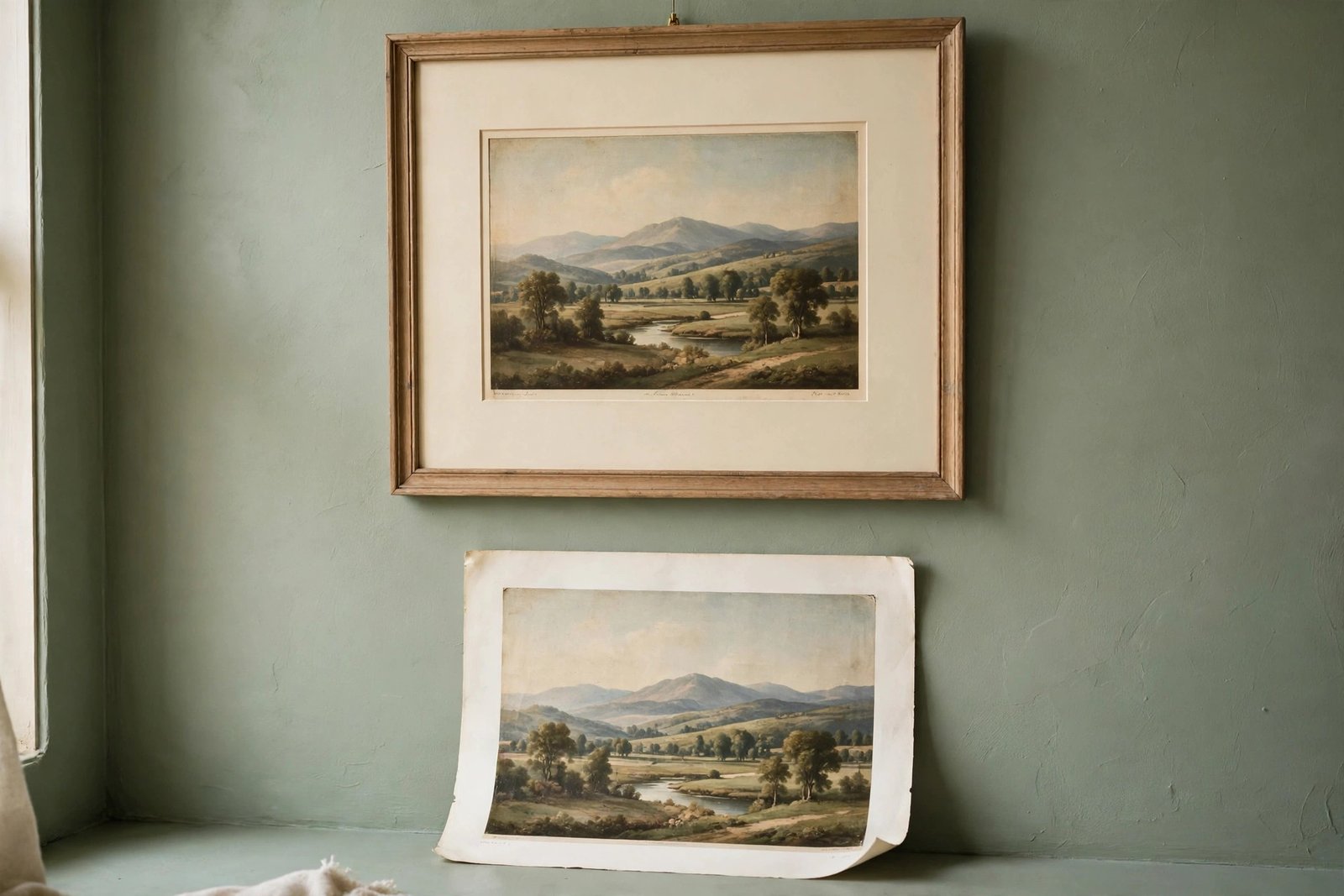
The mat is doing more work than the frame. A wide cream or white mat (buy pre-cut for $3–$5, or cut your own from mat board) adds instant gallery polish to any thrifted print. Rule of thumb: the mat should be at least 2 inches wide on each side — skinny mats look cheap, generous mats look custom. This is the single highest-ROI upgrade in thrifted wall art: a $4 flea-market landscape with a $4 mat in a $5 frame reads as a $75 framed piece. Always acid-free if the art matters to you.
4. Oversized Thrifted Canvas as Statement Art
Big canvases are thrift-store gold because nobody wants to transport them — which means $10–$20 for pieces that would cost $200+ new. One oversized piece above a sofa or fireplace does the work of an entire gallery wall. Don’t fear dated subject matter: a moody 1980s landscape in a good frame reads as vintage, not old. Check the canvas for tears and the frame for structural damage before buying; surface dust and dull varnish clean up, but a ripped corner doesn’t.
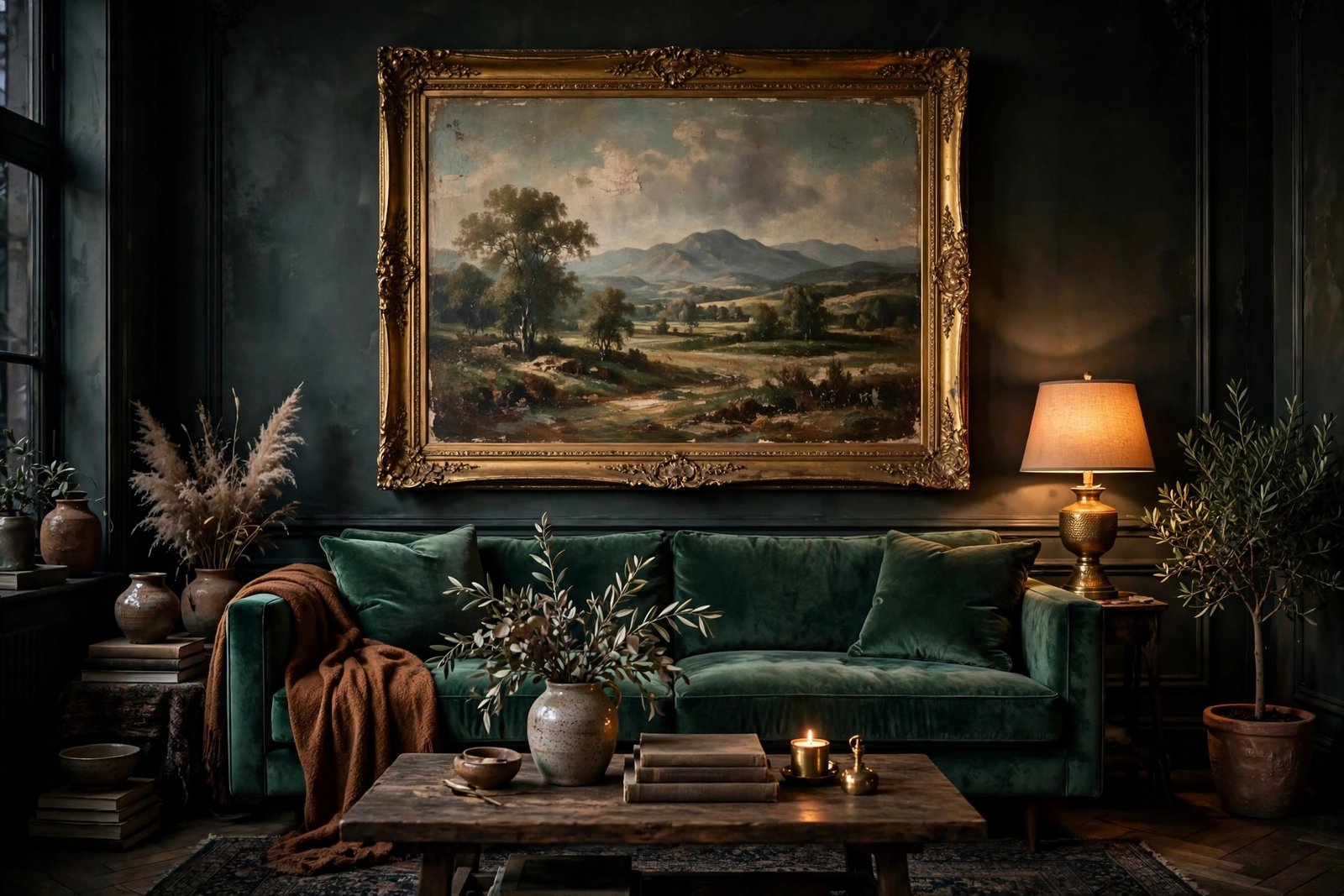
5. Lean Art on Consoles and Mantels
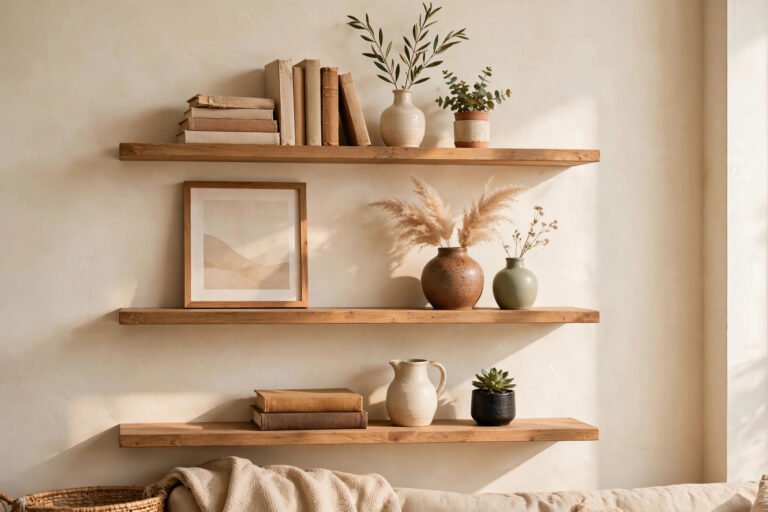
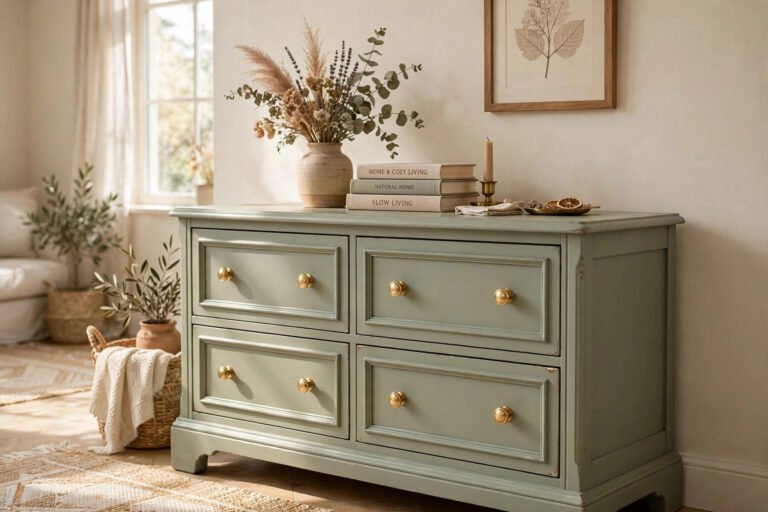
No drill, no holes, no commitment: leaning is the renter’s gallery wall. Layer 2–3 framed pieces at different heights on a console, dresser, or mantel — tallest in back, smallest in front, slightly overlapping. The casual overlap is what makes it look styled rather than unfinished. Tip: lean the largest piece about 6 inches from the wall so it casts a soft shadow; flat-against-the-wall leaning looks accidental. Swap pieces seasonally in seconds. For more damage-free decorating, see our renter-friendly living room ideas.

6. Vintage Landscapes in a Grid
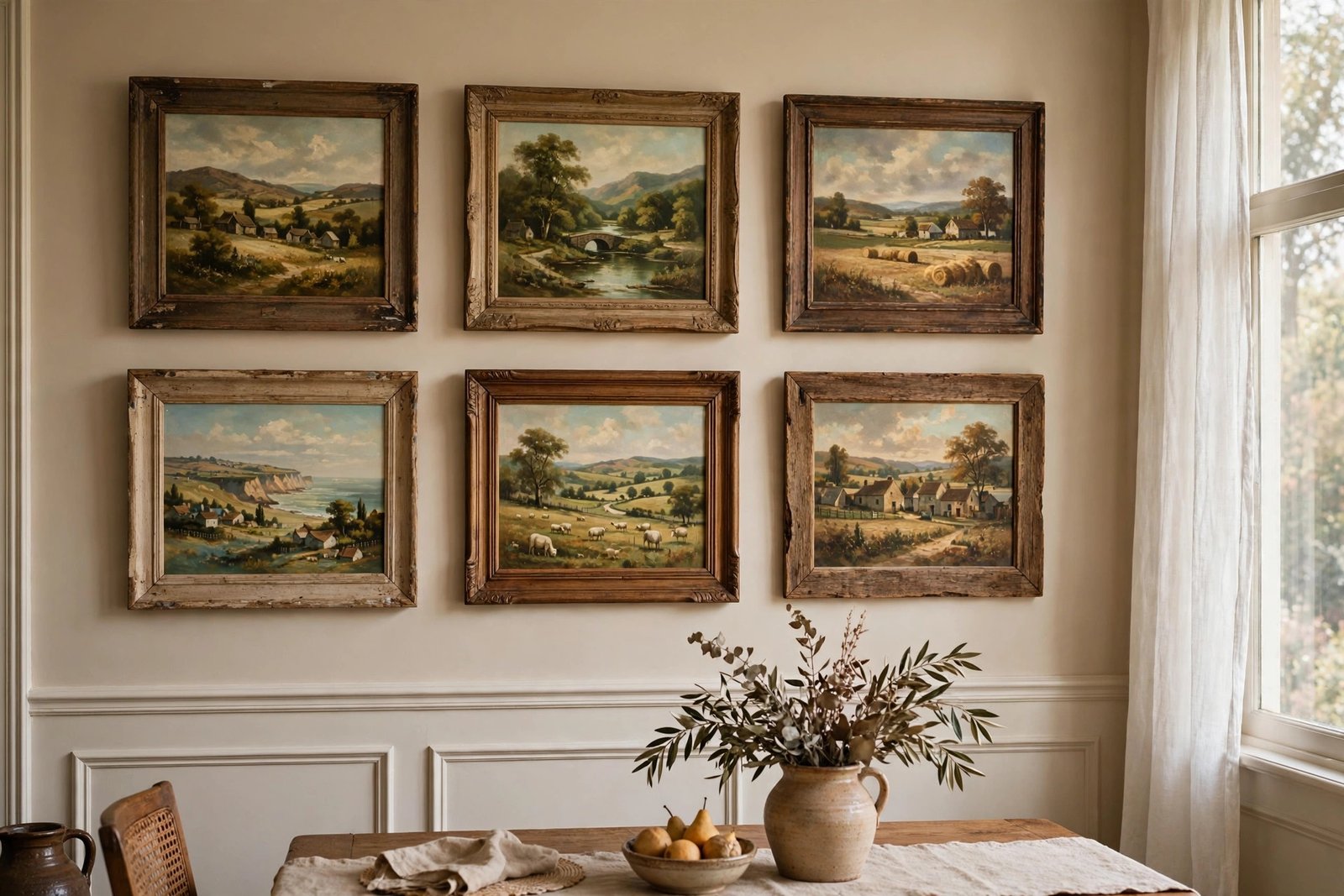
Thrift stores are overflowing with small landscape prints, and a grid turns the overflow into a feature. Collect 4, 6, or 9 pieces in similar sizes, frame them identically (this is where the spray-paint trick from idea 2 earns its keep), and hang in a precise grid with 2-inch spacing. The rigid geometry against loose, painterly landscapes is what makes it work — contrast between order and art. A 3×3 grid of $3 prints fills a dining room wall for under $40 total.
7. Botanical Print Groupings
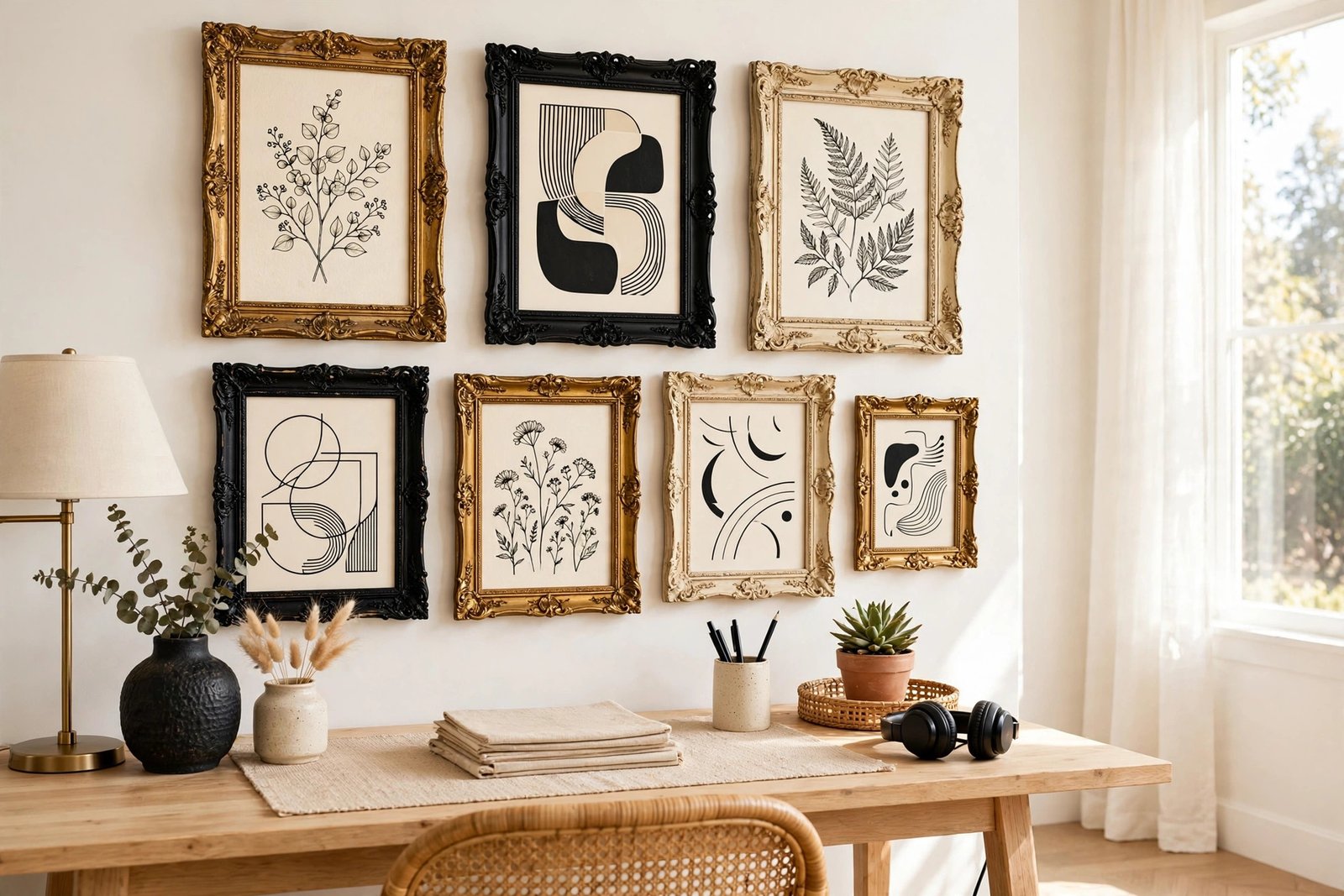
Botanical prints are the thrift store’s most reliable find — every decade produced them, so they’re always in stock at $2–$5 each. Hang a set of 6–9 in a grid above a bed or in a hallway, and they read as a deliberate collection. Mix real vintage botanicals with good reproductions freely; once framed and matted alike, nobody can tell. I’ve found that thin black or natural wood frames work best here — ornate gold fights the delicate linework. Keep the palette consistent: all green-and-cream, or all sepia.

8. Thrifted Frames + Free Printable Art
Here’s the budget cheat code: buy thrifted frames for the frames alone ($1–$4 each), discard the sad art inside, and fill them with free printable art. Museums and libraries offer thousands of public-domain prints — vintage botanicals, old maps, classic paintings — at print quality. A $2 ornate thrifted frame with a $3 library printout looks indistinguishable from a $50 boutique piece. Size your print to the mat opening, not the frame, and use the mat-upgrade trick from idea 3 for the full effect.
9. Plate Walls From Thrifted Dishes
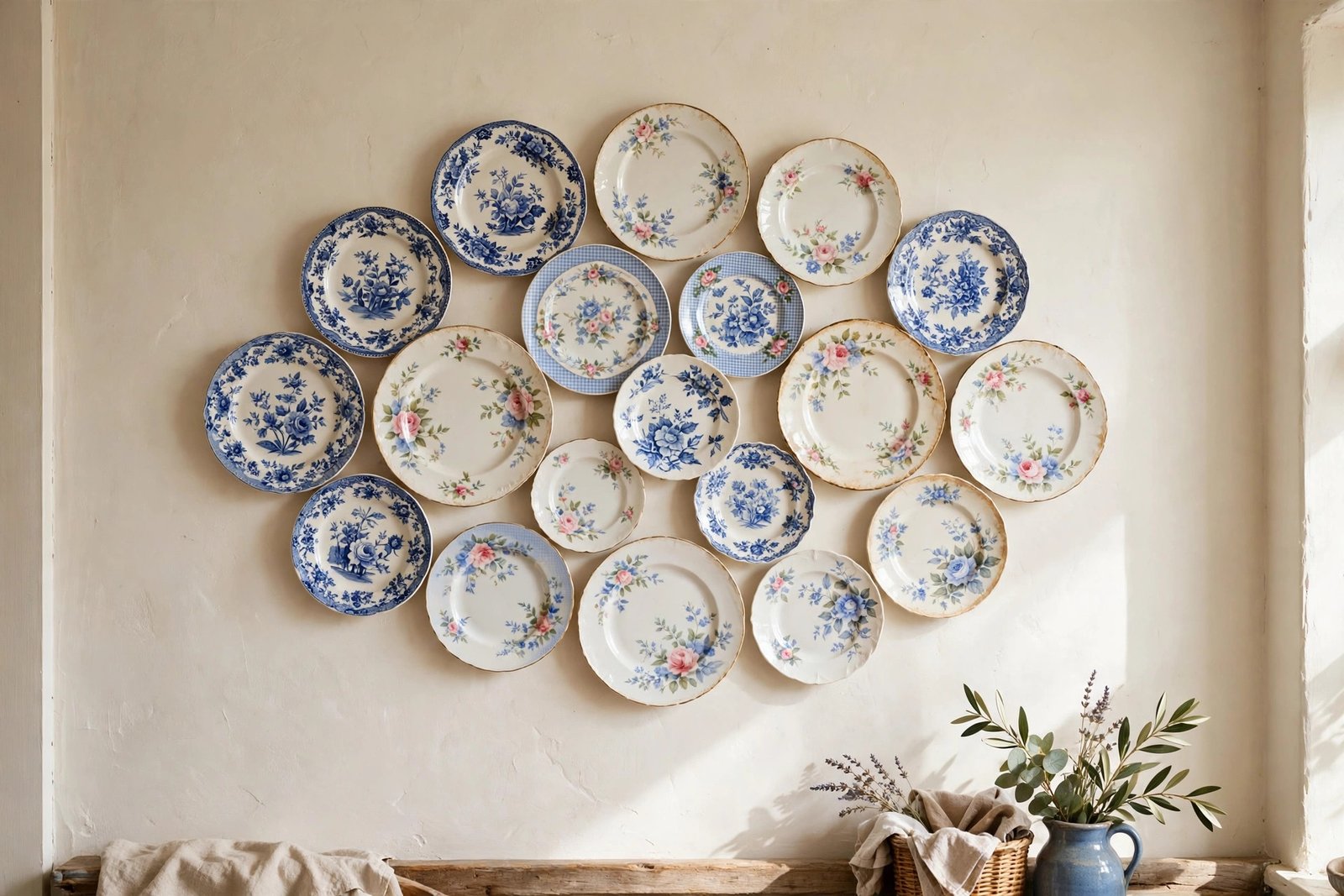
Decorative plates ($1–$3 each at thrift stores) make a wall that no one else has. Hang them with adhesive plate hangers ($1 each, no holes in the plates) in an oval or organic cluster — dining rooms and kitchens are the natural homes. Mix patterns freely but keep one color repeating through the set (blue-and-white is the classic for a reason). Tip: trace each plate on kraft paper, tape the templates to the wall first, and adjust the layout before a single nail goes in.
10. Framed Vintage Maps and Posters
Old maps, travel posters, and advertising prints are thrift-aisle staples with built-in color palettes. A framed vintage map does double duty: it’s art and a conversation piece, and the aged paper tones work with almost any decor style. Look for maps with strong color blocks (they read better from across the room) and posters without sun-fading. Frame simply — the art is busy enough. A $5 map in a $5 frame, hung in an entryway or office, looks like you travel more than you do.
11. Kids’ Art in Thrifted Frames
The most meaningful gallery wall costs almost nothing: your kids’ paintings and drawings in thrifted frames. A $2 frame and a $3 mat turn a kindergarten watercolor into legitimate art — and the kids notice. Hang a dedicated hallway or stairwell gallery and rotate pieces twice a year. Use identical simple frames for cohesion; the art provides all the variety you need. This is also the kindest possible use for all those ornate thrifted frames that are too fancy for grown-up art.
12. Framed Fabric and Scarves
Vintage scarves, embroidered textiles, and interesting fabric scraps ($2–$6 at thrift stores) frame beautifully and add texture no print can match. Stretch the fabric over a canvas or mat board, or float it between glass in a deep frame. A silk scarf with a bold pattern becomes abstract art; an embroidered piece becomes folk art. This works especially well in bedrooms, where soft textiles on the walls echo the bedding. Check fabric for stains by holding it to the light before buying.
13. The Asymmetrical Salon Hang
For the confident collector: a floor-to-ceiling salon wall that fills an entire wall with thrifted art, frames touching edge to edge in a deliberate jumble. Start with your largest piece slightly above center, then build outward, mixing sizes, frames, and subjects freely. The rule that keeps it from looking chaotic: consistent small gaps (1–2 inches) everywhere. Photograph thrift finds against your existing wall before buying — in my experience, the piece you love in the store is the one that clashes at home, and a phone photo prevents the mismatch.
Hanging-Height Cheat Sheet
| Situation | Rule |
|---|---|
| Single piece on a wall | Center at 58 inches from the floor |
| Above a sofa | Bottom of frame 6–8 inches above the sofa back; art spans ~2/3 of sofa width |
| Above a console/dresser | Bottom of frame 4–6 inches above the surface |
| Gallery wall | Treat the whole arrangement as one piece — its center at 58 inches |
| Hallway | Center at 58 inches; keep the line consistent down the hall |
| Stairwell | Follow the stair angle, keeping each frame’s center ~58 inches above its step |
Thrifted Wall Art: What You’ll Actually Pay
| Piece | Thrift price | Framed retail equivalent |
|---|---|---|
| Small framed print | $2–$5 | $25–$50 |
| Medium vintage painting | $5–$15 | $80–$200 |
| Oversized canvas | $10–$25 | $200–$500 |
| Ornate frame (art discarded) | $1–$4 | $30–$80 (frame alone) |
| Set of 4 botanical prints | $8–$20 | $60–$120 |
| Pre-cut mat upgrade | $3–$5 | $15–$30 (custom) |
Frequently Asked Questions
How much should I pay for thrifted wall art?
Small framed prints: $2–$5. Medium vintage paintings: $5–$15. Oversized canvases: $10–$25. Ornate frames bought for the frame alone: $1–$4. If a thrift store prices art near retail, walk away — the whole point is the discount. Always check the back for damage and make sure hanging hardware is intact before paying more than $10 for any single piece.
How do you hang a gallery wall without damaging the walls?
Use adhesive picture-hanging strips rated for the frame’s weight (they hold up to 16 lbs per set and remove cleanly), or lean art on furniture instead of hanging it. For plaster or brick walls, a single small nail in mortar is easier to patch than a failed adhesive strip. Photograph your layout on the floor first so you hang once, not three times.
What size art should go above a sofa?
Aim for art (or a gallery arrangement) spanning about two-thirds of the sofa’s width — for a 84-inch sofa, that’s roughly 56 inches of art. Hang it so the bottom of the frame sits 6–8 inches above the sofa back. One oversized piece beats three small ones here; small art floating above a big sofa is the most common scale mistake in living rooms.
How do you know if thrifted art is worth buying?
Buy for the frame, the mat potential, or genuine age — in that order. Check: is the frame solid wood (heavy = good)? Is the art on real canvas or quality paper, not a thin poster print? Is damage limited to dust and dullness (fixable) rather than tears and water stains (not fixable)? If it passes two of three, it’s worth the $5.
The Collected Finish
Great walls aren’t bought, they’re assembled — one $4 frame, one $3 mat, one lucky canvas at a time. Start with the spray-paint-and-mat combo on a single piece this week and you’ll see how fast a wall comes together. When the walls are done, style what’s beneath them with our thrifted home decor styling guide, and for the furniture underneath it all, our thrift store furniture makeover ideas have you covered.