14 Stunning Pool Coping & Tile Ideas for a Luxe Look
There is a moment — and if you have stood beside a beautifully finished pool, you know exactly the one — where you stop mid-step, coffee going cold in your hand, and just stare. Not at the water necessarily, but at the edge of it. The place where the pool ends and the world begins. That slim, architectural seam of coping and tile that somehow transforms a hole full of water into something that looks like it belongs on the cover of a design magazine. That moment is not accidental. Someone thought very hard about pool coping and tile ideas, and it absolutely shows.
If you are currently staring at your own pool — or planning one — and feeling that particular brand of overwhelm that comes with too many options and not enough direction, consider this your exhale. This article is a deep dive (yes, the pun was entirely intentional) into fourteen of the most beautiful, inspiring, and genuinely achievable pool coping and tile ideas that will make your outdoor space look like a high-end resort without requiring you to sell a kidney. We are talking real materials, real aesthetics, and real reasons why certain choices work better than others.
Let us get into it.
1. Travertine Coping: The Classic That Never Stops Being Gorgeous

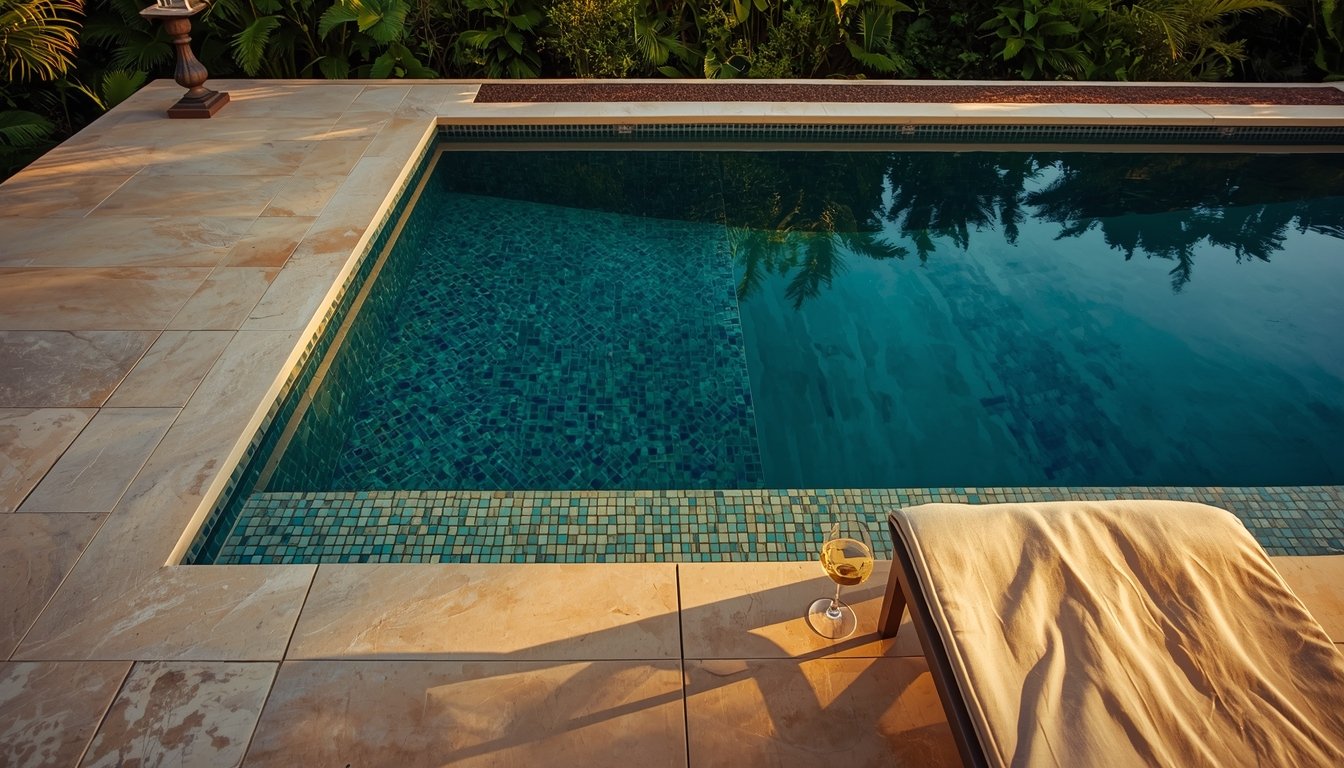
Travertine has been the gold standard of pool coping for decades, and it earns that title every single summer. This natural limestone material has a warmth to it — a soft, creamy palette of ivory, walnut, and gold tones — that makes even a modest backyard feel like a Tuscan retreat. The texture is part of the magic. Tumbled travertine, which has softened, rounded edges from a literal tumbling process, does not just look beautiful — it feels forgiving underfoot, which matters enormously when wet feet are the daily reality.
What truly sets travertine apart from the competition is its thermal performance. Unlike darker stones or certain concrete finishes, travertine stays cooler even under direct sun, a quality that your barefoot summer self will be deeply grateful for. It is not impervious to wear — travertine is porous and benefits from sealing — but properly maintained, it ages gracefully and even beautifully, developing a patina that looks intentional rather than tired.
For tile pairing, lean into travertine’s natural palette. A small mosaic tile in soft aqua or seafoam along the waterline complements the stone’s warmth without competing with it. If you want something more dramatic, a dark charcoal or deep navy waterline tile against ivory coping creates a contrast that feels both modern and timeless. Either way, travertine gives you a foundation that is extraordinarily hard to get wrong.
2. Cantilevered Concrete Coping: The Architect’s Favorite

If you have looked at any luxury pool built in the last fifteen years and thought, “that looks impossibly clean,” there is a strong chance cantilevered concrete coping was involved. This style extends beyond the pool shell in a smooth, unbroken overhang — no exposed edge, no interruption, just a continuous sweep of material that makes the pool look as though it was poured from a single thought. It is the architectural equivalent of a perfectly tailored suit.
The beauty of cantilevered coping is its versatility within minimalism. You can color it with integral pigments, acid-wash it for texture, or polish it to a near-mirror finish depending on the aesthetic you are chasing. It works magnificently with contemporary architecture, particularly homes that lean into clean lines, large glass panels, and open indoor-outdoor living. Paired with a large-format tile in a charcoal or soft grey on the pool floor, it creates a cohesive visual language that feels curated rather than assembled.
It is worth noting that cantilevered concrete requires skilled installation and proper engineering — this is not a DIY weekend project. But the investment in craftsmanship pays dividends every time someone walks through your backyard gate and audibly catches their breath.
3. Natural Bluestone Coping for That Moody, Elevated Look
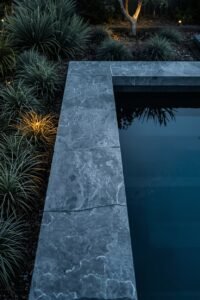
Bluestone occupies a unique emotional register in the world of pool coping and tile ideas — it is simultaneously rugged and refined, the kind of material that references old European estates while feeling completely at home beside a contemporary pool. Its blue-grey tonality deepens dramatically when wet, creating a color shift that makes the pool look like it exists in two different moods throughout the day.
Natural cleft bluestone (meaning it has been split along its natural grain rather than sawn) has a texture that provides excellent grip underfoot, which addresses one of the practical realities of pool living. Thermal comfort is where bluestone is slightly less forgiving than travertine — darker stones absorb more heat — so if your pool is in full sun and you tend toward bare feet, consider a lighter finish or plan for strategic shading.
For tile pairings, bluestone invites drama. A deep midnight blue or black mosaic tile at the waterline doubles down on the moody palette in the best possible way. Alternatively, a contrast in matte white subway tile can feel surprisingly fresh against bluestone, particularly in pools with a more eclectic design sensibility. The stone is strong enough stylistically to handle both minimalism and maximalism with equal confidence.
4. Brick Coping: A Nostalgic Choice With Modern Potential

Brick coping tends to get overlooked in the current era of polished concrete and imported natural stone, which is a shame, because when it is done well, it has a warmth and character that no other material quite replicates. There is something genuinely charming about a brick-coped pool — it speaks of summers past, of lemonade and lawn games and the particular ease of a backyard that was built to be lived in rather than photographed.
But brick is not just nostalgia in material form. Modern brick coping, particularly when set in a clean soldier or running bond pattern with tight, uniform mortar joints, reads as intentionally vintage in a way that is entirely contemporary. Think English garden party meets Palm Springs mid-century revival. The key is in the installation: sloppy mortar work or uneven cuts will tip the aesthetic from charming into tired, so skilled craftsmanship matters here as much as anywhere.
Tile choices with brick coping tend to work best when they either embrace the warmth — terracotta hexagons, warm amber glass tiles, earthy mosaics — or intentionally contrast with it through cool blues or crisp whites that let the brick be the star. Either direction, when committed to fully, looks genuinely extraordinary.
5. Large-Format Porcelain Tile Coping: Modern Luxury on a Real Budget
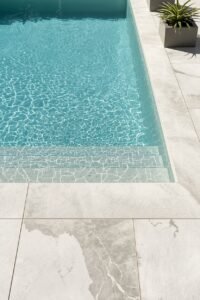
Here is where the budget-conscious luxe seeker gets to feel very clever, because large-format porcelain tile coping is one of the most impactful pool design decisions you can make for a price point that does not require a second mortgage. Modern porcelain manufacturing has reached a level of sophistication where tiles that mimic marble, limestone, travertine, and even wood are virtually indistinguishable from the real thing in photographs — and frankly, in person unless you crouch down and examine them.
The practical advantages of porcelain over natural stone are significant. It is non-porous, requiring no sealing. It resists staining, fading, and freeze-thaw cycles. Maintenance is minimal: a hose and mild cleaner keep it looking like the day it was installed. For households with children, pets, or frankly anyone who lives life enthusiastically around their pool, that durability is not a minor footnote — it is a genuine quality-of-life factor.
Large-format tiles, typically 24×24 inches or larger, also have the visual effect of expanding a space. Fewer grout lines mean the eye travels further without interruption, making even a modest pool look expansive and intentional. Pair with matching waterline tiles in the same family for a seamless, designer-approved finish.
6. Pebble and Aggregate Waterline Tile: Texture as the Hero
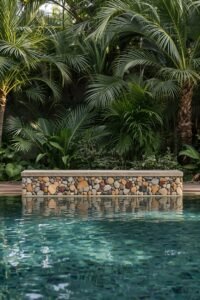
Waterline tile does not always need to be the quiet supporting character. In this particular pool coping and tile idea, texture is unapologetically the lead role, and it plays it beautifully. Pebble and aggregate tiles at the waterline bring an organic, naturalistic quality to a pool that no glazed ceramic or glass tile can replicate — it looks as though the pool grew there, rather than was installed there.
The appeal is strongest in pools that lean into the natural environment: those surrounded by mature trees, native plantings, boulder arrangements, or tropical landscaping. The material continuity between a pebble waterline tile and a stone-heavy garden creates a cohesion that feels less like design and more like geology. Which, if you have ever stood beside a natural swimming hole and felt that specific, deep calm, is exactly the feeling you are trying to bottle.
From a practical standpoint, pebble tiles require slightly more attention to cleaning — the texture catches debris more readily than smooth surfaces — but sealed properly and maintained with a good pool brush, they hold up remarkably well. Their non-slip texture is also a meaningful safety advantage, particularly in pools used heavily by children.
7. Glass Tile Waterline: The Jewel of the Pool World

If you have ever been to a high-end hotel pool and noticed how the waterline seemed to glow with an almost supernatural light, glass tile was almost certainly involved. Glass mosaic tile at the waterline is the pool design equivalent of jewelry — it is not structural, not essential, but entirely transformative, turning a lovely pool into something genuinely breathtaking.
The optical magic comes from how glass handles light. Unlike ceramic or stone, glass does not absorb light — it refracts it, bends it, multiplies it. On a sunny day, a glass tile waterline will scatter shifting patterns of color and light across the water surface and the walls of the pool. In the evening, with underwater lighting engaged, it becomes something almost theatrical. There is a reason this choice appears in virtually every luxury pool design portfolio: it performs.
Cost is the honest caveat here. Quality glass mosaic tile runs significantly higher than ceramic equivalents, and installation requires skill because glass is less forgiving of uneven substrate than denser materials. But if the budget allows for one splurge in a pool remodel or new build, this is the one that consistently earns the most compliments.
8. Terracotta and Saltillo Tile: Mediterranean Soul at the Poolside

There is a generosity to terracotta and Saltillo tile that other materials simply do not possess. These handmade, clay-based tiles carry the warmth of their origins in Mexico and Southern Europe — each one subtly different, irregularly beautiful, impossibly inviting. Used as pool coping or as the surrounding deck material, they give a pool a soul that manufactured tiles can approximate but never quite capture.
The aesthetic is distinctly Mediterranean and Southwestern, which makes it an exceptionally strong choice for certain architectural contexts. A Spanish colonial home, a Moroccan-inspired courtyard, a Southwestern adobe — these settings do not just tolerate terracotta, they require it. In those environments, swapping Saltillo for polished porcelain would feel like correcting a poem for grammatical errors: technically perhaps justified, but missing every point.
The practical trade-offs are real: terracotta is porous, requires sealing, and shows wear more visibly than engineered materials. But for homeowners who find beauty in patina, who want a pool that looks more like it was inherited than installed, those imperfections are features rather than flaws. Pair with simple white or cobalt blue waterline tile for a classic that never ages.
9. Limestone Coping: Quiet Elegance for the Long Game
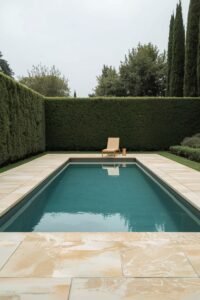
If travertine is the warm, social extrovert of natural stone coping, limestone is its quieter, more considered sibling. Honed limestone coping has a restraint to it — a soft, matte surface that does not demand attention but rewards it. In the right setting, particularly formal garden pools, lap pools, and estates with European architectural influences, limestone does not just work; it perfects.
What limestone brings that synthetic alternatives genuinely struggle to match is a sense of weight and permanence. It looks as though it has been there for a very long time and intends to remain so. That quality — which designers sometimes call “gravitas” — is difficult to manufacture and impossible to fake convincingly. When budget allows for natural stone and the aesthetic leans toward quiet sophistication, limestone is consistently the right answer.
Maintenance considerations are similar to travertine: sealing is recommended, particularly in climates with significant freeze-thaw cycles, and acidic pool chemicals should be managed carefully as they can affect the stone surface over time. None of these are insurmountable; they simply require the attentiveness that any beautiful, natural material deserves.
10. Bold Geometric Mosaic Tile: For the Pool That Refuses to Be Boring
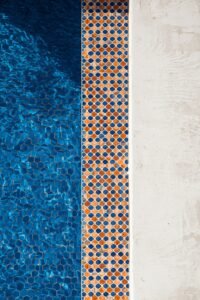
Not every pool wants to be serene. Some pools want to be an event, a statement, a declaration of the owner’s taste and personality delivered in ceramic and color. For those pools, bold geometric mosaic tile is the answer, and it is a spectacular one.
The range of options here is genuinely vast. Traditional Mediterranean patterns in cobalt and white bring an Andalusian vibrancy. Moroccan-inspired geometric repeats in jewel tones create a maximalist richness that is arresting in the best possible way. Mid-century modern sunburst or starburst patterns in muted pastels reference a specific, deeply beloved era of design. Art deco chevrons in gold and black are, frankly, ridiculous in their glamour. Whatever personality a homeowner brings to their overall design, there is a geometric mosaic language that speaks it.
The practical considerations are minimal: quality mosaic tile is durable, UV-stable, and relatively simple to maintain. The more significant investment is in the design decision itself — committing to a bold pattern requires confidence. But confidence in design, like most things, rewards those who hold it without apology.
11. Wood-Look Porcelain Deck and Coping Tile: The Warmth of Timber Without the Drama
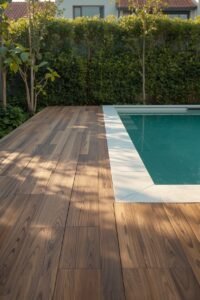
Real timber poolside decking is one of the most beautiful things you can do to an outdoor space. It is also one of the most demanding in terms of maintenance, most vulnerable to moisture damage, and most expensive to replace when it inevitably begins to deteriorate. Wood-look porcelain tile solves that equation with an elegance that feels almost unfair: all the visual warmth of timber, none of the existential maintenance anxiety.
Modern wood-look porcelain has become remarkably convincing. The technology involved in printing realistic grain patterns onto tile surfaces has advanced to the point where even informed guests will occasionally reach down to check whether they are touching real wood. The grout joint is usually the tell — but with careful color matching between tile and grout, even that can be minimized.
The style works particularly well in contemporary and Scandinavian-influenced designs where warmth is desired but the overall aesthetic leans clean and uncluttered. It also performs exceptionally in family pools where children are running constantly between house and water — the durability of porcelain versus real timber, in those conditions, is not a small consideration.
12. Infinity Pool Edge with Glass Tile Cascade: The Ultimate Showstopper

The infinity edge pool represents a particular peak of pool aspiration — the place where engineering ambition meets emotional impact and shakes hands very firmly. And when the infinity edge wall is finished in glass mosaic tile that catches and multiplies light from every angle, the result transcends “nice pool” and enters the territory of genuine architectural experience.
What makes this combination so effective is the layering of illusions: the visual disappearance of the pool’s edge into the landscape below, amplified by a tile finish that seems to shimmer and shift with the light, creates a surface that does not look entirely solid — it looks alive. In the right setting, particularly on a hillside with a view or beside a natural water feature, this kind of pool stops being a backyard amenity and becomes a destination.
The investment required for an infinity pool is significant at the construction level before tile is even considered, making it more aspirational for many budgets. But for those in the planning stages with the right site and the inclination toward something truly memorable, pairing the infinity form with glass mosaic tile is the combination that rewards every dollar spent in visual dividends for years.
13. Dark-Bottom Pool With Contrasting White Coping: Sophistication in Two Colors
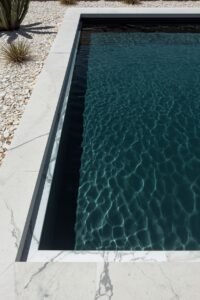
The dark-bottom pool has become one of the defining pool design choices of the last decade, and for excellent reasons. A deep charcoal, near-black, or rich midnight blue pool finish changes the color of the water entirely — rather than the aqua brightness of a white-plastered pool, you get something darker, more complex, more like a natural lagoon or a very deep lake. The effect is simultaneously dramatic and surprisingly calming.
The sophistication multiplies when you pair that dark water against crisp white or pale stone coping. The contrast is graphic and bold, the kind of visual statement that reads immediately and elegantly. It is a two-color palette that somehow manages to look both restrained and extraordinary, which is the hallmark of genuinely confident design.
From a practical standpoint, dark-bottom pools do absorb more solar heat, which can be a benefit in cooler climates and a neutral to mild consideration in warmer ones. The finish requires the same care as any plaster or aggregate pool surface. The drama, however, requires no maintenance whatsoever — it simply delivers, day after day.
14. Mixed Material Coping: Breaking the Rules With Intention
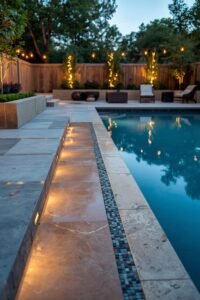
Design rules exist to give people a foundation — and then to be bent carefully by those who know exactly what they are doing. Mixed material coping is perhaps the most advanced pool coping and tile idea on this list, not because it is more expensive but because it demands the most design confidence. When it works, which in the hands of a skilled designer it absolutely does, it creates a pool environment that looks like it was built over decades, curated and evolved, rather than selected from a single catalogue page.
The key to successful mixed material coping is the hidden logic that ties the elements together. Perhaps all the materials share a common warm undertone. Perhaps the variation in texture is balanced by consistency in height and line. Perhaps a single material is used as the primary and the others serve as deliberate accent moments. Whatever the organizing principle is, it needs to exist — because the difference between “intentionally mixed” and “couldn’t decide” is legibility of vision.
For the adventurous homeowner willing to work closely with a designer or pool builder, mixed materials offer something no single-material approach can: a pool space that tells a story. And a pool that tells a story is, ultimately, a place where people want to linger.
A Final Thought Before You Dive In
The pool itself holds the water. The coping and tile hold everything else — the light, the mood, the sense of arrival, the particular pleasure of sitting at the edge of something beautiful and knowing it belongs to you. These are not small things to get right, which is exactly why they deserve the attention you are clearly already giving them. Whether your vision is the quiet elegance of honed limestone, the festive energy of bold geometric mosaic, or the silent drama of a dark-bottom pool against white coping, the right choice is not the most expensive one or the most popular one. It is the one that looks at your specific home, your specific landscape, your specific life, and says: yes, this is exactly where I belong. Trust that instinct. Then seal the travertine.