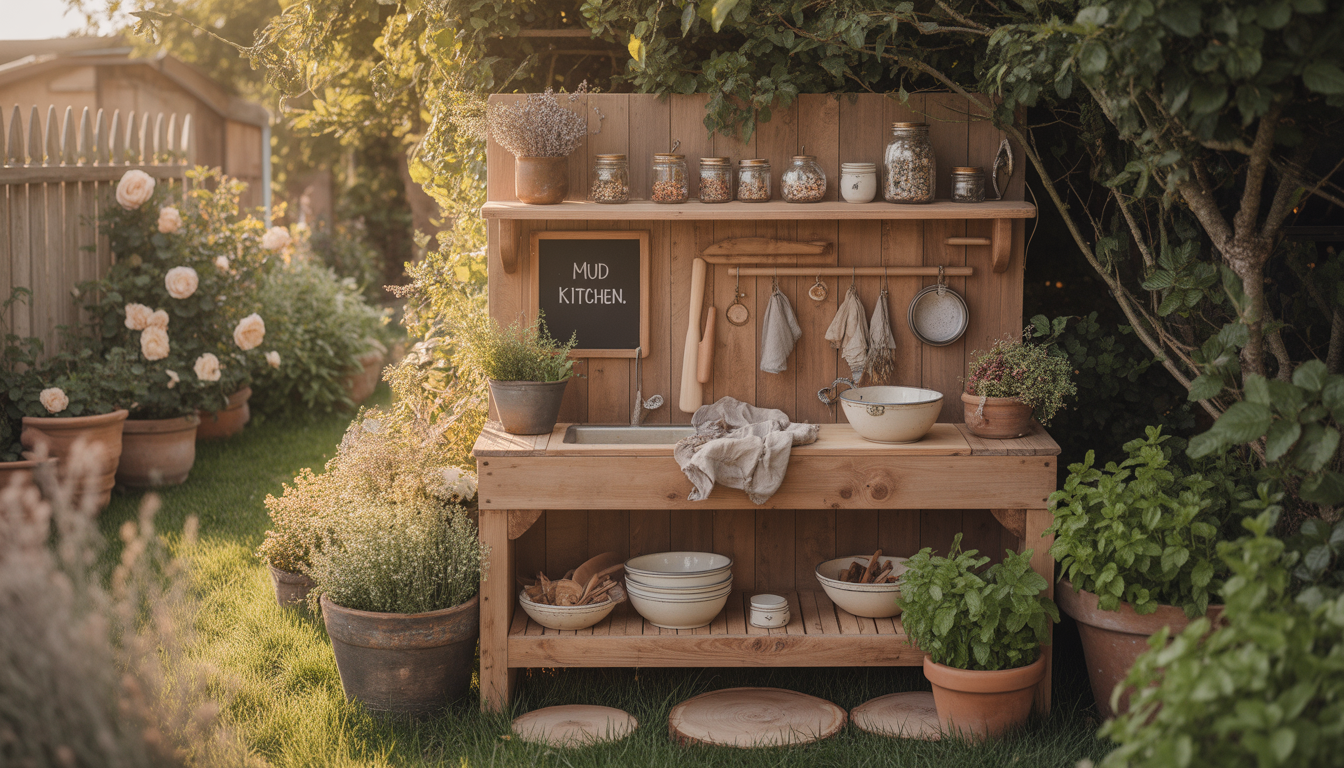
8 Mud Kitchen Ideas That Create an Ultimate Sensory Experience
There is a particular kind of magic that happens when a child digs their hands into a mound of cool, dark earth and begins to stir. No screen. No instructions. No rules. Just the ancient, instinctive joy of making something out of nothing — a mud pie, a soup, a “potion” that apparently cures everything wrong with the universe. If you have ever watched a child completely lose themselves in outdoor play, you already understand why mud kitchen ideas have taken the parenting world by storm. And if you are the kind of parent who is equal parts thrilled by the idea and mildly horrified by the laundry implications — welcome. You are in exactly the right place.
Mud kitchens are more than a backyard trend. They are a developmental goldmine. Sensory play builds neural connections, fosters creativity, reduces anxiety, and teaches children how to engage patiently and purposefully with the world around them. A well-designed mud kitchen takes all of that science and wraps it up in something that also happens to look genuinely beautiful in your backyard. That is not an accident. The best mud kitchen ideas are designed with intention — for the child who plays in them and for the parent who has to look at them every single day.
This guide walks you through eight inspired mud kitchen ideas, each one designed to elevate the sensory experience while staying grounded (pun absolutely intended) in practicality, creativity, and a healthy respect for your budget. Whether you are starting from scratch with reclaimed pallets or upgrading a setup that has seen better days, there is something here that will make your outdoor space feel like the most enchanting corner of childhood.
1. The Classic Pallet Mud Kitchen: Where It All Begins
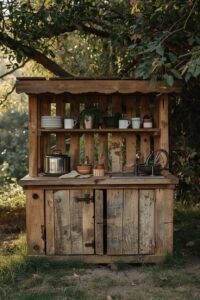
There is a reason the pallet mud kitchen remains the most searched and most-pinned mud kitchen idea on the internet. It is accessible, it is budget-friendly, and when it is done well, it looks like something straight out of a Scandinavian children’s storybook. Two or three wooden pallets, a few screws, a bit of sanding, and you have the skeleton of something genuinely wonderful. The charm lies in its imperfection — the grain of the wood, the slight unevenness of the shelves, the way it weathers beautifully over seasons.
What makes a pallet mud kitchen truly sing is the styling. Do not just nail the pallets together and call it done. Think about proportion: a lower work surface for small hands, a higher shelf for “ingredients” storage, and a hook or two on the side for hanging tools. Old enamelware from thrift stores adds an authentic farmhouse feel. A battered tin watering can repurposed as a utensil holder costs next to nothing and looks like it was styled by a professional. The details are everything.
The beauty of this starting point is that it grows with your child. Year one, they are making mud pies. Year three, they are running an elaborate outdoor restaurant with a chalk-written menu and a reservation policy. The pallet mud kitchen is not just a sensory play station — it is a stage for the entire arc of childhood imagination.
2. The Water-and-Mud Combo Station: Double the Sensory Magic
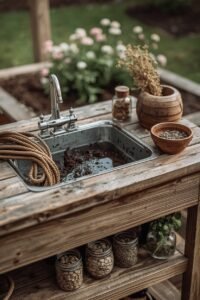
Water transforms mud play from a one-dimensional texture experience into a full multi-sensory event. The moment you introduce a water source — even something as simple as a plastic bin with a small pitcher beside it — the play deepens dramatically. Children begin to experiment with consistency, learning through pure tactile feedback what “too wet” and “too dry” feel like and how to find the balance. This is early science. This is early math. And it looks exactly like chaos.
The most effective water-and-mud combo stations incorporate a small sink basin directly into the kitchen structure. A deep metal bowl or an upcycled enamel basin set into a cut-out in the wooden countertop works beautifully. You can run a short length of garden hose from an outdoor tap nearby, or simply keep a large pitcher of water on the lower shelf that children can pour themselves — which, incidentally, is an excellent exercise in pouring control and spatial awareness.
The real secret to making this setup work without completely destroying your garden is drainage. A simple drilled hole in the bottom of your basin, directed onto a gravel patch or a small patch of designated mud earth, keeps the water flowing and the play sustainable. A mud kitchen that floods itself within ten minutes of play is nobody’s idea of a good afternoon.
3. Nature’s Pantry: Stocking the Shelves With the Real World

One of the most transformative things you can do for a mud kitchen — at zero additional cost — is to build what I like to call a nature pantry. This is simply a collection of natural materials gathered from your garden, your local park, or even a walk around the block, stored in small containers and displayed on the kitchen shelves like ingredients in a real kitchen. Dried flower petals. Crushed bark. Small pebbles. Sand. Feathers. Pine cones. Dried herbs from the garden. Seed pods. The variety does not need to be exotic — it needs to be tactilely interesting and visually appealing.
The sensory experience of a mud kitchen expands enormously when children have a range of materials to incorporate into their play. Smooth pebbles versus rough bark. The fragrant surprise of crushed lavender. The way dried petals dissolve differently than fresh ones. These are nuanced sensory discoveries that children make entirely on their own, without any prompting, simply because the materials are there and available. You have essentially created a scientific curiosity cabinet at ground level.
Practically speaking, small glass jars work beautifully for this purpose and can be found at any thrift store for next to nothing. Label them with simple hand-written tags — “seeds,” “petals,” “sand,” “stones” — and suddenly the mud kitchen has a vocabulary, a visual language that tells children this space is organized, this space is theirs, and this space takes their play seriously. Children respond to that message profoundly.
4. The Herb Garden Integration: Scent as a Sensory Superpower
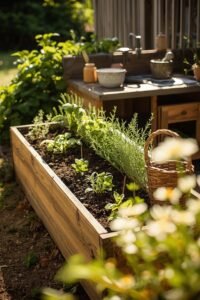
Scent is one of the most powerful and most overlooked components of sensory play. While mud kitchens typically engage touch and sight brilliantly, smell often gets left out of the equation entirely. Integrating a small herb garden directly into or beside your mud kitchen setup changes everything. When a child crushes a sprig of mint between their fingers while stirring their mud soup, the scent that rises up is not just pleasant — it is memorable in a way that reaches deep into the brain’s most ancient and emotionally resonant pathways.
You do not need a grand garden design to make this work. A single raised planter box attached to the side of your mud kitchen frame, or even a collection of terracotta pots placed on a low shelf, can hold a rotating selection of fragrant, child-safe herbs. Mint, lemon balm, lavender, chamomile, rosemary, and basil are all excellent choices — hardy, fast-growing, and wonderfully aromatic. The added bonus is that these are also edible, so there is no concern if an enthusiastic little chef decides to taste-test their creation.
Give children a small pair of safety scissors and a wicker basket and let them “harvest” their herbs as part of the cooking process. This simple act connects them to the idea that ingredients come from living, growing things — a lesson in ecology, in patience, and in the satisfying relationship between tending and reaping. It is the kind of quietly profound learning that only happens when you get out of the way and let the garden be the teacher.
5. The Upcycled Kitchen Appliance Station: Giving Old Things New Life
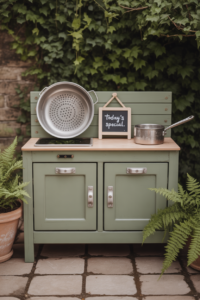
There is an argument to be made that the very best mud kitchen ideas do not involve a single trip to a specialty store. Instead, they begin with a walk through your local charity shop or a scroll through your neighborhood’s online marketplace. Old kitchen cabinets, retired baking equipment, dented pots and pans, mismatched colanders — these are the raw ingredients of a mud kitchen that has genuine character. More than that, they are the ingredients of a kitchen that teaches children something beautiful about resourcefulness.
An old kitchen cabinet — the kind with a small countertop and a lower cupboard — can be transformed into an extraordinary mud kitchen with nothing more than a coat of outdoor chalk paint in a color you love, a bit of sanding on the edges to create a distressed, vintage finish, and perhaps some new knobs sourced from a hardware store. The result looks intentional, artful, and genuinely lovely. The lower cupboard becomes a storage space for outdoor play materials. The countertop becomes the stage for hours of culinary creativity.
When it comes to tools and vessels, lean into the eclecticism. A mismatched collection of metal bowls, wooden spoons of varying sizes, a battered whisk, a tin funnel, a small ladle — the visual variety itself becomes part of the sensory experience. Children are drawn to objects that feel like the real thing, not plastic toy versions. Give them the real thing, safely retired from indoor use, and watch the quality of their play deepen noticeably.
6. The Mud Kitchen With a Chalkboard: Where Play Meets Literacy
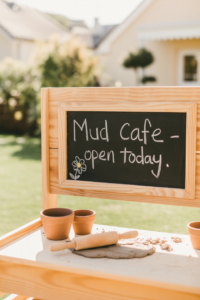
A chalkboard panel built into the back of a mud kitchen sounds like a small addition. It is, in practice, a complete transformation of the play experience. The moment children have a surface to write on — to name their kitchen, to write their menu, to record their recipes — the mud kitchen shifts from a sensory play station into a full-blown narrative environment. It becomes a cafe. A restaurant. A bakery. A potion laboratory with a very official-looking list of ingredients. The chalkboard is the hinge point where physical play and imaginative storytelling connect.
From a practical standpoint, installing a chalkboard panel is one of the easiest upgrades you can make to any mud kitchen. Chalkboard paint — available at any hardware store — can be applied directly to a section of the wooden back panel, to a piece of smooth plywood attached to the frame, or to a separate slate board hung from a hook. Keep a small wooden box of chalk nearby, along with a damp cloth for erasing, and the station is complete. The only maintenance required is occasionally restocking the chalk.
The literacy and pre-literacy benefits are well-documented and genuinely impressive. When children write in a context that feels meaningful to them — not a worksheet, not a practice drill, but an actual menu for an actual mud cafe — the motivation to form letters and words correctly comes entirely from within. They are not writing to please a teacher. They are writing because their restaurant needs a menu, and the menu needs to look right. That distinction matters more than most early literacy curricula acknowledge.
7. The Fairy-Tale Mud Kitchen: Because Magic Is Always the Right Aesthetic
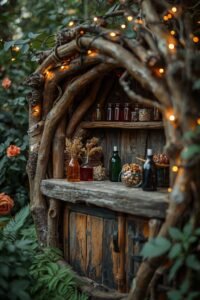
Not every mud kitchen needs to look like a farmhouse fixture. Some children — and if we are being honest, some parents — are drawn to something altogether more enchanted. The fairy-tale mud kitchen leans into the magic that children already naturally bring to outdoor play and turns it up several notches. Think natural curved branches instead of straight lumber. Think small glass bottles filled with colored water displayed on shelves like potions. Think tiny lights woven through the roof structure for the golden hour moment when the garden turns soft and the play turns mythological.
Building with curved or irregular natural materials requires a slightly different approach than standard carpentry — more patience, more improvisation, more willingness to let the material lead — but the results are genuinely unlike anything you can buy in a store. Foraged branches, driftwood, and sections of log can be combined into a structure that feels organic, ancient, and entirely unique. Many of these can be found for free in parks, on beaches, or after a good wind storm. The construction becomes part of the creative process.
The styling of a fairy-tale mud kitchen is where the magic is truly made or lost. Small glass bottles from charity shops, filled with water tinted with a drop of food coloring, become potions. Dried flowers pressed into small frames become botanical illustrations from the forest witch’s study. A tiny sign painted on a smooth piece of bark — “Enchanted Kitchen, Est. Today” — announces the space with exactly the right level of whimsy. This is not decoration for decoration’s sake. Every visual element feeds the narrative that children are already constructing in their minds, and in doing so, it feeds the quality and depth of the play itself.
8. The Measurement and Pouring Station: Where Sensory Meets Early Math
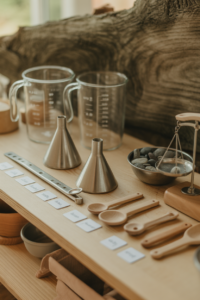
Every seasoned Montessori educator will tell you: the best learning happens when it is disguised as play so effectively that neither the child nor the observer can quite see the seam. A mud kitchen measurement station is the perfect embodiment of this principle. A simple collection of measuring cups, funnels, jugs, and a small set of balance scales placed on a dedicated shelf of the mud kitchen turns every pouring, mixing, and measuring session into an early mathematics lesson that children pursue with total volunteerism.
The materials do not need to be specialized or expensive. Standard kitchen measuring cups, a set of metal funnels in different sizes, a few clear plastic or glass jugs so children can see the levels of what they are pouring, and a small balance scale — available quite inexpensively — are all that is needed. The important thing is that these materials are organized, accessible, and displayed in a way that invites interaction. A shelf with each item in a designated spot, perhaps with a simple outline or label beneath, communicates that this is a thoughtful space and these tools have a purpose.
What unfolds when children engage with these materials is genuinely remarkable to observe. They begin to compare volumes, to notice that two small cups equal one large cup, to discover that mud is heavier than water, that sand pours faster than soil. These are not lessons being delivered — they are being discovered, which is a fundamentally different and far more powerful form of learning. The mud kitchen that incorporates measurement tools is quietly one of the most intellectually rich play environments you can create.
There is something quietly radical about building a space in your backyard that is explicitly designed to get dirty, to slow down, and to produce absolutely nothing of measurable value. In a world that endlessly optimizes children’s time, a mud kitchen is an act of gentle rebellion on their behalf. It says: here is time that belongs entirely to you. Here is texture and scent and water and earth. Here are tools and materials and a space that takes your play seriously. The rest is yours to make of it. And what children make of it — the elaborate stories, the scientific experiments, the recipes and potions and imaginary worlds — is invariably more beautiful and more surprising than anything we could have planned for them. That, more than any specific idea or design choice, is the ultimate sensory experience a mud kitchen can offer.